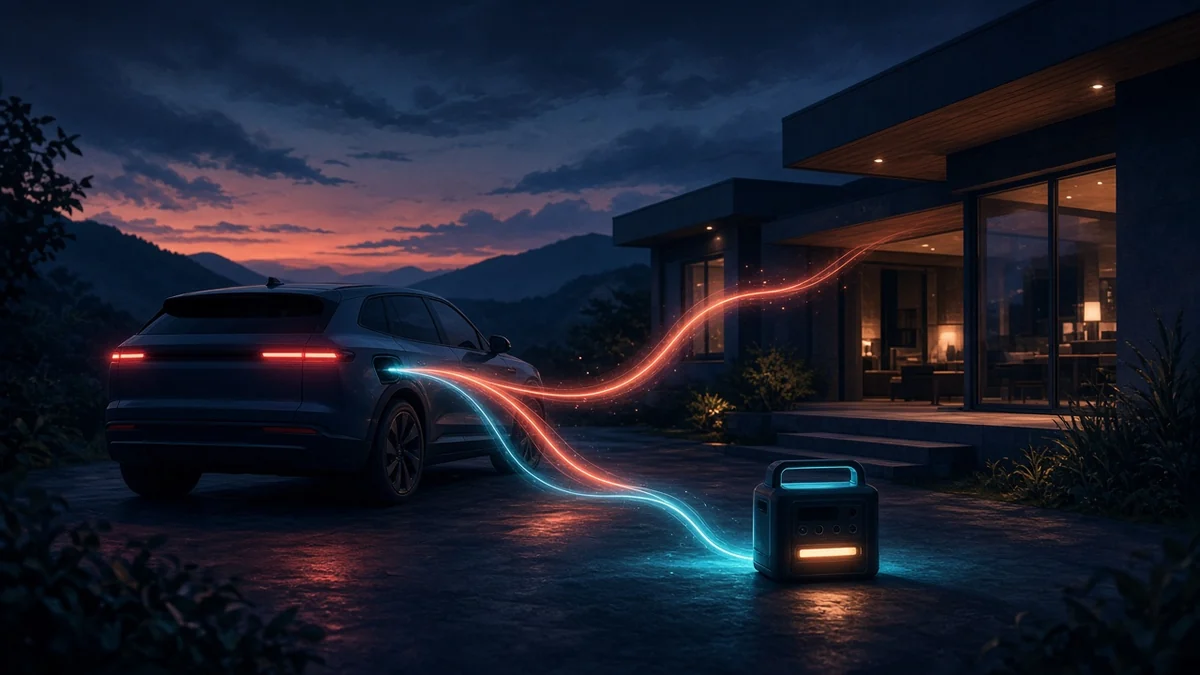
V2L (Vehicle-to-Load) allows an electric vehicle to supply electricity to individual appliances, while V2H (Vehicle-to-Home) allows a compatible EV to power a home’s electrical system through specialised bidirectional charging equipment. V2L typically delivers around 1.5–3.6kW, whereas V2H systems can supply approximately 9.6–11.5kW, making them useful for household backup during power outages.
V2H vs V2L: What is the difference?
Electric vehicles are increasingly becoming mobile energy storage systems rather than simply vehicles that consume electricity. Their batteries can potentially supply power to external equipment, homes and, in some cases, the electricity grid. This capability is known as bidirectional charging because electricity can flow in both directions.
However, not every EV with an external power outlet can run an entire house. V2L and V2H serve different purposes, require different equipment and operate at different power levels.
| Feature | V2L | V2H |
|---|---|---|
| Full form | Vehicle-to-Load | Vehicle-to-Home |
| Primary purpose | Power individual appliances | Supply electricity to a home |
| Typical output | 1.5–3.6kW | 9.6–11.5kW |
| Equipment | Vehicle outlet or compatible adapter | Bidirectional charger, inverter and transfer equipment |
| Installation | Usually minimal | Professional electrical installation |
| Typical application | Camping, appliances and tools | Home backup during outages |
What is V2L charging, and what can it power?
Vehicle-to-Load technology allows an EV to export electricity through an onboard power outlet or an external adapter. Instead of using a separate portable generator, owners can connect compatible appliances directly to their vehicles. The electricity comes from the vehicle’s high-voltage battery and is converted into usable AC power.
The Hyundai IONIQ 5 is a well-known example. Its V2L system supports up to 3.6kW of output, allowing owners to operate compatible electrical equipment through an interior socket or an external adapter. Depending on the market and vehicle configuration, the available outlet voltage and adapter requirements differ.
What appliances can V2L operate?
A 3.6kW V2L connection can support several everyday electrical appliances, provided their combined power consumption stays within the vehicle’s output limit. This makes the technology useful for outdoor activities, emergency situations and locations without conventional electricity access.
Examples include:
- Laptops, phones and other electronic devices.
- Televisions and small entertainment systems.
- Portable refrigerators and camping equipment.
- Electric cooking appliances within the available power limit.
- Power tools and compatible workshop equipment.
For example, a 1,000W appliance would use approximately 1kWh of energy for every hour of operation. Running several appliances simultaneously requires adding their individual power demands. Owners should also account for startup surges from equipment containing electric motors.
V2L is particularly useful because it does not generally require the installation of a dedicated home-energy system. However, the vehicle must support the feature, and the correct adapter or outlet must be used.
What is V2H charging, and how can an EV power an entire house?
Vehicle-to-Home technology takes bidirectional charging a step further. Rather than supplying electricity to individual appliances, a compatible EV can send stored energy into a home’s electrical distribution system. This allows household circuits to receive power from the vehicle when the electricity grid becomes unavailable.
The process requires specialised equipment because a vehicle cannot simply be connected to an ordinary household socket and allowed to energise the electrical panel. A V2H system generally includes a bidirectional charger, inverter, transfer equipment and a home energy management system.
How does V2H work during a power outage?
When the electricity supply fails, the system isolates the home from the utility grid to prevent electricity from flowing back into external power lines. This is an essential safety requirement for protecting utility workers and preventing uncontrolled electrical backfeed.
The vehicle then supplies electricity through the bidirectional charging system. Depending on the installation, the system can power selected essential circuits or a properly configured whole-home electrical panel.
Output capacity matters because a system supplying 9.6kW can support a different combination of appliances from one supplying 3.6kW. The home’s electrical configuration, simultaneous appliance demand and vehicle battery charge determine what can operate.
Which electric vehicles support V2H in 2026?
V2H compatibility is considerably more limited than V2L availability. Several manufacturers advertise bidirectional charging capabilities, but the actual ability to power a home depends on the vehicle’s hardware, software, compatible charger and regional approval.
In the US market, the Ford F-150 Lightning, Tesla Cybertruck, selected General Motors electric vehicles and Kia EV9 have established manufacturer-supported V2H pathways. The following examples illustrate the different systems available.
1. Chevrolet Silverado EV
The Chevrolet Silverado EV is one of the most interesting V2H applications because of its large battery capacity. Compatible configurations can work with the GM Energy PowerShift Charger and V2H Enablement Kit, allowing the vehicle to supply up to 9.6kW of backup power.
GM states that its 2026 Silverado EV Max Range can provide power to a properly equipped home for up to five days during an outage under its specified usage assumptions. Actual backup duration depends on battery charge, household consumption, weather and vehicle configuration.
2. Ford F-150 Lightning
The Ford F-150 Lightning uses a system called Intelligent Backup Power. When paired with the Ford Charge Station Pro and Home Integration System, the truck can provide up to 9.6kW of power to a compatible home installation.
Ford has advertised the ability to power a house for approximately three days using the truck’s extended-range battery under specified conditions. Its 131kWh extended-range battery provides a substantial energy reserve, although the actual duration depends on household demand and the amount of energy available when an outage begins.
3. Tesla Cybertruck
Tesla’s Cybertruck supports its Powershare energy system, which allows compatible configurations to supply electricity to a home. The system can provide up to 11.5kW of continuous power using the appropriate equipment.
Home backup requires the Powershare Gateway and compatible charging hardware or another supported home-energy configuration. This is different from simply connecting appliances to the truck’s onboard outlets. Buyers should verify equipment compatibility and installation requirements before assuming the vehicle can provide whole-home backup.
4. Kia EV9
The Kia EV9 is another important example in the bidirectional charging market. Kia has established a US V2H pathway involving the Wallbox Quasar 2 bidirectional charger and compatible home equipment.
However, availability depends on the vehicle model year, eligibility, activation and regional support. A Kia EV9 with V2L capability should not automatically be assumed to have an operational whole-home V2H system.
5. General Motors’ wider electric vehicle lineup
GM is expanding V2H compatibility beyond the Silverado EV. Its published list includes selected Chevrolet Blazer EV and Equinox EV models, GMC Sierra EV and Hummer EV variants, and Cadillac models such as the LYRIQ, OPTIQ and ESCALADE IQ.
GM also lists the 2027 Chevrolet Bolt EV as an upcoming compatible model. Eligibility depends on model year, hardware specifications and software updates, so buyers should verify the exact vehicle rather than relying on the model name alone.
Does the Hyundai IONIQ 5 support V2H?
The Hyundai IONIQ 5 supports V2L, including an output of up to 3.6kW in specified configurations. Its external adapter can power electrical devices, while an interior outlet provides another way to use the vehicle’s stored electricity.
However, V2L and V2H are different capabilities. The presence of bidirectional power functionality on the IONIQ 5 does not establish that every market version can supply an entire house through an approved V2H installation.
Hyundai Motor Group announced its AllDayEnergy V2X initiative in July 2026, bringing smart charging, V2G and V2H services under a common identity. The company outlined a phased rollout beginning with smart charging in the UK, followed by planned expansion into other markets. This does not mean that whole-home V2H functionality is already enabled on every IONIQ 5.
How much does V2H equipment cost?
The cost of installing V2H can be substantial because the system needs more than a conventional home EV charger. The installation may require a bidirectional charger, inverter, home energy hub, transfer equipment, electrical panel modifications and professional labour.
GM provides a useful example of the equipment costs involved. Its published US list prices include a $1,999 PowerShift Charger and a $6,999 V2H Enablement Kit, making the combined equipment price approximately $8,998 before installation and applicable taxes. Promotional prices can change, so buyers should check the current offer.
| Equipment | Published US list price |
|---|---|
| GM Energy PowerShift Charger | $1,999 |
| GM Energy V2H Enablement Kit | $6,999 |
| Combined equipment | $8,998 |
The Enablement Kit includes a Home Hub, inverter and Dark Start Battery. The Home Hub manages the home’s electrical connection, while the inverter converts vehicle battery power into electricity suitable for household use.
Installation costs are additional and depend on the home’s electrical panel, wiring, transfer equipment and local regulations. Some properties may require substantial electrical upgrades, making the final cost considerably higher than the equipment price alone.
How long can an EV power a house during a blackout?
Backup duration depends primarily on usable battery capacity and household electricity consumption. A vehicle with a 200kWh battery can theoretically supply more energy than one with a 100kWh battery, but the actual usable amount is affected by conversion losses, battery reserves and operating limits.
Consider a household using 30kWh of electricity per day for essential loads. A vehicle with 200kWh of usable energy would theoretically provide more than six days of electricity before accounting for conversion losses and operating reserves. In practice, the duration would be lower.
Ford’s F-150 Lightning and GM’s Silverado EV illustrate how manufacturers translate battery capacity into backup estimates. Ford advertises approximately three days for the extended-range Lightning, while GM advertises up to five days for the 2026 Silverado EV Max Range under its specified conditions.
These figures are not guarantees for every household. Running central air conditioning, electric heating, water heaters or other high-demand equipment can shorten backup duration considerably. Prioritising refrigerators, lighting, communications equipment and essential appliances can extend the available supply.
Is V2H worth buying in 2026?
V2H can be valuable for homeowners who experience frequent power interruptions, have a compatible EV and want to use their vehicle battery as an alternative to a stationary home battery. It can also provide flexibility when electricity supply becomes unreliable, provided the vehicle remains sufficiently charged.
However, the initial investment is significant. A household that experiences very few outages may struggle to justify a dedicated V2H installation purely for emergency backup. Those who already own a compatible vehicle and expect to use the system regularly may find the additional functionality more attractive.
There are also practical considerations. Your vehicle may need to remain connected during an outage, and using its battery for household electricity reduces the energy available for driving. Medical equipment should never be assumed to have uninterrupted backup support through a vehicle-energy system without checking the manufacturer’s safety guidance and arranging an appropriate independent backup.
Frequently asked questions
Can V2L power an entire house?
Not through a standard V2L outlet alone. V2L is designed to supply individual appliances within the vehicle’s output limit. Powering a household electrical panel requires an approved V2H system with suitable isolation, conversion and transfer equipment.
Which EV can power a house during a power outage?
In the US, supported options include the Ford F-150 Lightning, Tesla Cybertruck, selected GM electric vehicles and the Kia EV9 with its compatible V2H system. Availability and equipment requirements vary by model year and region.
Can a Hyundai IONIQ 5 run household appliances?
Yes. The IONIQ 5 supports V2L with up to 3.6kW of output in specified configurations. It can power compatible appliances through its interior outlet or an external adapter, but this should not be confused with whole-home V2H capability.
Is V2H cheaper than installing a home battery?
It can reduce the need to purchase a separate stationary battery if you already own a compatible EV. However, V2H requires specialised equipment and installation, and the vehicle must be available when backup power is needed. A dedicated home battery may be more convenient for households that need permanent backup.
Can an EV send electricity back to the electricity grid?
Yes, through Vehicle-to-Grid (V2G) technology, where compatible vehicles and charging systems can export electricity to the utility grid. This requires additional technical support, utility approval and appropriate energy-market arrangements. V2G is different from V2H, which supplies electricity to a home.
V2L makes an EV useful as a portable power source, while V2H turns a compatible vehicle into a potential household backup system. The technology is advancing through manufacturers such as Ford, GM, Tesla and Kia, although equipment costs and regional compatibility remain important limitations. Would you pay for a V2H installation to use your EV as a home battery, or would ordinary V2L outlets be sufficient for your electricity backup needs?