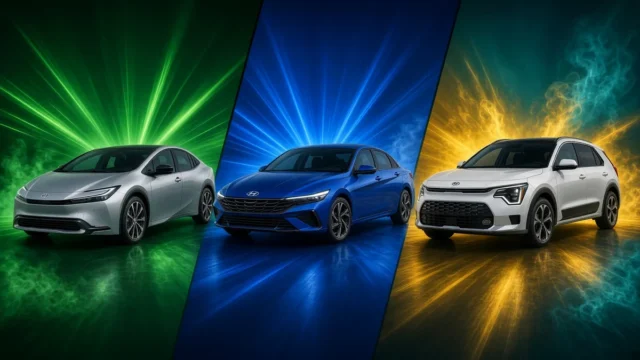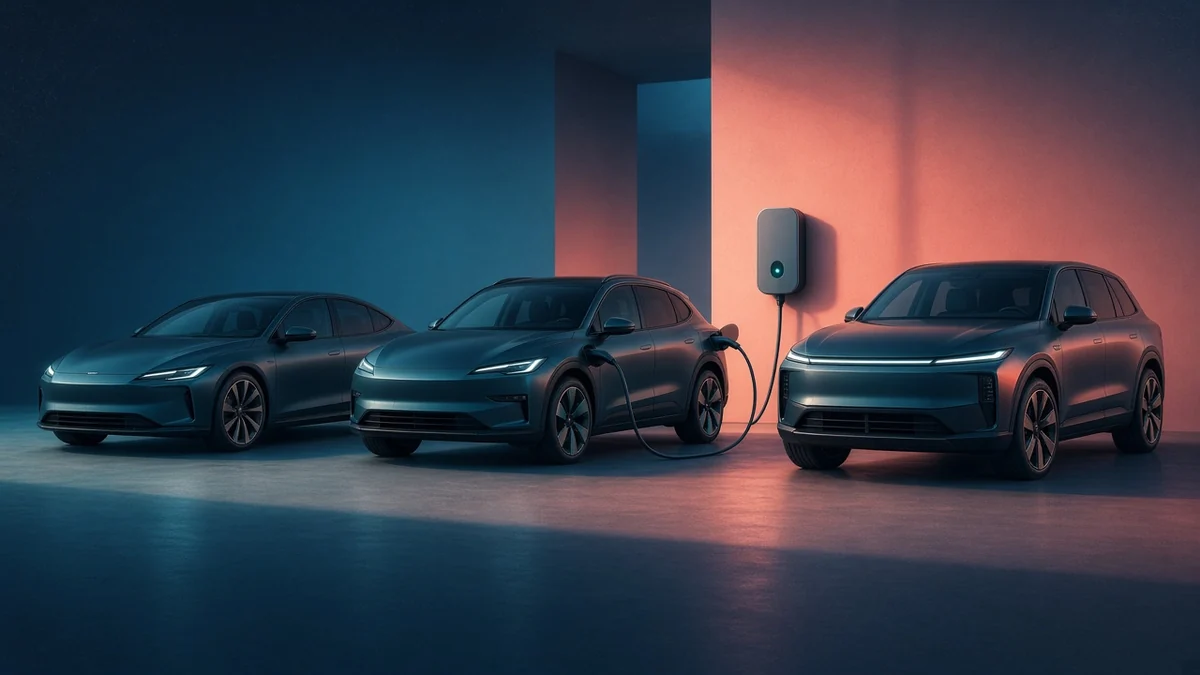
A conventional hybrid (HEV) is generally the easiest electrified vehicle to own because it uses petrol and charges its small battery automatically. A plug-in hybrid (PHEV) adds electric-only driving but needs regular charging to deliver its full efficiency benefits. A battery electric vehicle (EV) eliminates petrol and usually has the lowest routine maintenance requirements, provided charging is convenient and its purchase price fits your budget.
Hybrid vs plug-in hybrid vs EV: What is the difference?
All three technologies use electric motors, but they differ in how they store energy and power their wheels. A conventional hybrid combines a petrol engine with a relatively small battery, while a plug-in hybrid has a larger battery that can be charged externally. A fully electric vehicle relies entirely on electricity stored in its battery.
The distinction affects everything from fuel expenses and servicing to daily driving habits. A conventional hybrid requires no charging routine, a PHEV needs access to a power outlet to achieve its best efficiency, and an EV requires a suitable charging arrangement for regular use.
| Feature | Hybrid (HEV) | Plug-in hybrid (PHEV) | Electric vehicle (BEV) |
|---|---|---|---|
| Petrol engine | Yes | Yes | No |
| External charging | No | Yes | Yes |
| Electric-only driving | Limited | Typically 20–50 miles, depending on model | Entire driving range |
| Regenerative braking | Yes | Yes | Yes |
| Oil changes | Required | Required | Not required |
| Tailpipe emissions | Yes | When petrol engine operates | None |
| Routine maintenance | Engine and electrical systems | Engine and electrical systems | Primarily mechanical and electrical components |
1. How does a conventional hybrid work?
A conventional hybrid electric vehicle combines a petrol engine, an electric motor and a relatively small battery. Unlike a plug-in hybrid, it cannot be connected to an external charger. Instead, the battery receives energy through regenerative braking and, when required, the onboard engine.
When you slow down, regenerative braking captures some of the vehicle’s kinetic energy and converts it into electricity. The motor can then use that stored energy to assist acceleration or power the vehicle at low speeds under suitable conditions. The petrol engine takes over when additional power or sustained propulsion is needed.
This arrangement is particularly useful in urban traffic, where repeated braking and acceleration create opportunities to recover energy. Some full hybrids can travel short distances using electric power alone, but their electric-only capability is much more limited than that of a PHEV.
Do standard hybrids need to be plugged in?
No. This is one of their biggest ownership advantages. You refuel a conventional hybrid at a petrol station just like a regular petrol car, without needing a home charger or access to public charging infrastructure.
The US Energy Information Administration explains that conventional hybrids charge their batteries through the engine and regenerative braking. Their fuel efficiency varies by vehicle, but many are particularly effective in stop-and-go urban driving.
2. How does a plug-in hybrid differ from a normal hybrid?
A plug-in hybrid uses a larger battery and electric motor than a conventional hybrid. Its battery can be charged through a household outlet or compatible charging station, allowing the vehicle to travel a meaningful distance without starting its petrol engine. Once the available electric range is depleted, the petrol engine provides propulsion and extends the overall driving range.
Depending on the vehicle, electric-only range commonly falls around 40–80 kilometres, although some international models offer considerably more. The US Environmental Protection Agency describes many PHEVs as having electric-only ranges of approximately 20–70 miles, depending on battery capacity and vehicle design.
Does a PHEV need to be charged every day?
It does not need to be plugged in to operate, but regular charging is important if you want to benefit from its electric drivetrain. A driver who charges overnight and covers relatively short daily distances may complete much of the commute without using petrol.
However, someone who rarely charges a PHEV may end up carrying a large battery without using its main advantage. The additional battery weight can also affect fuel consumption when the vehicle operates primarily on petrol. Consumer Reports has highlighted this issue in its PHEV buying guidance, noting that an uncharged plug-in hybrid can be less efficient than its conventional hybrid equivalent.
3. Why are fully electric vehicles different?
A battery electric vehicle uses an electric motor powered by a rechargeable battery pack. It has no petrol engine, exhaust system or conventional engine oil requirements. Electricity from a home charger or public charging station replenishes its battery.
The 2026 Hyundai IONIQ 5 provides a useful example. Its US-specification rear-wheel-drive version has an EPA-estimated range of 318 miles with an 84kWh battery. Actual range depends on driving speed, temperature, terrain, tyres and climate-control use.
Fully electric vehicles also recover energy through regenerative braking. Instead of relying on an engine to produce power, they convert stored electrical energy directly into motion, making their powertrains mechanically simpler than those of petrol-powered hybrids.
Which vehicle has the lowest running costs?
There is no universal winner because running costs depend on electricity tariffs, petrol prices, annual mileage and driving conditions. However, an EV can have a substantial energy-cost advantage when charged at home using relatively inexpensive electricity. A conventional hybrid may be more economical when charging infrastructure is unavailable, while a PHEV can offer the lowest operating costs when most journeys fit within its electric range.
Consider the following simplified comparison for a driver travelling 1,000 kilometres:
| Vehicle | Illustrative energy consumption | Energy required |
|---|---|---|
| Hybrid | 4.5 litres/100km | 45 litres of petrol |
| PHEV in electric mode | 20kWh/100km | 200kWh of electricity |
| EV | 18kWh/100km | 180kWh of electricity |
These are illustrative consumption assumptions, not guaranteed figures for specific models. A PHEV will use a combination of petrol and electricity if its battery is depleted or the driving conditions activate the engine.
To calculate actual ownership costs, multiply consumption by your local petrol or electricity price. Also include charging losses, public charging premiums and any fixed charging subscription fees. Purchase price, insurance and depreciation can change the overall financial result substantially.
Which requires less maintenance: Hybrid, PHEV or EV?
Fully electric vehicles generally have the lowest routine powertrain maintenance requirements. They do not need engine oil changes, spark plugs, conventional exhaust servicing or engine air filters. Their electric motors also have fewer moving components than conventional combustion engines.
The US Department of Energy’s Alternative Fuels Data Center confirms that EVs generally require less maintenance because they have fewer moving parts and fluids to change. Regenerative braking can also reduce wear on conventional friction brakes.
Hybrids and PHEVs still contain petrol engines, which means they require conventional engine maintenance alongside inspections of their electrical systems. PHEVs have the additional complexity of a larger battery, charging hardware and two propulsion systems.
| Maintenance item | HEV | PHEV | EV |
|---|---|---|---|
| Engine oil and filter | Yes | Yes | No |
| Spark plugs | Yes, where applicable | Yes, where applicable | No |
| Brake inspection | Yes | Yes | Yes |
| Tyre replacement | Yes | Yes | Yes |
| Battery system inspection | Yes | Yes | Yes |
| Exhaust maintenance | Yes | Yes | No |
EV ownership does not mean maintenance-free ownership. Tyres, suspension components, cabin filters, brake fluid and cooling systems may still require attention according to the manufacturer’s service schedule. Battery and charging-system repairs can also be expensive if something goes wrong.
How long do hybrid and EV batteries last?
Battery longevity is an important consideration because replacing a high-voltage battery can be expensive. Conventional hybrids generally use relatively small batteries and manage their charge within a controlled operating range. This can reduce stress on the battery compared with repeatedly using its entire capacity.
Some hybrid batteries last for many years and can remain in service for the lifetime of the vehicle, but no universal 200,000–400,000-kilometre lifespan can be guaranteed. Battery chemistry, climate, usage patterns and maintenance all influence durability.
EV batteries have a different operating profile because they store substantially more energy and support longer electric-only journeys. Modern battery management systems help control temperature and charging behaviour, and many EV batteries retain substantial capacity after years of use.
Nevertheless, battery replacement remains one of the largest potential repair expenses for an EV. Before purchasing any electrified vehicle, check the battery warranty, its mileage and time limits, and the manufacturer’s coverage conditions.
What happens to EV range in cold weather?
Cold temperatures can reduce the driving range of electric vehicles because batteries operate less efficiently and cabin heating consumes additional energy. The effect depends on the vehicle’s thermal management system, battery temperature, journey length and outside conditions.
According to the US Department of Energy’s FuelEconomy.gov guidance, EV range can fall by approximately 41% in certain cold-weather testing conditions at 20°F compared with 77°F. This is a test-based estimate, not a universal reduction for every EV or climate.
Hybrids also experience lower fuel efficiency in cold weather because their engines take longer to reach operating temperature. The same government analysis reports significant winter fuel-economy reductions for conventional hybrids. PHEVs can experience reduced electric range as well, but their petrol engines provide an alternative source of propulsion.
For drivers who regularly travel through extremely cold regions, a hybrid or PHEV may offer greater flexibility. EV owners can reduce winter losses by preconditioning the cabin while connected to a charger and using heated seats where available.
Which should you buy in 2026?
The right choice depends on your driving habits and access to charging rather than simply choosing the newest technology.
- Choose a conventional hybrid if you drive regularly, spend considerable time in traffic and do not have convenient access to charging.
- Choose a plug-in hybrid if you can charge at home, complete most daily journeys within its electric range and still need petrol flexibility for longer trips.
- Choose a fully electric vehicle if you have dependable charging access, drive enough to benefit from lower energy costs and want to eliminate routine petrol-engine maintenance.
Frequently asked questions
Do hybrid cars charge themselves?
Yes. Conventional hybrids recharge their batteries through regenerative braking and the onboard engine. They do not require external charging. Plug-in hybrids, by contrast, can also recharge through a household outlet or charging station.
Is a PHEV cheaper to run than a normal hybrid?
It can be cheaper when regularly charged and used for journeys within its electric range. If you rarely charge it, the additional battery weight and higher purchase price may make it more expensive to own than a conventional hybrid.
Are EVs cheaper to maintain than hybrids?
Generally, yes, because EVs eliminate engine-related servicing such as oil changes and spark plug replacements. However, tyres, suspension, brakes and battery-related repairs still contribute to ownership costs.
Do electric cars need oil changes?
No. Fully electric vehicles do not have conventional combustion engines and therefore do not require engine oil changes. Some may still use lubricants in reduction gears and other components, which are serviced according to manufacturer recommendations.
Which is better for long-distance driving?
Conventional hybrids and PHEVs offer the convenience of petrol refuelling for long journeys. EVs can also handle long-distance travel, but the availability of compatible fast chargers and charging time should be considered when planning routes.
Conventional hybrids prioritise convenience, plug-in hybrids combine electric commuting with petrol flexibility, and fully electric vehicles generally offer the lowest routine powertrain maintenance. The financial winner depends on purchase price, energy costs, charging access and annual mileage. Would you choose a conventional hybrid, a PHEV or a fully electric vehicle for your next car, and how much does access to home charging influence that decision?