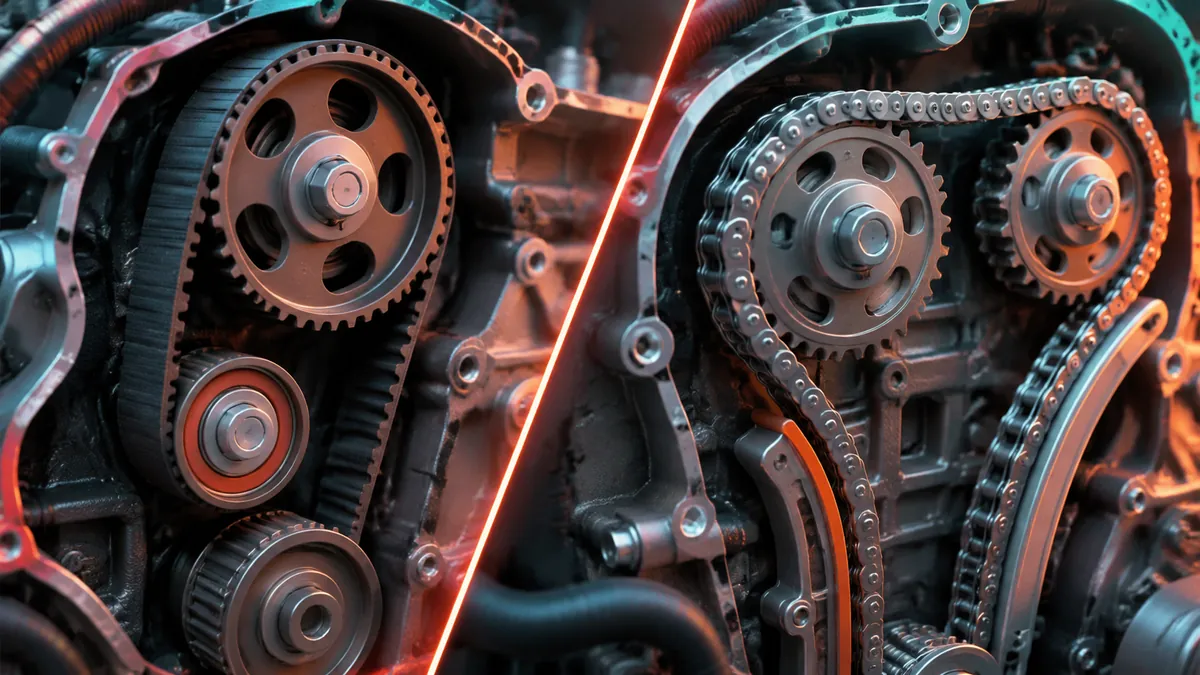
A timing belt and a timing chain perform the same essential job: synchronising the crankshaft and camshaft so an engine’s valves open and close at the correct time. The main differences are their construction, lubrication, maintenance requirements and replacement costs. Timing belts generally need scheduled replacement, while timing chains usually last longer but can also wear out.
What is the difference between a timing belt and a timing chain?
Both components connect the crankshaft to the camshaft, ensuring that the pistons and valves move in the correct sequence. Without this synchronisation, an engine cannot operate properly. Although their purpose is identical, the two systems use different materials and mechanical arrangements.
A timing belt is generally made from reinforced rubber with specially shaped teeth that engage with engine pulleys. A timing chain uses interlocking metal links that run over sprockets, much like a bicycle chain. Timing belts are generally lighter and quieter, while chains are designed for longer service life under suitable operating conditions.
| Feature | Timing belt | Timing chain |
|---|---|---|
| Material | Reinforced rubber | Metal links |
| Lubrication | Usually operates dry | Lubricated by engine oil |
| Location | Usually behind an external engine cover | Usually inside the engine |
| Noise | Generally quieter | Can produce more mechanical noise |
| Maintenance | Scheduled replacement required | Condition-based inspection and repair |
| Replacement cost | Generally lower | Can be considerably higher |
| Typical lifespan | Manufacturer-specified mileage or age limit | Often designed for extended engine life |
How long does a timing belt last?
Timing belts are wear components, which means they need to be replaced according to the vehicle manufacturer’s maintenance schedule. Their rubber construction makes them susceptible to ageing, heat, friction and deterioration. Even a car that covers relatively few kilometres can require a timing belt replacement because the component ages over time.
Many vehicles have replacement recommendations somewhere between 60,000 and 120,000 miles (approximately 96,000–193,000 kilometres), although some engines have different requirements. Certain manufacturers also specify a maximum number of years, regardless of mileage. There is no universal replacement interval that applies to every vehicle.
Continental recommends following the vehicle manufacturer’s specified replacement schedule rather than extending the interval. Its technical guidance also emphasises checking the associated tensioners and pulleys when replacing a timing belt. If the belt also drives the water pump, the pump may need replacement during the same service, depending on the engine design.
How long does a timing chain last?
Timing chains are generally designed to last longer than timing belts. Unlike conventional dry timing belts, they operate inside the engine and receive lubrication from engine oil. This helps reduce friction between the chain links and associated components.
However, a timing chain is not a lifetime component in every engine. The metal links, guides, sprockets and tensioners experience wear as the engine accumulates mileage. Poor lubrication, incorrect oil viscosity, low oil levels and extended oil-change intervals can accelerate deterioration.
Some engines have experienced premature timing chain problems, which means buyers should not automatically assume that a chain-equipped engine will never need expensive maintenance. Automotive component specialists have documented cases of premature chain wear in certain engine designs.
What happens when a timing belt or timing chain breaks?
A failure in either timing system can disrupt the relationship between the pistons and valves. The consequences depend on the engine’s design, particularly whether it is an interference or non-interference engine.
In an interference engine, the pistons and valves occupy overlapping space at different points in their operating cycles. The timing system prevents them from reaching that space simultaneously. If the belt breaks or the chain jumps out of position, the pistons can strike open valves, potentially bending them and damaging other internal components.
In a non-interference engine, the pistons and valves are designed to avoid physical contact even if engine timing is lost. A failure can still stop the vehicle and require repairs, but the likelihood of severe internal engine damage is lower.
This distinction is important when evaluating a used car. Two vehicles with similar engine capacities can have very different repair consequences following timing system failure.
What are the warning signs of a failing timing belt or chain?
Timing system problems do not always produce obvious warnings, particularly with timing belts. A belt can deteriorate internally without showing clear signs from outside its protective cover. This is why following the scheduled replacement interval is more reliable than waiting for symptoms.
Common timing belt warning signs
- Engine misfires: Incorrect valve timing can interfere with normal combustion.
- Difficulty starting: A severely worn or damaged belt can prevent the engine from maintaining correct timing.
- Unusual ticking noises: These can indicate problems with the belt or associated components, although other engine faults can produce similar sounds.
- Visible cracking or fraying: If an inspection reveals deterioration, the belt needs professional assessment.
- Loss of engine performance: Incorrect timing can affect power delivery and smooth operation.
Common timing chain warning signs
- Rattling during cold starts: A worn chain or malfunctioning tensioner can produce noise before adequate oil pressure develops.
- Persistent metallic noise: Excessive chain movement or worn guides can create rattling sounds.
- Engine warning light: Timing-related sensor readings may trigger diagnostic trouble codes.
- Rough idling: Incorrect camshaft timing can affect engine operation.
- Difficulty starting: Significant timing deviation can interfere with normal combustion.
These symptoms are not definitive proof of timing system failure. Faulty sensors, ignition components, variable valve timing systems and oil pressure problems can create similar issues. A proper diagnosis should include fault-code analysis and mechanical inspection before replacing expensive engine components.
Which is more expensive to replace?
Timing belt replacement is generally less expensive than timing chain replacement, although the actual cost depends on the engine and the amount of labour involved. A belt replacement may require removing protective covers, pulleys and other components to access the timing assembly. The job can become more expensive when the water pump, tensioners and idler pulleys also need attention.
Timing chain replacement is often more labour-intensive because the chain is located inside the engine. Accessing it can require removing engine covers, timing components and other surrounding parts. The repair may also involve replacing guides, tensioners and sprockets rather than installing a chain alone.
| Cost consideration | Timing belt | Timing chain |
|---|---|---|
| Parts | Usually less expensive | Can be more expensive |
| Labour | Varies by engine accessibility | Often higher |
| Associated parts | Tensioners, pulleys and sometimes water pump | Guides, tensioners and sprockets |
| Maintenance planning | Scheduled replacement | Condition-based repairs |
There is no reliable universal price comparison because labour rates, parts availability and engine layouts vary considerably across countries and vehicle manufacturers. The important consideration is the complete repair estimate rather than the price of the belt or chain alone.
How can you find out whether your car has a timing belt or chain?
The easiest way to identify your engine’s timing system is to consult the owner’s manual or the manufacturer’s maintenance schedule. Look for references to timing belt replacement, cam belt servicing or timing chain inspection. If the schedule specifies a belt replacement interval, your engine uses a timing belt.
You can also check using your vehicle identification number (VIN). Manufacturers and authorised service centres can use this information to identify the exact engine configuration and its maintenance requirements. This matters because the same car model can be sold with different engines, and those engines may use different timing systems.
Do not confuse the timing belt with the accessory or serpentine belt visible in many engine bays. The accessory belt drives components such as the alternator and air-conditioning compressor, while the timing system controls engine valve operation. They perform completely different functions.
Which is better when buying a used car?
A timing chain can be attractive because it generally avoids the scheduled replacement associated with conventional timing belts. However, a well-maintained belt-equipped engine can also be a reliable choice. The more important question is whether the particular engine has a good maintenance history and whether its timing system has known reliability issues.
Before purchasing a used vehicle, consider these checks:
- Confirm whether the engine uses a timing belt or timing chain.
- For belt-equipped engines, request documented evidence of the last replacement.
- Check the manufacturer’s recommended mileage and age limits.
- For chain-equipped engines, investigate any history of rattling, timing-related faults or premature chain repairs.
- Review engine oil change records and confirm that the correct oil specification was used.
- Arrange an independent mechanical inspection if the service history is incomplete.
A used car with a documented timing belt replacement can be a safer purchase than a chain-equipped vehicle with neglected oil changes and unexplained engine noises. Maintenance history matters more than the component’s name.
Frequently asked questions
Do timing chains need to be replaced?
Yes, they can. Although many timing chains are designed to last for a substantial portion of an engine’s service life, their links, guides and tensioners can wear out. Replacement becomes necessary when inspection and diagnostic testing confirm excessive wear or mechanical problems.
Can a timing belt break without warning?
Yes. Timing belts can deteriorate internally and fail without producing obvious symptoms beforehand. This is why manufacturers specify replacement intervals based on mileage and sometimes age, even when the engine appears to operate normally.
Does changing engine oil help a timing chain last longer?
Yes. Timing chains rely on engine oil for lubrication, and their tensioners may also depend on oil pressure. Following the manufacturer’s recommended oil-change intervals and using the specified oil grade can help reduce premature wear.
Can a timing belt be replaced with a timing chain?
No, not as a straightforward replacement. Timing belts and chains require different engine designs, pulleys or sprockets, lubrication arrangements and supporting components. Converting one system into another would require extensive engineering changes and is generally impractical.
Is a timing chain always better than a timing belt?
No. Timing chains generally offer longer service intervals, while timing belts are often quieter, lighter and less expensive to replace. Both systems have advantages, and reliability depends heavily on engine design, manufacturing quality and maintenance.
Timing belts require scheduled replacement, while timing chains generally offer longer service life but remain vulnerable to wear and lubrication problems. For car owners, checking the exact engine specification, following the manufacturer’s maintenance schedule and keeping proper service records are essential to avoiding expensive timing system failures. When choosing your next car, would you prioritise a timing chain’s longer service life or a timing belt’s generally lower replacement cost?