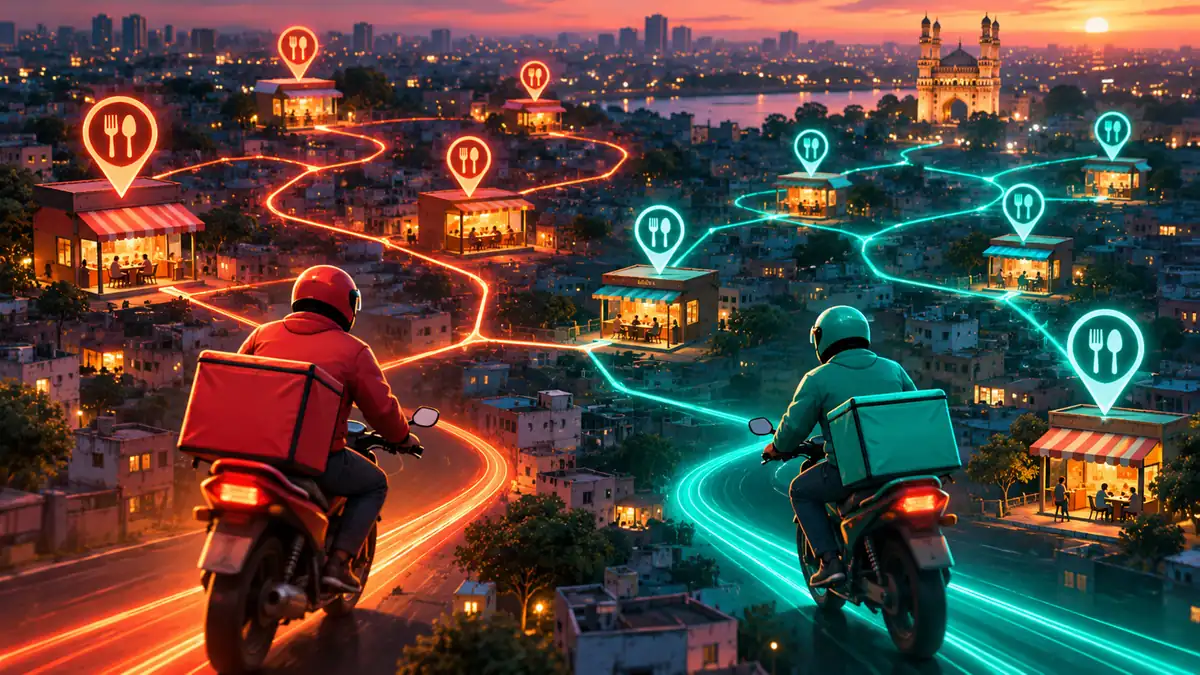
Zomato and Swiggy are competing on more than delivery speed in 2026. Zomato’s new Limitless Delivery feature can show eligible restaurants up to 40 km away, while Swiggy’s latest results report growth in food-delivery orders and users. For customers and restaurants, the competition now involves restaurant selection, delivery reach, affordability and the costs of using each platform.
The two platforms remain closely matched in the scale of their core food-delivery businesses, but their recent moves reflect different approaches to attracting orders. Zomato is experimenting with a wider geographic delivery area, while Swiggy’s FY26 numbers indicate growth supported by more transacting users and orders. Both companies are trying to give customers more reasons to use their apps regularly.
What is Zomato’s new Limitless Delivery feature?
Zomato launched “Limitless Delivery” on November 6, 2026, giving users access to eligible restaurants located as far as 40 km from their delivery address within their city. According to Mint’s report on the launch, the feature allows customers to order from restaurants that were previously too distant to access through the Zomato app. The 40 km figure represents the maximum possible reach, not a guarantee that every restaurant within that distance will be available.
Availability still depends on whether a restaurant can serve the user’s location through the feature. The name “Limitless” refers to the expanded discovery and delivery radius compared with the usual nearby-restaurant experience. Operational restrictions still apply, so customers should check which restaurants are available for their delivery address.
How does Limitless Delivery compare with Zomato Gold?
The main difference between the two features is delivery distance. Zomato Gold members currently receive free delivery on qualifying orders within a 7 km radius, whereas Limitless Delivery can show participating restaurants located up to 40 km away. Gold focuses on delivery-cost benefits, while Limitless Delivery gives customers access to restaurants beyond their usual delivery area.
| Feature | Zomato Gold delivery benefit | Limitless Delivery |
|---|---|---|
| Distance | Free delivery benefit within 7 km | Eligible restaurants up to 40 km away |
| Main purpose | Delivery-value benefit | Expand restaurant accessibility |
| Restaurant availability | Subject to applicable conditions | Only restaurants available through the feature |
Zomato has not established in the cited launch reporting that every long-distance order will have the same delivery economics as a nearby order. For customers, the immediate benefit is access to restaurants that may previously have been unavailable because of distance. A favourite restaurant on the other side of the city could become orderable, although availability and commercial terms may still differ between orders.
Why does a 40 km restaurant radius matter?
Food-delivery apps have traditionally relied heavily on proximity when displaying restaurants to customers. Expanding that range changes the proposition from “what can I get near me?” to something closer to “which restaurants across my city can serve me?”. For popular restaurants, the change could increase the number of customers who can find and order from them.
For users, location becomes less restrictive when searching for a particular restaurant or cuisine, provided Limitless Delivery is available. Restaurants may also reach customers who would otherwise need to travel across the city to purchase their food. This gives food aggregators another way to expand customer choice without depending entirely on adding more restaurant partners in each local area.
How strong is Swiggy’s food-delivery business in 2026?
Swiggy’s Q4 FY26 numbers show continued growth in its core food-delivery operation. According to Swiggy’s official Q4 FY26 results, food-delivery Gross Order Value reached ₹9,005 crore, representing 22.6% year-on-year growth. Order growth reached 19.0% during the quarter, while food-delivery Monthly Transacting Users increased 21% to 18.3 million.
These figures indicate that growth came from more than an increase in order values. Swiggy was serving more active customers and processing more orders during the quarter. Both measures matter because a food-delivery platform needs to attract customers and encourage them to place orders repeatedly. An increase in transacting users also creates opportunities to generate additional orders over time.
How do Zomato and Swiggy compare on Q4 FY26 scale?
Zomato’s Q4 FY26 food-delivery Net Order Value stood at ₹9,757 crore, up 18.8% year on year. Swiggy reported food-delivery GOV of ₹9,005 crore, representing growth of 22.6%. The figures use different measures because Zomato reports Net Order Value while Swiggy’s cited number is Gross Order Value. Both companies nevertheless reported substantial quarterly food-delivery activity and double-digit growth.
| Q4 FY26 metric | Zomato | Swiggy |
|---|---|---|
| Food-delivery order value | ₹9,757 crore NOV | ₹9,005 crore GOV |
| Year-on-year growth | 18.8% | 22.6% |
| Food-delivery MTUs | Not disclosed | 18.3 million |
| Order growth | Not disclosed | 19.0% |
The comparison requires some context because the companies report different order-value metrics. Swiggy recorded a higher reported growth rate on its GOV measure, while Zomato reported a larger absolute NOV. The difference between GOV and NOV means these numbers cannot be used as a direct comparison of identical financial measures. What they establish is that both businesses were operating at considerable scale in Q4 FY26.
What do Eternal’s FY26 numbers tell us about Zomato?
Zomato operates within the wider Eternal group, so its performance represents one part of the company’s business. Eternal reported Q4 FY26 consolidated revenue of ₹17,292 crore, while Zomato’s food-delivery operation remained part of its broader portfolio. For the full FY26 year, Zomato’s net profit reached ₹366 crore against total revenue of ₹54,364 crore.
Eternal’s Q4 FY26 shareholder update reports performance across several consumer businesses rather than focusing exclusively on food delivery. This provides context when comparing Zomato and Swiggy, since both companies operate beyond restaurant delivery alone. Their wider businesses can influence customer engagement and order frequency. They may also affect how the companies approach experiments with new services and delivery options.
How much do Zomato and Swiggy charge restaurants?
Restaurant commissions remain a source of concern within the food-aggregator business model. Industry estimates for 2026 place Zomato’s base delivery commissions at roughly 18% to 28%, while Swiggy’s base commissions range around 17% to 25%. The total amount deducted from restaurant earnings can be higher once other costs associated with selling through an aggregator are included.
Industry comparisons estimate effective aggregator deductions at roughly 25% to 35%, compared with approximately 12% for direct ordering channels. This difference helps explain why restaurants may want to maintain direct relationships with customers while continuing to use delivery platforms. Aggregators provide restaurant discovery and access to customers, along with delivery infrastructure. Direct ordering channels can offer different costs for restaurants that are able to attract customers independently.
Does Limitless Delivery change the business model for restaurants?
Limitless Delivery doesn’t replace the existing aggregator model, but it could increase the number of customers certain restaurants can reach. A restaurant that previously served customers within a smaller delivery area may become visible to people farther away when it qualifies for the feature. This could be useful for restaurants with established customer demand or customers willing to order from a particular outlet despite the distance.
However, a wider delivery radius doesn’t eliminate the commission and cost concerns restaurants already face when using aggregators. Restaurants may gain access to more potential customers while continuing to compare platform deductions with the expenses of operating their own ordering channels. The commercial benefit will therefore depend on whether additional orders make sense after the associated costs are considered.
Zomato vs Swiggy: What is the main competition in 2026?
At QuirkyByte, we see the competition extending beyond delivery speed. Zomato’s Limitless Delivery feature concentrates on restaurant availability and geographic reach, while Swiggy’s Q4 results show growth in users, orders and food-delivery GOV. Both companies are working to increase the number of orders customers place through their platforms.
Zomato’s approach gives eligible customers access to restaurants over a wider area, while Swiggy’s reported numbers demonstrate increased activity across its food-delivery business. Restaurants must still weigh the additional customer reach against commissions and other platform costs. Aggregators can connect them with large numbers of potential customers, but direct ordering channels remain an alternative for businesses capable of generating their own demand.
Frequently asked questions
What is Zomato Limitless Delivery?
Limitless Delivery is a Zomato feature launched on November 6, 2026, that allows customers to order from eligible Zomato-listed restaurants located up to 40 km away within their city. Availability depends on whether a restaurant is included for the user’s location. The feature is designed to expand the selection of restaurants customers can access.
Does Zomato Gold give free delivery up to 40 km?
No. Zomato Gold’s free-delivery benefit currently applies to qualifying orders within a 7 km radius, while Limitless Delivery expands restaurant accessibility up to 40 km. These are separate features with different purposes and conditions.
What was Swiggy’s Q4 FY26 food-delivery GOV?
Swiggy reported food-delivery Gross Order Value of ₹9,005 crore in Q4 FY26. That represented 22.6% year-on-year growth, while its food-delivery Monthly Transacting Users reached 18.3 million. Order growth for the quarter was 19.0%.
Which grew faster in Q4 FY26, Zomato or Swiggy food delivery?
Swiggy reported 22.6% year-on-year growth in food-delivery GOV, while Zomato’s food-delivery NOV increased 18.8%. The underlying GOV and NOV measures differ, so the percentages do not represent a comparison of identical metrics. Both businesses reported double-digit growth during the quarter.
Are direct restaurant orders cheaper for restaurants than aggregators?
Industry estimates cited for 2026 put direct ordering channels at approximately 12% in restaurant costs, while aggregator effective deductions can reach roughly 25% to 35%. Actual costs vary depending on the restaurant and its commercial arrangements. Aggregators can still provide restaurants with customer discovery and delivery infrastructure that direct channels may need to arrange separately.