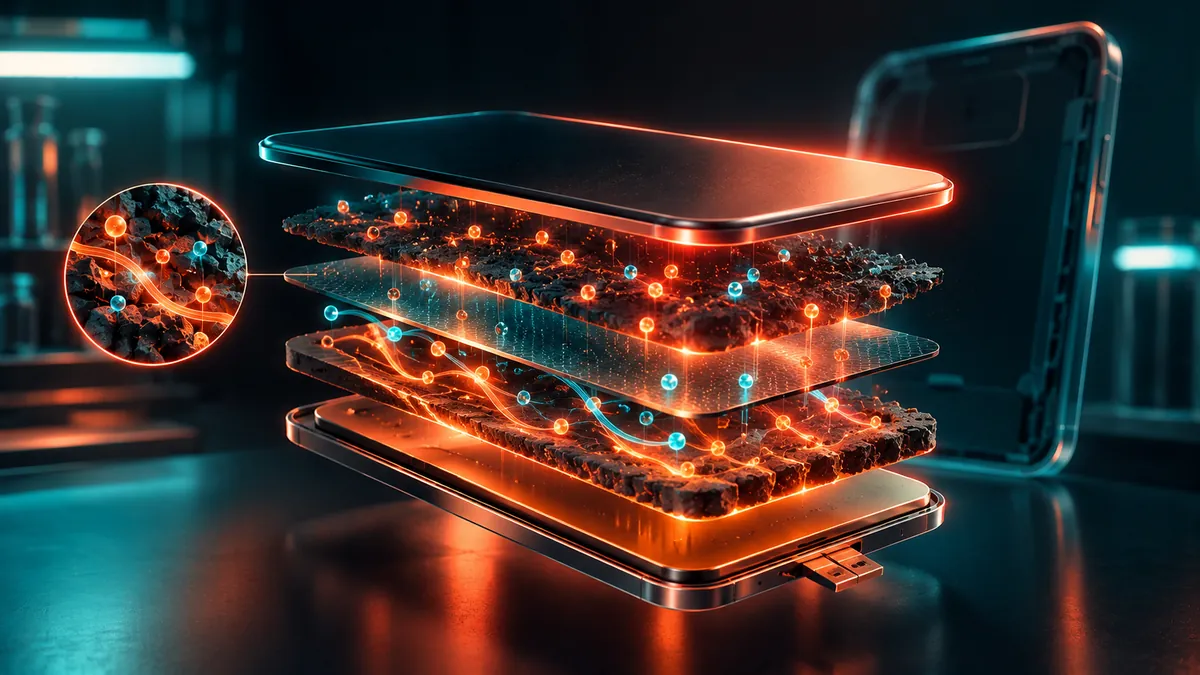
A silicon-carbon phone battery is still a lithium-ion battery, but its anode uses a silicon-carbon material alongside graphite instead of relying almost entirely on graphite. Silicon can store substantially more lithium per unit of mass, allowing manufacturers to increase battery capacity without making phones proportionally larger. The trade-off is that silicon expands much more during charging, which makes long-term stability and cycle life harder to manage.
Key takeaways
- Silicon-carbon smartphone batteries are still lithium-ion batteries; the main change is the use of silicon-containing material in the anode.
- Silicon can store much more lithium than graphite, helping manufacturers fit more capacity into a similar physical volume.
- The technology is already used commercially by brands including Honor, Oppo, Xiaomi and Samsung.
- Samsung introduced a silicon-carbon anode in its Galaxy Z Fold8 generation, confirming that the chemistry has moved into major mainstream foldables.
- Silicon expands significantly during charging and discharging, which creates engineering challenges around swelling, degradation and cycle life.
- A bigger mAh number can improve runtime, but battery chemistry alone does not determine how long a phone lasts on one charge or how well the battery ages.
- Silicon-carbon is not the same as solid-state battery technology.
How does a normal phone battery work?
Most smartphones use lithium-ion batteries. A lithium-ion cell generally contains three major functional parts: an anode, a cathode and an electrolyte that allows lithium ions to move between them. The anode and cathode are the two electrodes, and the electrolyte is the medium that lets ions pass between them.
During charging and discharging, lithium ions travel between the cathode and anode while electrons move through the external circuit. In conventional smartphone lithium-ion batteries, the anode has traditionally relied heavily on graphite. Graphite works well because it is stable, commercially mature and capable of repeatedly accepting and releasing lithium ions. The problem is that battery makers have already spent decades improving graphite-based designs, and there are limits to how much more energy can be stored without changing the materials themselves.
That is where silicon becomes attractive. A 2023 review in Nature Energy describes silicon as a promising alternative to conventional graphite because of its much higher theoretical capacity. Commercial batteries generally do not replace graphite entirely with silicon; instead, they use silicon-containing materials such as silicon-carbon composites alongside graphite. For smartphones, that can translate into a battery with more capacity without requiring an equally large increase in physical size.
What changes in a silicon-carbon cell?
The biggest change is in the anode. A so-called silicon-carbon battery typically mixes silicon-containing material with graphite rather than replacing the entire graphite anode with pure silicon. That distinction matters.
As Engadget’s August 2026 explainer notes, the name “silicon-carbon battery” can make the technology sound more radically different than it is. The batteries still use lithium-based chemistry, and current smartphone implementations usually incorporate a percentage of silicon-carbon material into an otherwise familiar lithium-ion design. The benefit comes from silicon’s ability to store far more lithium than graphite. A recent scientific review in Nature cites a theoretical capacity of roughly 3,579mAh per gram for silicon, compared with about 372mAh per gram for graphite.
That does not mean a smartphone with silicon-carbon chemistry suddenly stores ten times as much energy. Commercial battery design is far more complicated, and manufacturers use only a limited proportion of silicon because of durability and swelling challenges. What it does mean is that adding silicon gives battery designers another way to raise energy density. For phones, that can produce one of two benefits: more capacity in a similar amount of space, or a smaller battery for a similar capacity. Manufacturers can choose how to use that advantage depending on whether the priority is endurance, thinness or a balance between the two.
Why can silicon-carbon batteries hold more energy?
Silicon can absorb significantly more lithium than graphite during charging. That higher lithium-storage capacity is the fundamental reason battery makers are interested in it. Engadget’s silicon-carbon battery explainer quotes battery experts describing silicon as the major challenger to graphite after years of optimisation elsewhere in lithium-ion battery design.
The practical result is higher energy density. Energy density matters enormously in a smartphone because internal space is limited. A battery has to compete for room with cameras, cooling systems, speakers, haptic motors, wireless-charging hardware, antennas, processors and foldable hinges in folding phones.
Increasing battery life by simply making the battery physically larger can therefore make the phone thicker or force compromises elsewhere. Silicon-containing anodes allow manufacturers to increase capacity without relying only on a larger battery pack. That is why recent phones can carry capacities that would have been unusually large only a few years ago without becoming dramatically thicker.
Which brands already use silicon-carbon batteries?
Silicon-carbon batteries are already commercially established in smartphones. Engadget reported in August 2026 that Honor, Oppo and Xiaomi were among the major Chinese manufacturers that had adopted the technology, with Samsung subsequently joining them. Examples include phones across flagship, foldable and high-capacity categories.
| Brand | Verified silicon-carbon adoption |
|---|---|
| Honor | Commercial adoption reported across its recent smartphone portfolio |
| Oppo | Commercial adoption reported by Engadget |
| Xiaomi | Commercial adoption reported by Engadget |
| Samsung | Silicon-carbon anode confirmed in the Galaxy Z Fold8 generation |
The important point is not that every phone from these brands uses identical battery chemistry. “Silicon-carbon” covers a range of implementations, and manufacturers can use different silicon concentrations, electrode structures and supporting materials. Two phones advertised as using silicon-carbon batteries can therefore behave very differently in capacity, charging speed, longevity and thermal performance.
Does Samsung really use silicon-carbon batteries now?
Yes. Samsung officially confirmed that it introduced a silicon-carbon anode in its latest Galaxy Z foldable battery system. In a Samsung Newsroom engineering interview, Samsung said the material was introduced to improve energy density. The company also explained why battery chemistry cannot be considered in isolation.
Silicon-carbon materials can be more reactive, so Samsung says it had to optimise the wider battery system to maintain stability under high-voltage conditions. Samsung’s more recent Galaxy Z Fold8 overview similarly says the Fold8 uses Samsung’s first silicon-carbon anode, combined with changes intended to manage heat and stress. That is significant because Samsung had previously taken a relatively conservative approach to smartphone battery capacity. Its adoption shows that silicon-containing anodes are no longer limited to a few specialist or China-focused devices.
Why are manufacturers interested in silicon-carbon batteries?
The central attraction is energy density. A manufacturer can use the additional energy density in different ways. One company may choose to keep the phone roughly the same thickness while installing a higher-capacity battery. Another may preserve battery capacity while making the handset thinner.
Foldable phones are an especially obvious use case because they have unusually tight internal packaging constraints. Samsung’s engineering explanation illustrates this approach. Rather than simply using silicon-carbon chemistry to chase the biggest possible mAh figure, the company says it combined higher-density battery material with structural changes to preserve a slimmer foldable design.
Other manufacturers have taken a more capacity-focused approach. For example, Engadget’s hands-on coverage of the Xiaomi 17 Ultra identified its 6,000mAh silicon-carbon battery as one of the phone’s major hardware features. The key point is that silicon-carbon chemistry gives engineers more design flexibility.
Does silicon-carbon automatically mean better battery life?
No. A higher-capacity battery gives a phone more stored energy, but battery capacity is only one part of real-world endurance. Runtime also depends on factors such as processor efficiency, display size and brightness, refresh rate, cellular signal conditions, camera use, gaming, background apps, software optimisation and thermal management. Capacity tells you how much energy is stored, not how efficiently the phone spends it.
A 7,000mAh phone will not necessarily last exactly 40 percent longer than a 5,000mAh phone. The two devices may have very different displays, chipsets and software behaviour. Silicon-carbon therefore gives manufacturers more room to increase battery capacity, but it does not guarantee a particular number of hours or days of use. Independent battery testing remains more useful than chemistry alone when comparing actual endurance.
What is the biggest downside of silicon-carbon batteries?
The central technical problem is silicon expansion. Silicon changes volume considerably as lithium enters and leaves it during charging and discharging. A Nature Communications study explains that high-silicon anodes can undergo enormous volume changes during lithiation, creating cracking, electrode swelling and degradation problems. A separate Nature Energy review identifies severe volume expansion as one of the key obstacles to wider commercial use of high-silicon anodes.
That explains why manufacturers generally do not simply replace an entire graphite anode with pure silicon. Instead, silicon is combined with carbon and other materials, while battery makers use structural and chemical engineering to control swelling and maintain stability. The challenge is to find a useful balance: more silicon can increase capacity, but managing its expansion and degradation becomes harder.
Do silicon-carbon batteries wear out faster?
They can, but this should not be treated as a universal rule for every phone. Engadget’s 2026 analysis highlights shorter cycle life as a potential trade-off when more silicon is added. The scientific explanation supports that concern.
Silicon’s repeated expansion and contraction can create mechanical stress. Cracks expose new surfaces to the electrolyte, which can drive additional reactions and contribute to capacity loss. A 2024 Nature Communications study describes how large silicon volume changes can crack particles and interfaces, leading to swelling and faster capacity decay if the problem is not properly controlled.
However, modern commercial batteries are engineered specifically to reduce these effects. The actual longevity of a phone battery therefore depends on far more than whether the marketing material says “silicon-carbon.” Relevant factors include how much silicon is used, the structure of the anode, electrolyte chemistry, charging voltage, temperature, battery-management software, charging habits and cell manufacturing quality. For that reason, there is no single scientifically defensible cycle-life number that applies to every silicon-carbon smartphone battery.
What do Samsung’s battery figures tell us about longevity?
Samsung provides an interesting real-world example because the company now uses silicon-carbon chemistry while continuing to classify its batteries as lithium-ion cells. Engadget reported that regulatory information for Samsung’s newer foldables indicated a lower rated cycle figure for the silicon-containing generation than the preceding generation. That is useful evidence that manufacturers themselves may face trade-offs between energy density and cycle life. It should not, however, be converted into a blanket claim that every silicon-carbon phone will degrade faster than every graphite-based phone.
Battery design differs significantly between manufacturers. A lower-silicon implementation designed around longevity may behave differently from a high-capacity cell that pushes the chemistry harder. The useful buyer takeaway is simply that higher capacity and long-term battery health should be evaluated separately.
Does bigger mAh mean better battery health over several years?
No. The mAh rating primarily describes how much charge the battery can store. It does not tell you how much capacity will remain after hundreds of charging cycles. A phone can therefore have excellent day-one endurance, a very large advertised battery and faster degradation than another phone. Or it can combine high capacity with strong longevity if its battery system is engineered conservatively. When comparing phones, separate these two questions:
- How long does it last per charge when new?
- How much of that capacity does it retain after prolonged use?
Those are different measurements. This distinction becomes especially important as phone makers compete using 6,000mAh, 7,000mAh and larger capacity numbers. A larger battery may still be valuable even if percentage degradation is similar, because it starts with more absolute capacity. But the mAh figure alone cannot tell you how the battery will behave after two or three years.
Can silicon-carbon batteries charge faster?
Potentially, but silicon-carbon chemistry does not automatically guarantee a particular charging speed. Engadget’s battery explainer notes that silicon can offer advantages for fast charging because lithium can move into silicon differently from the way it intercalates into graphite. However, the charging speed advertised for a phone depends on the entire battery and charging system, not only the anode material. That includes cell construction, charging voltage, thermal management, charger design, battery-management software and whether the phone uses single-cell or multi-cell architecture. Samsung, for example, says its Galaxy Z Fold8 generation uses a redesigned charging architecture alongside the new silicon-carbon battery system. So a silicon-carbon phone may support fast charging, but buyers should verify the actual charging specification of each model rather than assuming the chemistry itself guarantees it.
What should buyers watch in reviews?
The most useful approach is to look beyond the headline mAh number. For a silicon-carbon phone, check at least four things. First, look for independent battery tests rather than relying only on manufacturer “two-day battery” claims. Battery capacity matters, but efficiency can change the result dramatically.
Second, compare phone thickness and weight. A large battery is more impressive if the manufacturer has increased capacity without making the phone substantially thicker or heavier. That is one of silicon-carbon technology’s main potential advantages.
Third, consider long-term battery health. This is harder to assess at launch. Battery-health measurements after months or years of use are more valuable than first-week reviews when judging degradation.
Fourth, look at manufacturer durability claims. Some manufacturers publish battery-retention or charging-cycle targets. When available, these are more useful than assumptions based solely on whether the battery contains silicon. The broader lesson is that battery chemistry should be treated as one specification among many, not as a guarantee of superior endurance or longevity.
Is silicon-carbon the same as solid-state battery technology?
No. They are fundamentally different concepts. Current silicon-carbon smartphone batteries are still generally lithium-ion cells using conventional electrolytes, with silicon-containing material added to the anode. Samsung itself continues to describe its silicon-carbon-equipped foldable batteries as lithium-ion.
A solid-state battery, by contrast, is defined primarily by replacing the conventional liquid or gel-like electrolyte with a solid electrolyte. That means a battery can use a silicon-containing anode without being solid-state. Likewise, future solid-state batteries could potentially use different anode chemistries. The terms should therefore never be used interchangeably.
Are silicon-carbon batteries the future of smartphones?
They are increasingly important, but universal adoption is not guaranteed. The technology solves a genuine smartphone-design problem: users want more battery capacity while manufacturers also want thinner, lighter devices with larger cameras and more powerful hardware. Silicon-containing anodes provide a practical route to higher energy density without requiring an entirely new battery architecture. The fact that Honor, Oppo, Xiaomi and now Samsung have adopted the technology shows that it has moved well beyond laboratory research.
At the same time, the chemistry still presents engineering challenges around swelling, stability, cost and degradation. That means the most likely near-term evolution is not a sudden switch to pure-silicon batteries, but continued improvement in silicon-carbon and silicon-graphite composite anodes. Manufacturers can gradually increase or optimise the silicon content as materials science and battery-management systems improve.
FAQ
What is a silicon-carbon battery?
A silicon-carbon smartphone battery is a lithium-ion battery whose anode contains silicon-carbon material alongside graphite. Adding silicon can increase energy density and allow more capacity to fit into a similar physical space.
Are silicon-carbon batteries really lithium-ion batteries?
Yes. Current silicon-carbon smartphone batteries are still lithium-ion batteries. The term refers mainly to the silicon-containing anode rather than an entirely different battery chemistry.
Why is silicon better than graphite for capacity?
Silicon has a much higher theoretical lithium-storage capacity than graphite. Scientific literature puts silicon at roughly 3,579mAh/g, compared with around 372mAh/g for graphite.
Why don’t manufacturers make the whole anode from silicon?
Silicon expands dramatically when it takes in lithium. That expansion can cause cracking, swelling and degradation, so commercial cells generally combine silicon-containing material with graphite and other engineered components.
Do silicon-carbon batteries last fewer years?
They can face greater degradation challenges because silicon expands and contracts during cycling, but there is no universal rule saying every silicon-carbon battery lasts fewer years. Longevity depends on silicon content, electrode design, electrolyte, charging strategy, temperature and battery-management software.
Which smartphone brands use silicon-carbon batteries?
Commercial adoption has been reported from Honor, Oppo, Xiaomi and Samsung, among others. Samsung officially confirmed a silicon-carbon anode in its Galaxy Z Fold8 generation.
Does Samsung Galaxy Z Fold8 use silicon-carbon?
Yes. Samsung says the Galaxy Z Fold8 generation uses its first silicon-carbon anode to improve energy density. It is the company’s own confirmation of the technology in a flagship foldable.
Do silicon-carbon batteries give better battery life?
They can enable larger battery capacities in a similar amount of space, which can improve endurance. Actual battery life still depends heavily on the processor, display, software, network use and other hardware.
Can silicon-carbon batteries charge faster?
The chemistry can provide advantages for charging, but a phone’s actual charging speed depends on the complete battery and charging architecture. Silicon-carbon does not by itself guarantee fast charging, so check each model’s charging specification.
Is silicon-carbon the same as solid-state?
No. Silicon-carbon describes the anode material, while solid-state refers primarily to using a solid electrolyte instead of the conventional liquid electrolyte. Current silicon-carbon phone batteries are still lithium-ion batteries.
Will every future phone use silicon-carbon batteries?
There is no evidence that every smartphone will adopt the technology. Silicon-containing anodes are becoming more common, particularly in flagship and high-capacity phones, but manufacturers will continue balancing cost, capacity, durability, thickness and other design priorities.