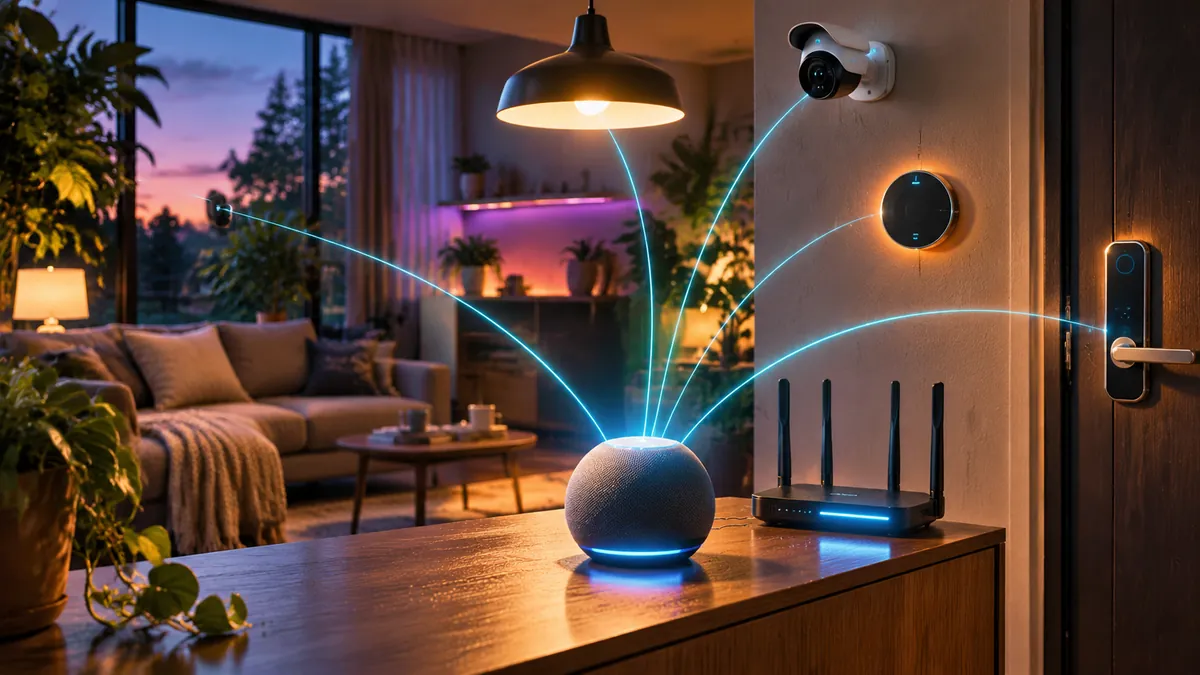
Matter is a shared smart-home connectivity standard that lets certified devices from different brands work with major platforms such as Apple Home, Google Home, Amazon Alexa and Samsung SmartThings. It runs over a home’s IP network using Wi-Fi, Ethernet or Thread, allowing compatible lights, locks, sensors and newer devices to be controlled through one or more ecosystems.
What is Matter in a smart home?
Matter is an open standard developed by the Connectivity Standards Alliance (CSA), with participation from major technology companies including Apple, Google, Amazon and Samsung. It gives smart-home products a common language, reducing the need for a separate proprietary integration for every platform a device supports.
Matter defines how devices identify themselves, describe their capabilities and exchange commands. It is not a wireless signal or a replacement for your Wi-Fi router. It operates at the application layer over IPv6, while the underlying connection uses Wi-Fi, Ethernet or Thread.
Bluetooth Low Energy is commonly used during setup, when a phone discovers an accessory and helps transfer network credentials. After commissioning, the device communicates over its supported Matter network transport rather than using Bluetooth for normal control.
How does Matter work: Wi-Fi, Ethernet and Thread?
Matter uses three main network transports, each suited to different products. The manufacturer chooses which connection a device supports.
-
Wi-Fi: Useful for devices that need more bandwidth, including appliances and some cameras. A Wi-Fi Matter product connects to your normal wireless router.
-
Ethernet: Used by hubs, bridges and network equipment that benefit from a wired connection. It places them on the same IP-based home network as Wi-Fi and Thread devices.
-
Thread: A low-power IPv6 mesh network designed for small connected devices such as sensors, locks and switches. Mains-powered products can pass messages around the mesh, while battery-powered devices conserve energy.
A Thread Border Router links the Thread mesh to the rest of the home IP network. It routes traffic between Thread and networks such as Wi-Fi or Ethernet; it does not translate Matter into a different protocol. Examples include Apple HomePod mini, HomePod (second generation), selected Apple TV 4K models, Google Nest Hub (second generation), Nest Hub Max, Nest Wifi Pro and Amazon Echo (fourth generation). Check the exact model before buying, because Matter support over Wi-Fi does not mean a device contains a Thread radio.
Do you need a hub or Thread border router?
You do not need a Thread Border Router for every Matter product. A device using Matter over Wi-Fi connects to your existing router, while an Ethernet device uses a wired connection. A Thread-based product does need access to a Thread network, so a compatible Thread Border Router must be available.
Your smart-home platform may also require a Matter controller or hub. Google Home requires a compatible Matter hub for setup and local control. Apple supports adding and controlling Matter accessories directly from compatible iPhones, although Thread devices still need Thread capability from the phone or a border router. Compatible Echo and eero products can serve as Alexa controllers, and selected models also include Thread border routers. Check the platform’s current device list before purchasing extra hardware.
Which smart-home platforms support Matter?
Matter is supported by Apple Home, Google Home, Amazon Alexa and Samsung SmartThings. Home Assistant also supports local Matter control, providing another option for managing compatible products without depending on a manufacturer’s cloud for basic device operation.
Multi-Admin allows a compatible device to be added to more than one smart-home ecosystem, so a light can appear in Apple Home and Google Home rather than being locked to its first app. Matter 1.4 introduced Enhanced Multi-Admin options, while Matter 1.6 added Joint Fabric, which lets multiple authorised controllers co-administer a shared Matter network.
Certification does not mean every platform supports every Matter device category or advanced feature at the same time. Support is added in stages, and a camera, appliance or energy device may offer different controls in each app. Check both the device maker’s compatibility notes and the platform’s supported-device list.
What Matter devices work in 2026?
Matter has expanded well beyond the lights, plugs, locks and thermostats covered at launch in October 2022. The CSA’s current catalogue spans more than 30 device types, although support in the specification does not mean every brand or platform already sells or supports each category.
Matter 1.2 added refrigerators, room air conditioners, dishwashers, washing machines and robot vacuums, alongside smoke and carbon monoxide alarms, air-quality sensors, air purifiers and fans. Matter 1.3 brought energy reporting, EV charging, water-leak and freeze detectors, rain sensors, controllable water valves, and kitchen and laundry appliances such as ovens, cooktops, microwaves and dryers.
Matter 1.4 expanded energy management with solar inverters, home batteries, heat pumps and water heaters. Matter 1.5, released in November 2025, added cameras and video doorbells with WebRTC-based live audio and video, soil sensors, and broader control for awnings, gates and garage doors. The March 2026 Matter 1.5.1 update refined camera streaming and media support.
The latest major release, Matter 1.6, arrived on June 17, 2026. It did not add new device categories; instead, it introduced full two-way NFC commissioning, allowing some products to be set up before they are powered or installed, and Joint Fabric for shared control across ecosystems. MatterCatalog’s reading of the CSA certification ledger on November 15, 2026 counted 13,162 certified product models from 498 companies.
Is Matter better than Zigbee, Z-Wave or Wi-Fi?
These technologies do different jobs, so the comparison is not one-to-one. Matter is an application-layer standard for cross-platform communication. Wi-Fi and Thread carry Matter traffic, while Zigbee and Z-Wave are separate smart-home protocols with their own device networks.
Zigbee and Z-Wave remain useful, established choices, especially if you already own compatible sensors, switches or other low-power products. Matter does not communicate natively with Zigbee or Z-Wave devices, but a compatible bridge can translate supported products into the Matter ecosystem. Existing devices can therefore continue working alongside newer Matter accessories.
For a new purchase, Matter is attractive when cross-platform compatibility and local control are priorities. Thread suits many battery-powered sensors and locks, while Wi-Fi is better for devices that need more bandwidth. The best choice depends on the product, the functions you need and your existing controller.
Frequently asked questions
Does Matter work without the internet?
Basic Matter control can work locally over your home network without an active internet connection. Remote access while you are away generally needs an internet-connected controller in the home, and some manufacturer-specific features may still depend on cloud services.
Can Matter devices from different brands work together?
Yes, if the products are Matter-certified and the relevant device types and functions are supported by your platform. The Matter badge is a useful starting point, but check the product’s supported features and ecosystem compatibility.
Can I keep my existing Zigbee or Z-Wave devices?
Usually, yes. You do not have to replace them simply because you are adding Matter products. A compatible bridge can expose supported Zigbee, Z-Wave or proprietary devices to a Matter platform, although the bridge determines which functions are available.
Matter now covers lighting, security, appliances, cameras and energy management, with local IP-based communication and multi-platform control at its core. Before buying, check the certification, the device’s Wi-Fi or Thread connection, and the features supported by your chosen platform. Which Matter device would make the biggest difference in your home: a camera, a smart lock or an energy-management system?