Choosing between an eSIM and a physical SIM in 2026 comes down to convenience, compatibility and how you use your phone. Both provide access to the same cellular networks, so neither inherently delivers better signal strength or faster internet. However, eSIM offers easier digital activation, better flexibility for international travel and an additional layer of protection if your smartphone is stolen.
What is the difference between an eSIM and a physical SIM?
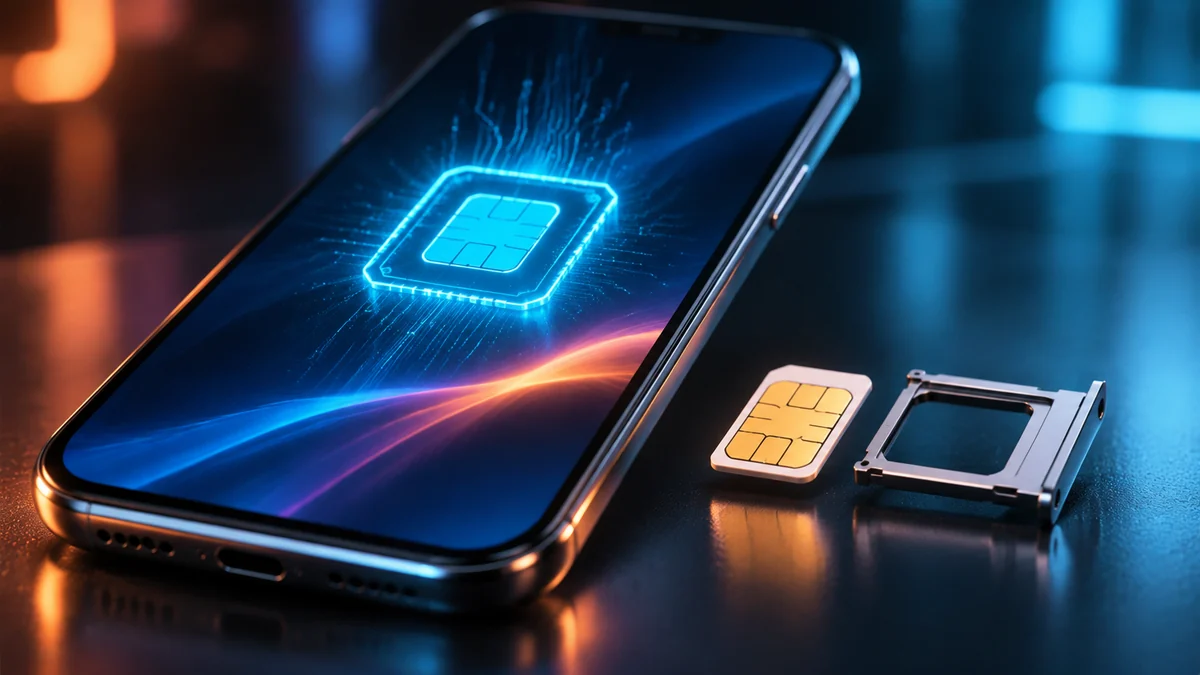
A physical SIM is a removable plastic card containing the subscriber information required to connect your smartphone to a mobile network. You insert it into a dedicated SIM tray, and your phone uses its credentials to authenticate with your carrier. If you change phones, you can generally move the card to another compatible, unlocked device without requesting a new SIM.
An eSIM, short for embedded SIM, performs the same function without requiring a removable card. It uses a small electronic component built into the smartphone, known as an embedded Universal Integrated Circuit Card (eUICC). Instead of inserting a card, you download a digital SIM profile supplied by your mobile network operator.
The biggest distinction is how you manage your mobile connection. A physical SIM requires handling a card, whereas an eSIM allows you to activate, transfer and manage supported cellular plans through your phone’s settings, a carrier application or a QR code.
| Feature | eSIM | Physical SIM |
|---|---|---|
| Format | Embedded digital SIM | Removable plastic card |
| Activation | Digital download or transfer | Insert card and activate |
| Phone switching | Requires supported transfer or reactivation | Usually move the card |
| Network performance | Depends on carrier and phone hardware | Depends on carrier and phone hardware |
| Dual SIM support | Supported on compatible devices | Supported on compatible devices |
| Physical removal | Not possible | Possible |
| International travel | Convenient digital activation | Requires obtaining and inserting a card |
Does an eSIM provide better signal strength than a physical SIM?
No. An eSIM does not inherently improve cellular reception, download speeds or call quality compared with a physical SIM. Both technologies perform the same fundamental job: providing the subscriber credentials that allow a smartphone to authenticate with a mobile network.
Actual network performance depends on the smartphone’s cellular modem, supported frequency bands, antenna design, carrier infrastructure, network congestion and signal availability in your location. These factors matter considerably more than whether your subscription is stored on a removable card or an embedded chip.
There is one important distinction. Two SIM plans from different carriers can deliver different speeds because of coverage, network prioritisation, roaming arrangements and data restrictions. If a travel eSIM connects through a different local network than your regular carrier, your experience may change. That difference comes from the network and plan, not the eSIM technology itself.
Can you use an eSIM and a physical SIM simultaneously?
Yes. Many modern smartphones support Dual SIM functionality, allowing users to maintain two mobile connections on one device. Depending on the model, this can mean one physical SIM alongside an eSIM or two simultaneously active eSIMs.
Apple supports Dual SIM functionality on iPhone XS and later models, provided the relevant carrier supports eSIM. iPhone 13 and subsequent generations also support two active eSIMs, alongside the option of using a physical SIM and an eSIM on compatible regional models.
This arrangement is particularly useful for people who want to separate personal and professional numbers without carrying two smartphones. Both lines can make and receive calls and messages, while the user selects which connection should handle mobile data. An iPhone uses one cellular data network at a time.
International travellers can also keep their regular number active for important calls and SMS verification while using a local or international travel eSIM for cheaper mobile data. However, users should check their home carrier’s roaming charges because keeping the primary line active can still generate additional costs.
Which smartphones only support eSIM without a physical SIM tray?
eSIM-only smartphones are becoming more common, although availability depends heavily on the country where a particular model is purchased. Apple introduced eSIM-only iPhones in the United States with the iPhone 14 generation, and the approach has since expanded to additional markets and manufacturers.
According to Apple’s current SIM compatibility documentation, examples of eSIM-only iPhone models include:
- iPhone 14, 14 Plus, 14 Pro and 14 Pro Max purchased in the United States.
- iPhone 15 series models purchased in the United States.
- iPhone 16 series models purchased in the United States.
- iPhone 17 series models purchased in the United States and several additional markets, depending on the model.
- iPhone Air and selected newer iPhone models in markets where Apple has removed the physical SIM tray.
Google has also moved towards eSIM-only hardware in certain markets. The US versions of the Pixel 10, Pixel 10 Pro and Pixel 10 Pro XL launched without physical SIM trays.
Buyers should pay attention to the exact regional variant rather than relying on the smartphone’s model name alone. An iPhone 17 purchased in one country may support both a nano-SIM and eSIM, while the same model purchased in another market may rely exclusively on eSIM.
Is an eSIM safer than a physical SIM if your phone is stolen?
An eSIM offers a meaningful security advantage because a thief cannot simply remove the SIM card and insert it into another smartphone. With a traditional SIM, removing the card can immediately disconnect the stolen device from its original mobile subscription, potentially making network-based tracking more difficult.
An eSIM remains embedded in the device, and its profile is managed through protected digital provisioning mechanisms. The GSMA’s eSIM specifications establish security requirements for profile management and authentication, helping protect the process against unauthorised access.
However, an eSIM is not a complete anti-theft solution. Someone who steals a smartphone may still switch it off, interfere with its connectivity or attempt other ways of preventing location tracking. The device’s screen lock, account security and built-in tracking features remain essential.
For iPhone users, Apple recommends enabling Find My before a device goes missing. Owners can use iCloud’s Find Devices service to mark a stolen phone as lost, protect personal information and attempt to locate it. Keeping the eSIM active makes physical SIM removal impossible, but it does not guarantee that the device will remain trackable.
Is an eSIM better for international travel?
For frequent international travellers, eSIM is one of the most practical advantages of modern smartphones. Instead of searching for a local SIM vendor after landing, travellers can purchase a compatible data plan before departure and install it digitally.
Depending on the provider, activation happens through a QR code, a mobile application or a direct installation link. Travellers can then select the travel eSIM for mobile data while retaining their home number for calls and messages.
There are two important conditions. First, the smartphone must support eSIM functionality and the selected carrier or travel provider must offer compatible service at the destination. Second, the phone must be unlocked if the traveller wants to use an eSIM from a different network provider.
Apple’s international travel guidance specifically requires an iPhone to have no carrier restrictions before using another provider’s travel eSIM. Users can check this under Settings, General and About, where an unlocked iPhone displays “No SIM Restrictions” beside Carrier Lock.
Physical SIM cards still have an advantage in destinations where local prepaid cards are cheaper, eSIM availability is limited or travellers need a connection for an extended stay. They can also be more convenient when moving a number between compatible phones without completing a digital transfer.
What are the disadvantages of switching to eSIM?
Despite its convenience, eSIM has limitations that buyers should consider before purchasing an eSIM-only smartphone.
- Device compatibility: Older smartphones and some regional variants do not support eSIM.
- Carrier restrictions: Not every mobile operator offers eSIM activation, and some plans have additional requirements.
- Phone replacement: Moving an eSIM to a replacement device may require a supported transfer process or assistance from the carrier.
- Limited local availability: Some countries and smaller mobile operators still rely heavily on physical SIM cards.
- Activation requirements: Digital activation may require an internet connection, a compatible application or a carrier-issued QR code.
Physical SIMs avoid several of these inconveniences. Someone with multiple compatible phones can move a card between devices relatively quickly, provided the devices are unlocked and support the same SIM format and network bands.
Frequently asked questions
Can an eSIM stop working if I reset my smartphone?
It depends on the device and the reset options selected. Some smartphones offer the choice to retain or erase eSIM profiles during a factory reset. If a profile is deleted, you may need to contact your carrier or use its supported reactivation process to restore service.
Can I have multiple eSIMs on one smartphone?
Yes, supported smartphones can store multiple eSIM profiles. Apple states that compatible iPhones can store eight or more profiles, although the number of simultaneously active lines depends on the specific device and its configuration.
Can I convert my physical SIM into an eSIM?
Yes, if your mobile carrier and smartphone support the conversion process. Compatible iPhones offer a Convert to eSIM option under cellular settings with participating carriers. The physical SIM stops working once the conversion is completed successfully.
Does an eSIM work without Wi-Fi?
Initial activation methods vary by smartphone and carrier. Many digital activations require an internet connection, usually through Wi-Fi, but some devices and carrier-supported activation processes can complete setup without a separate Wi-Fi connection.
eSIM vs physical SIM: Which should you choose?
An eSIM is generally the more convenient option for people who travel frequently, manage multiple mobile numbers or prefer activating cellular plans digitally. It also removes the possibility of someone physically extracting the SIM card from a stolen phone. A physical SIM remains useful for frequent phone switching, local prepaid connections and markets where eSIM support is limited.
Neither technology offers an inherent advantage in signal strength or mobile data speed. The right choice depends on your smartphone’s regional specifications, carrier compatibility and how frequently you change devices or travel internationally. Would you choose an eSIM-only smartphone for its convenience, or would you prefer keeping a physical SIM slot as a backup?