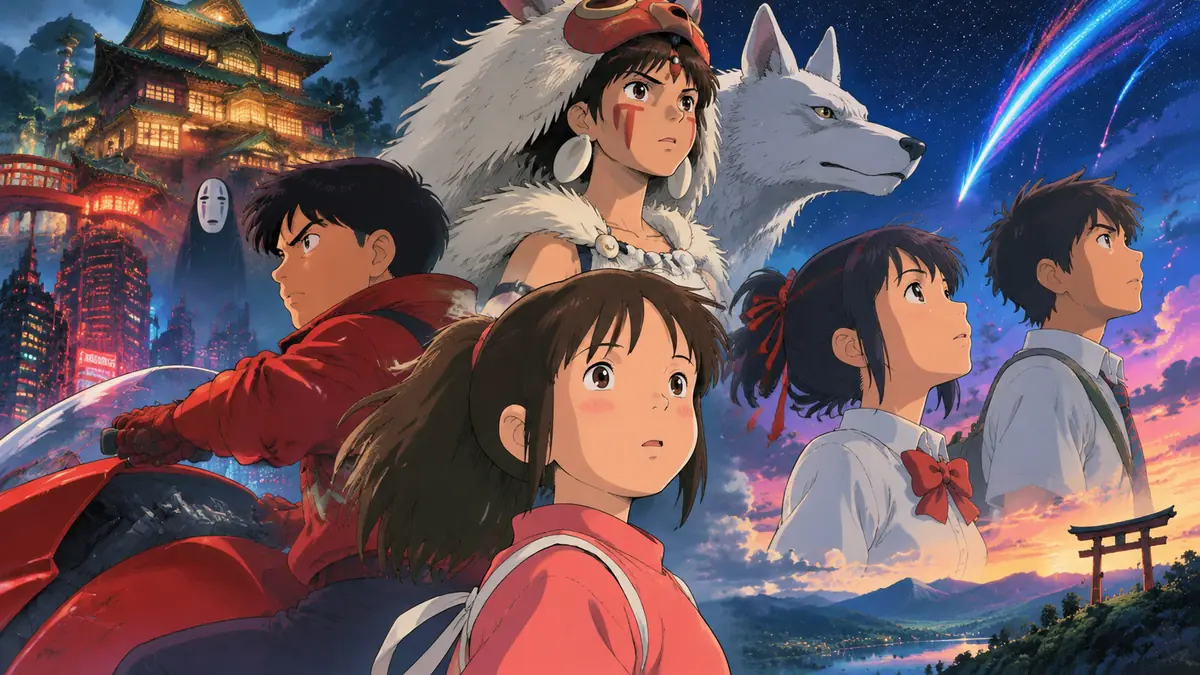
Anime movies have produced some of the most imaginative, emotionally powerful and visually extraordinary experiences in cinema. From Hayao Miyazaki’s magical worlds to Katsuhiro Otomo’s dystopian science fiction and Satoshi Kon’s psychological thrillers, Japanese animation has repeatedly demonstrated that its storytelling can reach audiences far beyond traditional animation fans. We have ranked the 10 best anime movies of all time based on their storytelling, animation, cultural influence and lasting emotional impact.
This selection includes celebrated Studio Ghibli productions, groundbreaking cyberpunk adventures, heartbreaking dramas and imaginative science-fiction stories. Some changed how international audiences viewed Japanese animation, while others demonstrated how animated films could explore complicated human experiences with remarkable depth. Here are the movies that deserve a place on every anime fan’s watchlist.
1. Spirited Away (2001)
Spirited Away is arguably the greatest anime movie ever made, combining extraordinary imagination with a deeply personal coming-of-age story. Directed by Hayao Miyazaki and produced by Studio Ghibli, the film follows 10-year-old Chihiro, who accidentally enters a mysterious spirit world after her parents are transformed into pigs. To rescue them, she must work inside an enormous bathhouse operated by the powerful witch Yubaba, where gods, spirits and strange supernatural creatures come together.
What makes the film exceptional is how naturally it builds an entire fantasy world without overwhelming its central character. Chihiro begins as a frightened and reluctant child, but her experiences gradually teach her courage, responsibility and compassion. Characters such as Haku, No-Face and Yubaba give the story several memorable emotional and psychological dimensions.
The animation is particularly remarkable, with the bathhouse, supernatural landscapes and countless background details creating a world that feels alive. Joe Hisaishi’s music adds another layer of emotion to the experience. Spirited Away won the Academy Award for Best Animated Feature at the 75th Academy Awards in 2003, becoming the first Japanese-produced film to win the category. It remains an extraordinary achievement in animated filmmaking.
2. Akira (1988)
Akira is one of the most influential science-fiction anime movies ever produced. Directed by Katsuhiro Otomo and based on his own manga, the film takes place in Neo-Tokyo, a futuristic city rebuilt after a catastrophic explosion. The story follows motorcycle gang leader Kaneda and his childhood friend Tetsuo, whose involvement in a military experiment awakens terrifying psychic abilities.
As Tetsuo’s powers grow beyond his control, the government attempts to contain him while Kaneda desperately searches for a way to save his friend. Their relationship gives the film an emotional centre beneath its political conspiracies, military experimentation and spectacular destruction. The story also examines the consequences of unchecked power, social unrest and scientific interference.
Akira’s animation remains extraordinary, particularly its detailed motorcycle sequences, crowded city streets and explosive action scenes. Its depiction of a technologically advanced but deeply troubled society influenced generations of filmmakers and helped introduce international audiences to the possibilities of adult-oriented Japanese animation. More than three decades after its release, its visual ambition and dystopian storytelling remain remarkably powerful.
3. Princess Mononoke (1997)
Princess Mononoke is Hayao Miyazaki’s extraordinary fantasy adventure about humanity’s increasingly destructive relationship with nature. The story follows Ashitaka, a young prince who becomes cursed after fighting a corrupted boar god. Searching for a cure, he travels to a region where the industrial settlement of Irontown is locked in a violent conflict with the forest gods and their defenders, including San, the human girl raised by wolves.
One of the film’s greatest strengths is its refusal to divide its characters into straightforward heroes and villains. Lady Eboshi is determined to protect the people of Irontown and provide opportunities to those rejected by society, but her industrial ambitions threaten the surrounding forest. San, meanwhile, sees humanity as an enemy because of the destruction inflicted upon her home. Ashitaka finds himself caught between these opposing forces, attempting to prevent a conflict that neither side seems willing to abandon.
The film’s extraordinary creature designs and detailed environments make its fantasy setting particularly memorable. Its action sequences are intense, but the story’s central concerns are considerably more complicated than a conventional battle between good and evil. Princess Mononoke remains one of animation’s most thoughtful explorations of environmental destruction, industrialisation and the difficult relationship between humans and the natural world.
4. Grave of the Fireflies (1988)
Grave of the Fireflies is one of the most emotionally devastating animated films ever made. Directed by Isao Takahata and produced by Studio Ghibli, the story follows siblings Seita and Setsuko as they struggle to survive in Japan during the final months of the Second World War. After an air raid destroys their home and separates them from their mother, the children attempt to build a life together despite increasingly desperate circumstances.
Unlike many war films that concentrate on soldiers, military operations and political decisions, this story focuses on the experiences of two ordinary children. Seita tries to protect his younger sister while dealing with hunger, displacement and the collapse of the support system around them. Setsuko’s innocence makes their situation even more heartbreaking because she cannot fully understand the circumstances destroying their childhood.
Takahata’s direction avoids turning the tragedy into an exaggerated spectacle. The quiet moments between the siblings, their small attempts at happiness and the recurring image of fireflies create an emotional experience that stays with viewers long after the film ends. Grave of the Fireflies is essential viewing for anyone interested in the storytelling possibilities of animation, although its subject matter makes it considerably more difficult to watch than most animated features.
5. Your Name (2016)
Makoto Shinkai’s Your Name became an international phenomenon through its combination of romance, fantasy and emotional storytelling. The film follows Mitsuha Miyamizu, a high-school girl living in a small rural town, and Taki Tachibana, a teenage boy living in Tokyo. Their lives become connected when they mysteriously begin switching bodies while sleeping, forcing them to communicate through messages and adapt to each other’s completely different routines.
What initially appears to be a playful supernatural comedy gradually develops into a much larger mystery involving memory, destiny and a celestial event. Shinkai carefully builds the relationship between the two teenagers, allowing their connection to develop even though they have never properly met. The film’s second half introduces an emotional complication that transforms the meaning of their unusual experiences.
The animation is one of its biggest attractions. From Tokyo’s crowded streets to the breathtaking countryside and the glowing comet that hangs over the story, every setting receives extraordinary visual attention. The soundtrack by RADWIMPS also plays an important role in shaping the film’s emotional rhythm. Your Name became a major international success and helped establish Shinkai as one of the most recognisable contemporary anime filmmakers.
6. Ghost in the Shell (1995)
Ghost in the Shell is a landmark cyberpunk anime directed by Mamoru Oshii and based on Masamune Shirow’s manga. Set in a technologically advanced future, the film follows Major Motoko Kusanagi, a cybernetic operative working for Public Security Section 9. Her team is assigned to track down a mysterious hacker known as the Puppet Master, whose ability to manipulate digital identities creates a serious threat to national security.
The investigation becomes increasingly philosophical as Motoko begins questioning her own identity and the meaning of consciousness. In a world where human bodies can be replaced with artificial components and memories can be manipulated, the distinction between biological life and machine intelligence becomes difficult to define. The film uses its detective storyline to explore questions about individuality, personal identity and what makes someone human.
Oshii’s direction gives the film a distinctive atmosphere through its detailed futuristic cityscapes, haunting music and deliberately measured pacing. Its visual approach and philosophical themes influenced later science-fiction works, including films exploring artificial intelligence, simulated reality and cybernetic identity. Ghost in the Shell remains an important viewing experience for anyone interested in the evolution of science-fiction cinema.
7. Perfect Blue (1997)
Satoshi Kon’s Perfect Blue is a psychological thriller that demonstrates how effectively anime can explore paranoia, identity and the darker side of celebrity culture. The film follows Mima Kirigoe, a member of a popular Japanese idol group who decides to leave music behind and pursue an acting career. Her transition proves difficult as she encounters uncomfortable professional demands, an increasingly obsessive fan and a series of disturbing events that begin to blur her understanding of reality.
As the pressure intensifies, Mima struggles to separate her public image from her private identity. An online website appears to reveal intimate details about her life, while a mysterious figure resembling her former idol persona begins haunting her. The film deliberately confuses viewers about what is real, creating an increasingly unsettling experience as Mima’s psychological condition deteriorates.
Kon’s editing and visual storytelling are especially impressive because they repeatedly move between dreams, memories, performances and reality without obvious transitions. The film also examines the expectations placed on female performers and the damaging relationship between celebrity culture and personal privacy. Perfect Blue remains one of the strongest psychological thrillers in anime history and an essential introduction to Satoshi Kon’s filmmaking.
8. My Neighbor Totoro (1988)
My Neighbor Totoro is one of Hayao Miyazaki’s most beloved films, offering a quieter and more comforting experience than many of the other entries on this list. The story follows sisters Satsuki and Mei, who move with their father to an old countryside house while their mother recovers from an illness in a nearby hospital. Their new surroundings introduce them to mysterious forest spirits, including the enormous and gentle creature known as Totoro.
The film does not depend on a conventional villain or an elaborate central conflict. Instead, it builds its appeal through the sisters’ everyday experiences, their discoveries around the countryside and their encounters with the supernatural inhabitants of the forest. Totoro’s appearance at a rainy bus stop and the magical Catbus have become some of the most recognisable moments in Japanese animation.
Miyazaki’s attention to small details makes the countryside feel wonderfully authentic, while the film’s music and expressive animation create a sense of warmth throughout. Its treatment of childhood imagination, family relationships and the natural world gives it a timeless quality. My Neighbor Totoro is also an excellent introduction to Studio Ghibli for viewers who prefer gentle fantasy over intense action or complicated storytelling.
9. A Silent Voice (2016)
A Silent Voice is one of the most emotionally mature anime dramas of the modern era. Directed by Naoko Yamada and produced by Kyoto Animation, the film follows Shoya Ishida, a former school bully who attempts to reconnect with Shoko Nishimiya, a deaf girl he tormented during their elementary school years. Years after Shoko leaves the school, Shoya is isolated from his former friends and consumed by guilt over his behaviour.
His decision to find Shoko and apologise begins a difficult journey involving forgiveness, accountability and the possibility of rebuilding damaged relationships. The film does not present redemption as an easy process, nor does it suggest that a single apology can erase years of emotional harm. Both characters carry their own insecurities and painful experiences, making their attempts to understand each other particularly moving.
Yamada’s direction gives considerable attention to facial expressions, body language and the small gestures through which people communicate. The film also handles bullying, disability, loneliness and mental health with sensitivity, allowing its characters to feel complicated rather than defined by a single experience. A Silent Voice is a powerful reminder that animated storytelling can address deeply personal subjects without losing its visual beauty.
10. Paprika (2006)
Paprika is Satoshi Kon’s extraordinary science-fiction thriller about a machine that allows researchers to enter and observe people’s dreams. The story follows Dr. Atsuko Chiba, a psychotherapist who secretly uses the dream identity Paprika to help patients confront their psychological problems. When experimental DC Mini devices are stolen, the technology falls into dangerous hands and begins causing dreams to spill into the waking world.
The resulting chaos gives Kon an opportunity to create some of the most imaginative sequences in anime cinema. Ordinary streets transform into surreal dream environments, familiar objects behave in impossible ways and characters move between different realities without clear boundaries. As the investigation progresses, Atsuko and her colleagues must identify the person responsible before the technology destroys the distinction between consciousness and imagination.
What makes Paprika particularly impressive is how its visual experimentation supports the central story rather than existing purely for spectacle. The film examines the relationship between technology, identity and the subconscious while constantly challenging the audience’s expectations. Its inventive editing, elaborate dream sequences and unforgettable soundtrack make it one of the most distinctive science-fiction anime films ever produced.
These 10 films demonstrate the extraordinary range of Japanese animation, from the emotional devastation of Grave of the Fireflies to the imaginative fantasy of Spirited Away and the psychological complexity of Perfect Blue. Each offers a different reason to appreciate anime as a cinematic medium, whether through groundbreaking animation, memorable characters or stories that remain relevant long after the credits roll. Which of these 10 anime movies would you place at number one, and is there another masterpiece you believe deserves a spot on this list?