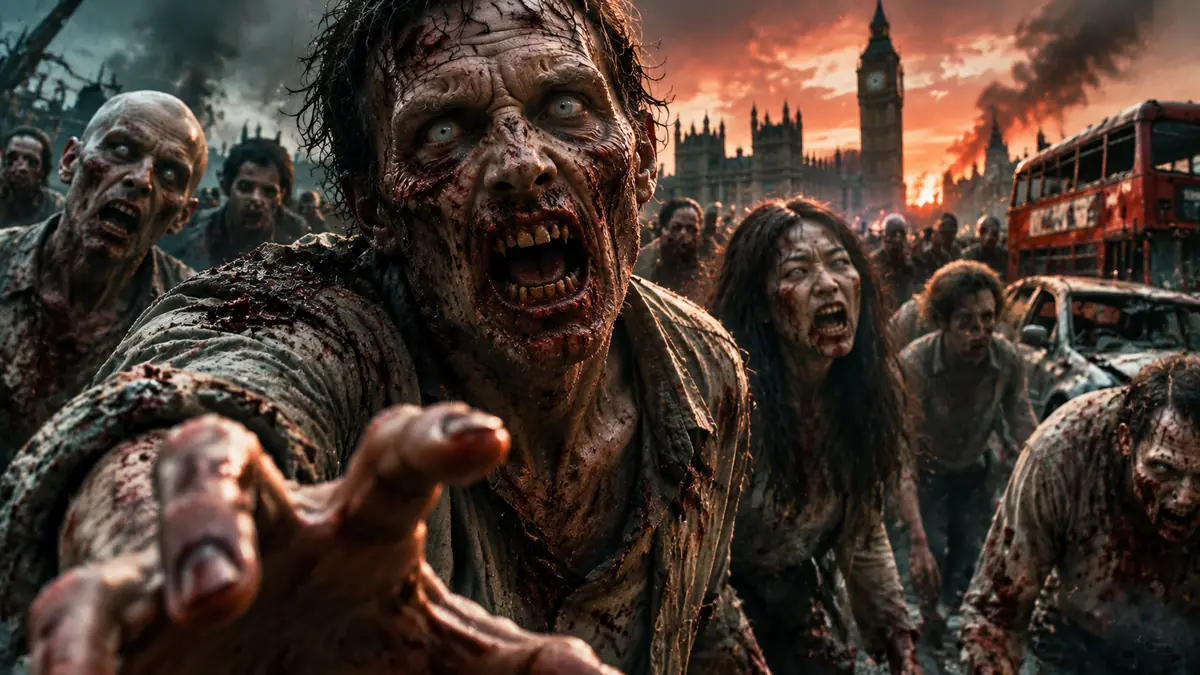
Zombie movies have a special ability to turn ordinary places into nightmares. An empty supermarket, a crowded train or even a familiar neighbourhood can become terrifying when the dead begin walking and the people around us start fighting for survival. The genre has also produced some extraordinary films, from George A. Romero’s groundbreaking horror classics to modern international hits such as Train to Busan. With 28 Years Later and its sequel bringing renewed attention to apocalyptic horror in 2025 and 2026, we are ranking the 10 best zombie movies of all time, considering their scares, storytelling, characters and lasting influence.
10. Zombieland (2009)
Zombie movies do not always need to be relentlessly terrifying, and Zombieland proves that an apocalypse can be hilarious without losing its horror credentials. Directed by Ruben Fleischer, the film follows Columbus, a socially awkward survivor who develops a personal set of rules for staying alive after a zombie outbreak. Jesse Eisenberg plays Columbus, while Woody Harrelson delivers an entertaining performance as Tallahassee, a gun-loving survivor with an unusual obsession with finding Twinkies.
Their journey becomes more complicated when they encounter Wichita and Little Rock, played by Emma Stone and Abigail Breslin. The four characters gradually form an unlikely group, although their individual priorities and trust issues create plenty of problems along the way. Bill Murray also makes a memorable appearance as himself in one of the film’s funniest sequences.
What makes Zombieland work is its understanding of comic timing. The rules displayed throughout the film, the exaggerated action sequences and the characters’ constant arguments create a distinctive personality. It is a refreshing alternative for viewers who want zombie entertainment with plenty of laughs between the bloodshed.
9. Day of the Dead (1985)
George A. Romero’s Day of the Dead takes the zombie apocalypse into an underground military facility where a small group of scientists and soldiers struggle to coexist. Humanity has been pushed close to extinction, and the survivors are attempting to understand the undead while maintaining some form of organised society. Unfortunately, the military personnel and researchers have very different ideas about what should happen next.
Lori Cardille plays Sarah, a scientist trying to understand the zombies, while Joseph Pilato portrays the increasingly unstable Captain Rhodes. Their conflict gives the film much of its tension, as the possibility of human survival becomes entangled with arguments about authority, scientific responsibility and basic decency.
The film is particularly memorable for Bub, a zombie experimented on by scientist Dr. Logan. His ability to recognise familiar objects and respond to certain human behaviours challenges the assumption that every undead creature is incapable of learning. The practical effects, created by Tom Savini, also deliver some of the most gruesome imagery in Romero’s original trilogy.
Although it initially received a more divided reception than Dawn of the Dead, the film has developed a strong following among horror enthusiasts. Its claustrophobic setting and grim examination of human behaviour make it an essential part of Romero’s zombie mythology.
8. The Return of the Living Dead (1985)
Dan O’Bannon’s The Return of the Living Dead takes a wonderfully chaotic approach to the zombie genre. The story begins when two employees at a medical supply warehouse accidentally release a mysterious gas that causes the dead to rise. What follows is a series of increasingly disastrous encounters as the newly awakened creatures begin hunting for human brains.
James Karen and Thom Mathews play Frank and Freddy, the warehouse employees responsible for triggering the outbreak. Their attempts to contain the situation quickly become futile, while a group of local punks find themselves caught in the middle of the nightmare. The film also introduces zombies that can speak, adding an unexpectedly disturbing dimension to the comedy.
One of its greatest strengths is the personality of its undead creatures. These are not simply slow monsters wandering around waiting to be destroyed. They communicate, make demands and can be surprisingly difficult to stop, giving the film a unique identity within the genre.
The practical effects and punk-inspired atmosphere make the movie particularly enjoyable. Its mixture of gruesome horror and irreverent humour has helped it remain a cult favourite, and its influence can still be felt in zombie films that refuse to take themselves too seriously.
7. [REC] (2007)
Spanish horror film [REC] takes the zombie outbreak into a Barcelona apartment building and uses found-footage filmmaking to make the experience feel frighteningly immediate. Directed by Jaume Balagueró and Paco Plaza, the story follows television reporter Ángela Vidal and her cameraman Pablo as they accompany firefighters responding to an emergency call. What initially appears to be a routine assignment turns into a nightmare when residents begin displaying violent and inexplicable behaviour.
Manuela Velasco plays Ángela, whose reporting duties gradually become a fight for survival. The building is sealed by authorities, leaving the people inside with no clear understanding of what is happening or how to escape. The handheld camera stays close to the characters, allowing the audience to discover each new horror alongside them.
The film’s greatest achievement is its atmosphere. Instead of relying on elaborate action sequences, it uses narrow corridors, dark stairwells and sudden noises to create tension. The infected are aggressive and unpredictable, while the limited visibility makes even apparently safe spaces feel dangerous.
The final stretch is particularly effective, taking the film into much darker territory than its opening scenes suggest. For anyone interested in found-footage horror, [REC] remains one of the genre’s strongest examples. Its success also led to several sequels and an American remake titled Quarantine.
6. 28 Years Later (2025)
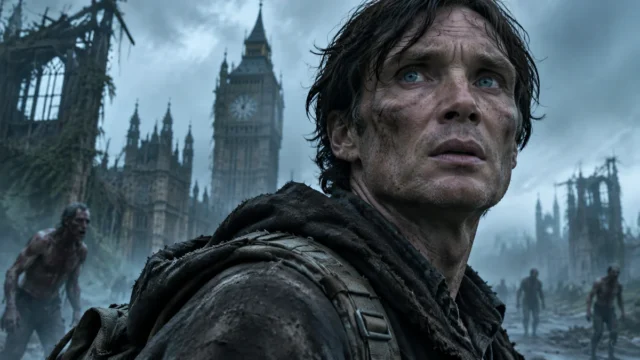
Danny Boyle and Alex Garland returned to the world of the Rage Virus with 28 Years Later, a film that takes the franchise in a more unusual direction. Set nearly three decades after the original outbreak, the story follows a community of survivors living on an isolated island connected to mainland Britain by a heavily guarded causeway. Aaron Taylor-Johnson plays Jamie, while Jodie Comer portrays his wife, Isla, and Alfie Williams plays their son, Spike.
Rather than repeating the structure of the original film, Boyle explores how an entire generation has grown up knowing little about the world that existed before the outbreak. The survivors have developed their own routines, beliefs and methods of protection, but their isolation does not eliminate the dangers waiting beyond their settlement.
Ralph Fiennes also delivers an important performance as Dr. Ian Kelson, a mysterious survivor whose relationship with the infected introduces a different perspective on the apocalypse. His storyline helps the film move beyond conventional survival horror and explore the strange ways people adapt to an environment that has become permanently hostile.
The film’s visual style is another major attraction. Boyle uses unconventional filming techniques and striking imagery to create a world that feels both familiar and deeply unsettling. Its success helped revive interest in the franchise and set up the next chapter, 28 Years Later: The Bone Temple, released in 2026.
5. Shaun of the Dead (2004)
Edgar Wright’s Shaun of the Dead is arguably the definitive zombie comedy, although calling it a comedy alone would undersell how effectively it works as horror. Simon Pegg plays Shaun, an ordinary London salesman whose personal life is falling apart just as a zombie outbreak begins spreading through the city. His first response is remarkably casual, largely because he initially fails to recognise what is happening around him.
Nick Frost plays his best friend Ed, whose enthusiasm for doing absolutely nothing becomes a running source of comedy. When Shaun finally understands the danger, he develops a plan to rescue his mother, reunite with his girlfriend Liz and reach the relative safety of the local pub. The plan is predictably less organised than Shaun imagines.
The film’s comedy comes from its attention to everyday behaviour. People continue following familiar routines even as society collapses, and Shaun’s attempts to maintain some sense of normality create several brilliant moments. Wright also uses editing, visual jokes and carefully timed musical sequences to give the film an unmistakable rhythm.
However, the emotional relationship between Shaun and Ed gives the story more substance than a collection of zombie jokes. The film understands friendship, responsibility and growing up, which is why its quieter moments work just as well as its funniest scenes. It is one of the rare horror comedies that manages to be genuinely moving without losing its sense of fun.
4. Dawn of the Dead (1978)
George A. Romero’s Dawn of the Dead remains one of the most important zombie films ever made. The story follows four survivors who escape an increasingly dangerous city and take refuge inside a large shopping mall. At first, the building seems like an ideal sanctuary, offering food, supplies and protection from the undead outside.
David Emge, Ken Foree, Scott Reiniger and Gaylen Ross play the four central survivors. Their attempts to establish a comfortable existence inside the mall gradually become complicated by personal disagreements, boredom and the arrival of another group of survivors. The undead continue gathering outside, creating a constant reminder that their temporary safety could disappear at any moment.
Romero uses the shopping mall as more than a convenient location for a horror story. The zombies wandering through its stores become an unsettling reflection of consumer behaviour, while the survivors’ growing attachment to material comfort raises questions about what society values. The film’s social commentary gives its violence a deeper purpose.
Tom Savini’s practical effects also deserve special recognition. The gruesome makeup and memorable zombie sequences helped establish a visual standard for the genre, while the film’s mixture of satire, suspense and spectacular horror made it a landmark production. Even decades later, its central idea remains remarkably effective.
3. Train to Busan (2016)
South Korean director Yeon Sang-ho delivered one of the most emotionally powerful zombie films with Train to Busan. The story follows Seok-woo, a busy fund manager travelling from Seoul to Busan with his young daughter Su-an when a zombie outbreak begins spreading across the country. What should have been a straightforward journey quickly turns into a desperate fight for survival aboard a moving train.
Gong Yoo plays Seok-woo, while Kim Su-an delivers an impressive performance as his daughter. Their relationship forms the emotional centre of the film, particularly because Seok-woo begins the story as a father whose work and personal ambitions have left him disconnected from his child. The outbreak forces him to reconsider what actually matters.
Ma Dong-seok is another major highlight as Sang-hwa, a physically imposing passenger whose courage makes him one of the film’s most memorable characters. Jung Yu-mi and Choi Woo-shik also contribute to an ensemble that gives the story several different perspectives on survival.
The train setting is particularly clever because it creates a series of confined spaces where characters must constantly make decisions about whether to help strangers or protect themselves. The infected move with terrifying speed, and the film’s action sequences use the narrow carriages to create genuine suspense. Its emotional conclusion is equally powerful, giving the movie an impact that extends far beyond its horror sequences.
2. 28 Days Later (2002)
Danny Boyle’s 28 Days Later changed the way modern audiences experienced zombie horror. Cillian Murphy plays Jim, a bicycle courier who wakes from a coma in an abandoned London hospital and discovers that society has collapsed after a highly contagious virus spreads across Britain. The empty streets, abandoned vehicles and eerie silence create one of the most recognisable opening sequences in modern horror cinema.
Jim eventually encounters other survivors, including Selena, played by Naomie Harris, and Frank, played by Brendan Gleeson. Their journey becomes a struggle to find safety, but the film gradually reveals that the infected are not necessarily the greatest danger facing the survivors. Human fear, desperation and the desire for control can produce their own kind of horror.
One important distinction is that the Rage Virus does not technically bring the dead back to life. Its victims are living people whose behaviour changes dramatically after infection. Nevertheless, the film is widely discussed alongside zombie classics because its visual language and apocalyptic premise helped redefine the modern undead subgenre.
Boyle’s use of digital video cameras gives the film a raw, almost documentary quality. The infected sprint rather than shuffle, making encounters considerably more frightening, while the film’s quieter scenes provide room for its characters to develop. Murphy’s performance is essential to that balance, taking Jim from a confused survivor to someone capable of making difficult decisions under extreme pressure.
More than two decades later, the film remains a major influence on zombie and outbreak cinema. Its combination of social commentary, terrifying imagery and emotional storytelling makes it one of the most complete horror experiences of its generation.
1. Night of the Living Dead (1968)
George A. Romero’s Night of the Living Dead takes the top position because it fundamentally changed what audiences expected from zombie movies. The black-and-white horror film follows a group of people trapped inside a farmhouse while the dead begin returning to life and attacking the living. What initially appears to be an isolated emergency gradually reveals itself as a much larger catastrophe.
Duane Jones plays Ben, who takes charge of organising the farmhouse’s defences, while Judith O’Dea portrays Barbara, one of the first survivors encountered in the story. The group quickly discovers that staying alive requires more than keeping the doors locked. Conflicts between the survivors become almost as dangerous as the creatures outside, particularly when fear and disagreements prevent them from working together.
Romero’s film established many of the conventions that would define the modern zombie movie. The undead are relentless, the outbreak creates widespread panic and ordinary people must find ways to survive without understanding what has happened. The decision to place the characters in a confined farmhouse also gives the film an atmosphere of constant pressure.
Its social and political undertones have remained central to discussions about the movie. Ben’s character was played by Jones, a Black actor, at a time when Hollywood rarely placed Black performers in conventional leading roles. The film’s bleak final sequence has consequently attracted considerable critical discussion, particularly in relation to the racial tensions of the period in which it was released.
Made on a modest budget, Night of the Living Dead demonstrated that horror did not require enormous production resources to leave a lasting impression. Its influence can be seen in countless films, television shows and video games that followed. More than half a century after its release, it remains the foundation on which much of modern zombie cinema was built.
The zombie genre continues to evolve
From Romero’s black-and-white farmhouse horror to the high-speed infected of Danny Boyle’s films, zombie cinema has constantly found new ways to frighten audiences. The best entries in the genre also understand that the monsters are only part of the story. Whether the setting is a shopping mall, a moving train or an isolated community, the most memorable films explore what happens when ordinary people are forced to confront extraordinary circumstances.
The renewed interest surrounding 28 Years Later and The Bone Temple shows that audiences still have an appetite for apocalyptic horror, even after decades of undead stories. If you could save only one film from this ranking for a zombie-movie marathon, would it be Night of the Living Dead, 28 Days Later or Train to Busan?