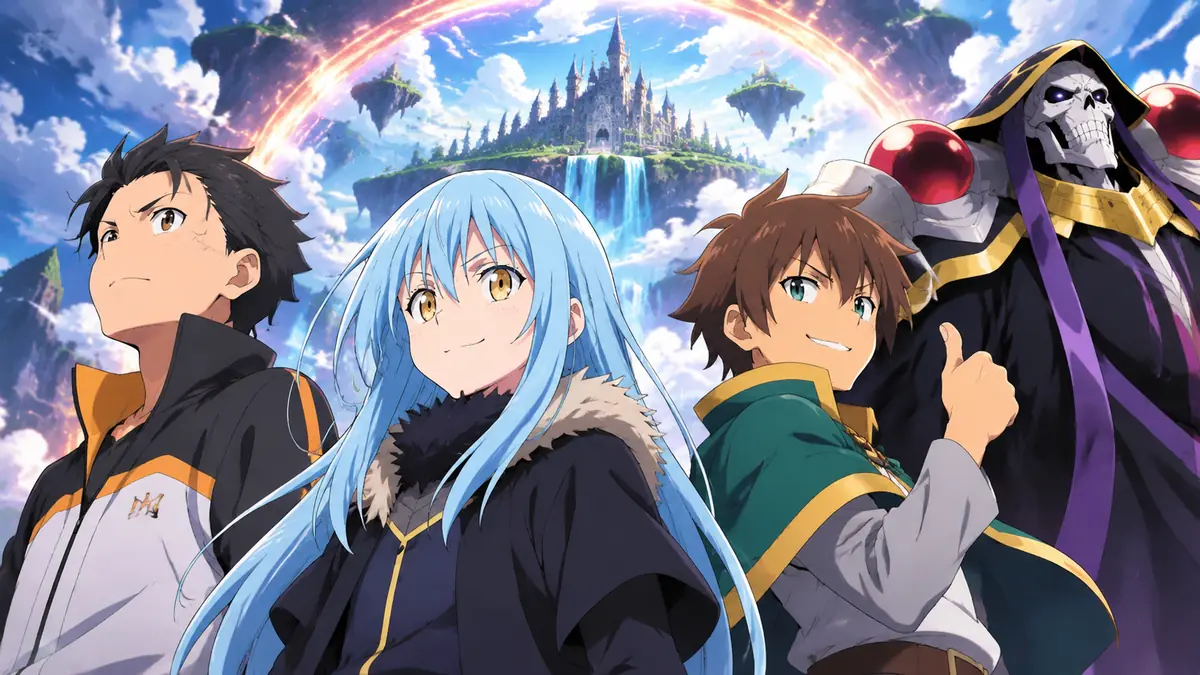
Isekai anime has grown into one of the most entertaining and unpredictable corners of Japanese animation. The basic idea is simple: an ordinary person gets transported, summoned or reincarnated into another world, but the best series take that premise in completely different directions. Some deliver psychological horror and heartbreaking character development, others explore enormous fantasy kingdoms, while a few turn familiar adventure conventions into brilliant comedy. With Re:Zero officially announcing its fifth season during its 10th-anniversary celebrations on November 14, 2026, there is no better time to revisit the genre’s strongest entries.
We are ranking these shows based on storytelling, worldbuilding, character development, originality and their lasting impact on anime audiences. This is not simply a list of protagonists with ridiculously powerful abilities. The strongest isekai anime make their fictional worlds feel alive, give supporting characters meaningful roles and ensure that victories actually mean something.
1. Re:Zero – Starting Life in Another World (2016)
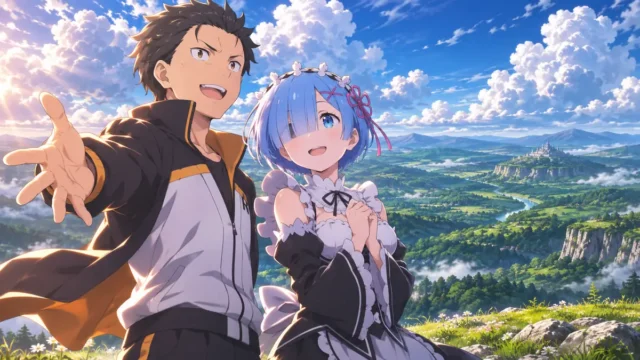
Re:Zero takes the familiar fantasy reincarnation formula and turns it into a psychological nightmare. Subaru Natsuki is suddenly transported into another world, where he discovers that his extraordinary ability is Return by Death. Whenever he dies, he returns to an earlier point in time with his memories intact, while everyone around him remains unaware of the horrors he has experienced.
What makes the series exceptional is that Subaru is far from a conventional overpowered protagonist. He cannot defeat every enemy through strength, and his ability forces him to experience repeated deaths, failures and emotional breakdowns. His relationship with Emilia, Rem and the other characters becomes increasingly complicated as he struggles to protect them without revealing the terrible price he pays.
The series also deserves enormous credit for its supporting cast and political worldbuilding. The royal selection, the Witch Cult and the various factions surrounding the Kingdom of Lugunica give the story considerably more depth than a straightforward survival adventure. With Season 5 now officially in production and the original author Tappei Nagatsuki teasing another punishing chapter, Re:Zero remains the strongest overall recommendation in the genre.
2. Mushoku Tensei: Jobless Reincarnation (2021)
Mushoku Tensei is one of the most ambitious fantasy anime to emerge from the modern isekai boom. Its protagonist is a socially withdrawn man who dies in his previous life and is reincarnated as Rudeus Greyrat in a world filled with magic, monsters and unfamiliar cultures. Unlike many reincarnation stories, the series follows him from childhood, allowing viewers to watch his abilities and personality develop over an extended period.
The biggest attraction is the extraordinary attention given to its fantasy world. Different regions have distinct cultures, languages, magical traditions and social structures, while Rudeus’s travels introduce him to people whose motivations extend well beyond his personal ambitions. The animation from Studio Bind also gives the landscapes, magical encounters and action sequences a cinematic quality.
Rudeus is deliberately a difficult protagonist to support at times. His behaviour and the series’ treatment of certain subjects can be uncomfortable, and viewers should be aware of its mature themes. However, the willingness to portray an imperfect character whose decisions have consequences is a major part of the story’s identity. For viewers who want a sprawling fantasy adventure with long-term character development, Mushoku Tensei is essential viewing.
3. The Twelve Kingdoms (2002)
Long before modern isekai became dominated by reincarnated heroes and video-game mechanics, The Twelve Kingdoms demonstrated how powerful the genre could be as serious fantasy storytelling. The anime follows Youko Nakajima, an ordinary Japanese schoolgirl who is suddenly transported into a mysterious world of twelve kingdoms. Her arrival throws her into political conflicts, dangerous encounters and a struggle to understand why she has been brought there.
What separates this series from many contemporary entries is its approach to character development. Youko begins as an insecure teenager who struggles to make decisions independently, but the circumstances surrounding her gradually force her to reconsider her understanding of courage, responsibility and leadership. Her transformation is neither immediate nor effortless, which makes her journey particularly satisfying.
The worldbuilding is another major strength. The kingdoms have their own rulers, political structures, traditions and supernatural rules, creating a setting that feels considerably larger than the protagonist’s immediate adventure. The series also explores the consequences of poor leadership and the responsibilities attached to power. Although its older animation style may require some adjustment for modern viewers, The Twelve Kingdoms remains one of the genre’s most rewarding classics.
4. That Time I Got Reincarnated as a Slime (2018)
Imagine dying and waking up in another world as a slime, one of fantasy’s least threatening creatures. That is precisely what happens to Satoru Mikami, a Japanese office worker who is reincarnated as Rimuru Tempest. What initially sounds like a joke quickly develops into an entertaining fantasy adventure about friendship, monster communities and the creation of an entirely new nation.
Rimuru’s ability to absorb other creatures and acquire their skills gives the series plenty of exciting battles. However, the real attraction is what happens between those encounters. Rather than simply travelling from one dungeon to another, Rimuru establishes relationships with different monster species, builds a community and gradually becomes involved in international diplomacy.
The supporting characters also give the show considerable personality. Benimaru, Shuna, Shion, Souei and the rest of Rimuru’s growing group bring different strengths and motivations to the story. The series occasionally becomes heavy with political discussions and escalating power levels, but its optimistic tone makes it an accessible entry point for newcomers. Few isekai shows make nation-building as entertaining as this one.
5. KONOSUBA: God’s Blessing on This Wonderful World! (2016)
KONOSUBA is what happens when an isekai protagonist receives an opportunity to become a legendary hero and proceeds to make almost every possible mistake. After dying in an embarrassing incident, Kazuma Satou is offered a new life in a fantasy world. He chooses the goddess Aqua as his companion, only to discover that she is considerably less useful than he expected.
Their dysfunctional party eventually includes Megumin, an explosion-obsessed magician, and Darkness, a knight with some very unusual preferences. None of them behaves like the dependable fantasy heroes audiences might expect. Their adventures are frequently derailed by terrible decisions, financial problems and arguments that are often funnier than the actual battles.
The series works because its comedy comes from character rather than relying entirely on references to other anime. Kazuma is selfish, Aqua is wonderfully irritating, Megumin is absurdly committed to her one spell, and Darkness takes her role far too seriously. The chemistry between the four makes even relatively ordinary quests entertaining. For anyone who wants an isekai that actively makes fun of the genre’s conventions, KONOSUBA is difficult to beat.
6. Ascendance of a Bookworm (2019)
Ascendance of a Bookworm offers one of the most unusual premises in modern isekai anime. A young woman who loves books dies in an accident and is reincarnated as Myne, a physically weak child in a medieval-style society where books are expensive and largely inaccessible to ordinary people. Instead of becoming a powerful warrior or defeating a demon lord, she decides to find a way to make books herself.
The brilliance of the series lies in its understanding of how difficult that seemingly simple ambition would be. Myne must learn about available materials, manufacturing methods, local customs and the economic structures surrounding her. Her modern knowledge gives her an advantage, but her fragile body and limited resources constantly prevent her from achieving everything she wants.
The story gradually expands into a much larger exploration of social hierarchy, commerce, craftsmanship and magic. Relationships with her family and the people who help her also provide much of the emotional appeal. It is a considerably slower experience than action-heavy isekai shows, but viewers who appreciate intelligent problem-solving and detailed worldbuilding will find plenty to enjoy. Myne proves that an extraordinary fantasy adventure does not need a sword fight in every episode.
7. Overlord (2015)
Most isekai anime follow protagonists who want to become heroes, protect innocent people or find a way home. Overlord takes a considerably darker approach. The story follows Momonga, a player who remains logged into the virtual reality game Yggdrasil as its servers shut down. When the game world continues to exist beyond that moment, he finds himself inhabiting his powerful undead avatar, Ainz Ooal Gown.
Unlike conventional protagonists, Ainz begins with extraordinary abilities and commands an army of powerful guardians. His main challenge is understanding the unfamiliar world around him while maintaining the authority and reputation of his former gaming guild. His actions increasingly influence kingdoms, political alliances and military conflicts.
The most interesting part of Overlord is its perspective. Viewers frequently follow Ainz and his followers rather than the ordinary people who must deal with their overwhelming power. The guardians, particularly Albedo and Demiurge, have their own interpretations of their master’s intentions, sometimes producing consequences that Ainz never anticipated. Its morally dark storytelling and elaborate fantasy battles make it an excellent choice for viewers who want something very different from the usual heroic isekai formula.
8. Log Horizon (2013)
Log Horizon starts with a familiar idea: thousands of players suddenly find themselves trapped inside the online role-playing game Elder Tale. However, instead of focusing entirely on escaping the game or defeating its strongest monsters, the series asks a more interesting question. What happens when an entire population has to build a functioning society inside a world that was originally designed for entertainment?
Its protagonist, Shiroe, is a strategist rather than a conventional frontline fighter. He becomes increasingly involved in negotiations, guild politics, trade arrangements and the difficult process of establishing rules for the people living in the new world. The series takes its time explaining how these systems work, giving its fantasy setting a surprisingly grounded structure.
Combat remains an important part of the experience, but the most memorable moments often involve planning and cooperation. The non-player characters also receive meaningful attention, challenging the assumption that they are simply background elements within a game. Viewers who enjoy intelligent strategy, political discussions and large-scale worldbuilding will find Log Horizon particularly rewarding.
9. The Saga of Tanya the Evil (2017)
The Saga of Tanya the Evil takes the reincarnation premise into an alternate version of early twentieth-century warfare. A ruthless Japanese salaryman is confronted by a mysterious entity that identifies itself as God. After refusing to acknowledge its authority, he is reincarnated as Tanya Degurechaff, a young girl in a world experiencing devastating military conflicts.
Tanya’s primary ambition is to secure a comfortable and safe existence, preferably far away from the battlefield. Unfortunately, her intelligence, magical abilities and calculated military decisions repeatedly push her into more dangerous assignments. Her attempts to avoid the worst of the war frequently produce exactly the opposite result.
The anime stands out because it combines supernatural fantasy with military strategy and dark humour. Tanya is a fascinating protagonist precisely because she is not interested in becoming a traditional hero. Her relationship with the mysterious entity also creates an unusual philosophical conflict beneath the aerial battles and military operations. It is one of the most distinctive isekai series for viewers who prefer tactical warfare to conventional fantasy adventures.
10. No Game No Life (2014)
No Game No Life introduces a world where almost every conflict is settled through games rather than conventional violence. The protagonists are Sora and Shiro, two exceptionally talented siblings whose combined gaming abilities make them virtually unbeatable. After being transported to Disboard by a mysterious figure known as Tet, they discover a society governed by a set of rules that make games the foundation of political and social life.
The central appeal is watching the siblings use intelligence, psychological manipulation and unconventional strategies to overcome opponents with seemingly impossible advantages. Their challenges involve everything from individual contests to games with enormous consequences for entire communities. Instead of relying on increasingly powerful attacks, the series makes clever thinking its main source of excitement.
Visually, No Game No Life is also distinctive, with an unusually colourful art style that separates it from darker fantasy anime. Sora and Shiro’s contrasting personalities create an entertaining partnership, while the rules of Disboard provide a steady stream of imaginative challenges. Its first television season arrived in 2014, followed by the 2017 prequel film No Game No Life: Zero. The long wait for a second television season remains frustrating for fans, but the existing story is still worth watching.
The isekai genre has something for every kind of anime fan
From Subaru’s repeated suffering in Re:Zero to Kazuma’s spectacularly dysfunctional adventures in KONOSUBA, the best isekai anime demonstrate how much can be done with a single storytelling premise. Some prioritise emotional development, others build entire fantasy societies, while series like No Game No Life turn intellectual competition into their central attraction. Their differences are precisely what make the genre so enjoyable to explore.
Re:Zero’s fifth-season announcement has also given longtime viewers another reason to revisit the genre’s most memorable series. Whether someone prefers psychological drama, dark fantasy, military strategy or ridiculous comedy, there is an isekai adventure worth discovering. Which of these 10 anime deserves the top spot, and which series would you add to the ranking?