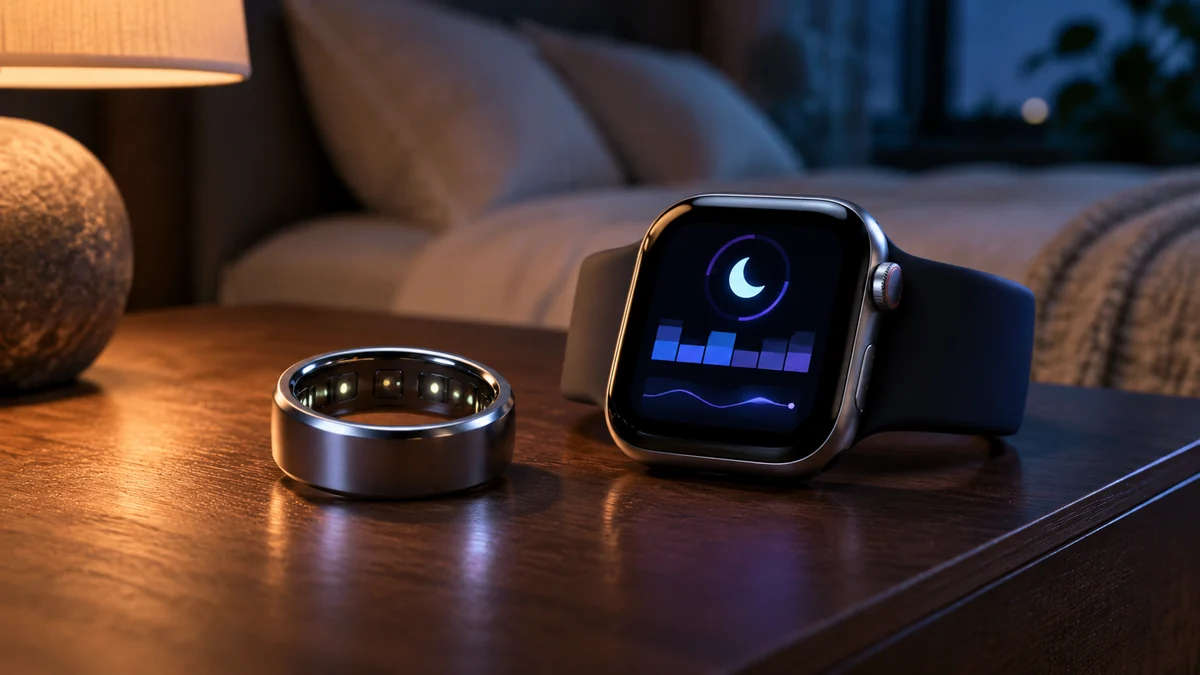
Smart rings are generally more convenient than smartwatches for overnight sleep tracking because they are lightweight, discreet and offer longer battery life. However, that does not automatically make them more accurate. Research comparing devices against clinical sleep tests shows that both categories can track sleep reasonably well, with the best choice depending on comfort, the metrics you value and how you use your wearable during the day.
Smart ring vs smartwatch: What is the difference for sleep tracking?
Both devices estimate sleep using sensors that monitor movement, heart rate, heart rate variability (HRV) and other physiological signals. They use this information to estimate when you fall asleep, how frequently you wake up and how much time you spend in different sleep stages, including light sleep, deep sleep and REM sleep.
The biggest difference is where the sensors sit. A smart ring measures signals from your finger, while a smartwatch collects most of its optical measurements from your wrist. Since the finger has a rich blood supply and can provide a strong photoplethysmography (PPG) signal, it offers certain advantages for collecting physiological data during sleep.
PPG works by shining light into the skin and measuring changes in reflected light caused by variations in blood volume. Smart rings use this information to estimate heart rate and HRV, while movement and temperature measurements help their algorithms interpret the body’s overnight patterns.
Wrist-based sensors can also collect useful data, but their readings may be affected by sensor positioning, loose straps and movement. A 2025 study published in the European Heart Journal – Digital Health found that wrist flexion and extension could significantly affect PPG accuracy, demonstrating one of the technical challenges associated with wrist-based monitoring.
Which is more accurate: Oura Ring or Apple Watch?
The most useful way to compare sleep-tracking accuracy is to examine studies that evaluate consumer wearables against polysomnography (PSG). PSG is the clinical reference standard for sleep assessment because it records several physiological signals, including brain activity, eye movements and muscle activity, to identify sleep stages.
A 2024 study published in the journal Sensors compared three popular consumer devices against PSG: the Oura Ring Gen 3, Apple Watch Series 8 and Fitbit Sense 2. The researchers studied 35 healthy adults aged 20 to 50 during an overnight sleep assessment.
The results showed that all three devices could identify sleep and wake periods reasonably well. However, their performance differed when identifying individual sleep stages.
| Device | Light sleep precision | Deep sleep precision | REM sleep precision |
|---|---|---|---|
| Oura Ring Gen 3 | 79.5% | 77.0% | 79.1% |
| Apple Watch Series 8 | 72.7% | 87.8% | 77.7% |
| Fitbit Sense 2 | 72.8% | 73.2% | 73.1% |
These figures represent precision, meaning the proportion of sleep-stage classifications made by a device that agreed with PSG. They are not an overall accuracy score, and the results do not establish one universal winner. The Apple Watch performed particularly well for deep sleep in this study, while the Oura Ring delivered more consistent precision across the three sleep stages.
There were also differences in how the devices estimated sleep duration. The Apple Watch overestimated light sleep by approximately 45 minutes and underestimated deep sleep by approximately 43 minutes compared with PSG. Oura did not show statistically significant differences from PSG for its estimates of the main sleep stages and several overall sleep measurements.
Another validation study involving 96 participants and more than 421,000 sleep epochs found that Oura Ring Gen 3 achieved sleep-stage accuracy ranging from 75.5% for light sleep to 90.6% for REM sleep. This provides further evidence that smart rings can perform well, although results from separate studies should not be treated as a direct comparison between products.
Why smart rings can be more comfortable for sleeping
Comfort is one of the strongest reasons people consider replacing their smartwatch with a smart ring. Even relatively slim watches have a screen, casing and strap that can become noticeable when someone changes sleeping positions or rests their arm beneath a pillow.
Smart rings have a smaller form factor and sit close to the finger. The Samsung Galaxy Ring weighs approximately 2.3 to 3 grams depending on its size, while the Oura Ring 5 starts at just 2 grams. Their low-profile construction makes them less noticeable for many people who prefer not to wear a watch in bed.
However, rings are not automatically comfortable for everyone. An incorrectly sized ring can feel restrictive, particularly when fingers swell overnight. People who sleep with their hands beneath their bodies or frequently experience discomfort from jewellery should consider the fit before purchasing one.
Smartwatches have their own comfort advantages because users can remove them whenever necessary and choose different strap materials. Overnight comfort depends on wrist size, finger shape, sleeping position and personal preference rather than the device category alone.
Which device has better battery life?
Battery life is another important consideration because sleep tracking requires wearing the device throughout the night. A wearable that needs charging every evening can create gaps in overnight data, particularly when users forget to recharge it before going to bed.
The current generation of smart rings has a considerable advantage here. Oura Ring 5 offers up to six to nine days of battery life, depending on ring size and usage. Samsung advertises up to seven days for larger Galaxy Ring sizes, although smaller sizes can have shorter battery life.
Smartwatches generally require more frequent charging because they power larger displays, wireless connectivity and additional applications. Apple rates the Watch Series 12 for up to 24 hours of normal use, including six hours of sleep tracking in its battery testing. Low Power Mode extends the advertised battery life to as much as 38 hours.
| Device | Advertised battery life | Subscription |
|---|---|---|
| Oura Ring 5 | Up to 6–9 days | Required for full insights |
| Samsung Galaxy Ring | Up to 7 days | No recurring subscription for basic health data |
| Apple Watch Series 12 | Up to 24 hours, 38 hours in Low Power Mode | No subscription for basic sleep tracking |
Apple has also introduced faster charging support that makes overnight tracking more practical. According to its published specifications, five minutes of charging can provide up to 10 hours of sleep tracking. This reduces the charging disadvantage, although users still need to build a charging routine into their day.
Oura vs Samsung Galaxy Ring vs Apple Watch: Which offers better value?
Sleep-tracking accuracy is only one part of the buying decision. Purchase price, recurring costs, smartphone compatibility and additional health features can make a substantial difference over several years of ownership.
Oura Ring 5
Oura Ring 5 starts at $399 in the United States, with premium finishes costing more. Its battery can last up to nine days, and the ring works with both iOS and Android smartphones. Oura also provides sleep, readiness and activity scores, alongside detailed insights into recovery, temperature trends and HRV.
Its biggest disadvantage is the recurring membership fee. US customers pay $5.99 per month or $69.99 annually after the introductory free month. Without an active membership, access to detailed health information and personalised insights becomes considerably more limited.
Samsung Galaxy Ring
The Samsung Galaxy Ring offers a subscription-free alternative for people who want continuous health and sleep monitoring. It tracks heart rate, movement and skin temperature, with its data integrated into Samsung Health. Its lightweight construction and charging case make it convenient for people who prefer a screen-free wearable.
However, smartphone compatibility matters. The Galaxy Ring requires an Android device for setup and does not support iPhones. Some of its advanced features also depend on having a compatible Samsung Galaxy smartphone.
Apple Watch Series 12
The Apple Watch Series 12 offers a broader collection of features beyond sleep monitoring. It includes sleep-stage tracking, sleep scores, workout monitoring, GPS capabilities and ECG functionality. It also supports additional health notifications and provides live information directly on the wrist.
Unlike Oura, Apple does not require a separate subscription for its standard sleep-tracking features. Its main limitations for overnight use are its shorter battery life and the fact that it requires an iPhone. For someone who already owns an Apple Watch, these factors may not justify purchasing another wearable exclusively for sleep monitoring.
Should you buy a smart ring if you already own a smartwatch?
Buying both devices can make sense if you want detailed overnight health trends without sacrificing the functionality of a smartwatch during the day. A smart ring can remain on your finger while you sleep, while a watch can provide workout tracking, GPS data, notifications and interactive features when you are awake.
However, there is considerable overlap between the two products. Both can monitor heart rate, movement and sleep patterns, so purchasing both does not necessarily provide twice as much useful information. Their algorithms may also produce different estimates because they use different sensors and measurement methods.
For most people, choosing one device based on their primary requirement is a more practical approach. A smart ring makes sense when overnight comfort, battery life and passive health monitoring are the priorities. A smartwatch is more versatile when sleep tracking is only one part of a broader fitness and health routine.
Frequently asked questions
Is a smart ring more accurate than an Apple Watch for sleep tracking?
Not necessarily. A 2024 PSG comparison found that Oura Ring Gen 3 delivered relatively consistent precision across light, deep and REM sleep, while Apple Watch Series 8 performed particularly well for deep sleep. The results depend on the sleep stage being measured, and neither device consistently outperformed the other across every metric.
Can I wear both an Oura Ring and an Apple Watch?
Yes. Both devices can collect sleep and activity information independently. Wearing them together can provide additional data points, although their readings may differ because of sensor placement and proprietary algorithms. You should also consider whether the additional information is useful enough to justify the cost of owning two devices.
Does a smart ring track deep sleep and REM sleep?
Yes. Smart rings such as Oura and Samsung Galaxy Ring estimate different sleep stages using heart rate, HRV, movement and other physiological signals. These are algorithm-based estimates rather than direct measurements of brain activity, so they should not be treated as equivalent to a clinical sleep study.
Is Oura better than Samsung Galaxy Ring?
Oura offers more detailed personalised sleep and recovery insights, but requires a paid membership for its full experience. Samsung provides subscription-free basic health tracking and integrates with Samsung Health. The better option depends on how much value you place on detailed sleep analysis and whether you use a compatible Samsung smartphone.
Do smart rings replace clinical sleep studies?
No. Consumer wearables can help identify sleep patterns and changes over time, but they cannot replace polysomnography or a medical assessment. Anyone experiencing persistent sleep difficulties, suspected sleep apnoea or significant daytime fatigue should seek professional medical advice rather than relying exclusively on wearable readings.
Smart rings offer advantages in overnight comfort and battery life, while smartwatches provide greater versatility for daytime health and fitness tracking. Research shows that both can estimate sleep stages reasonably well, but neither should be considered a replacement for clinical sleep assessment. If you had to choose between an Oura Ring 5, Samsung Galaxy Ring and Apple Watch Series 12, which device would best fit your daily routine and why?