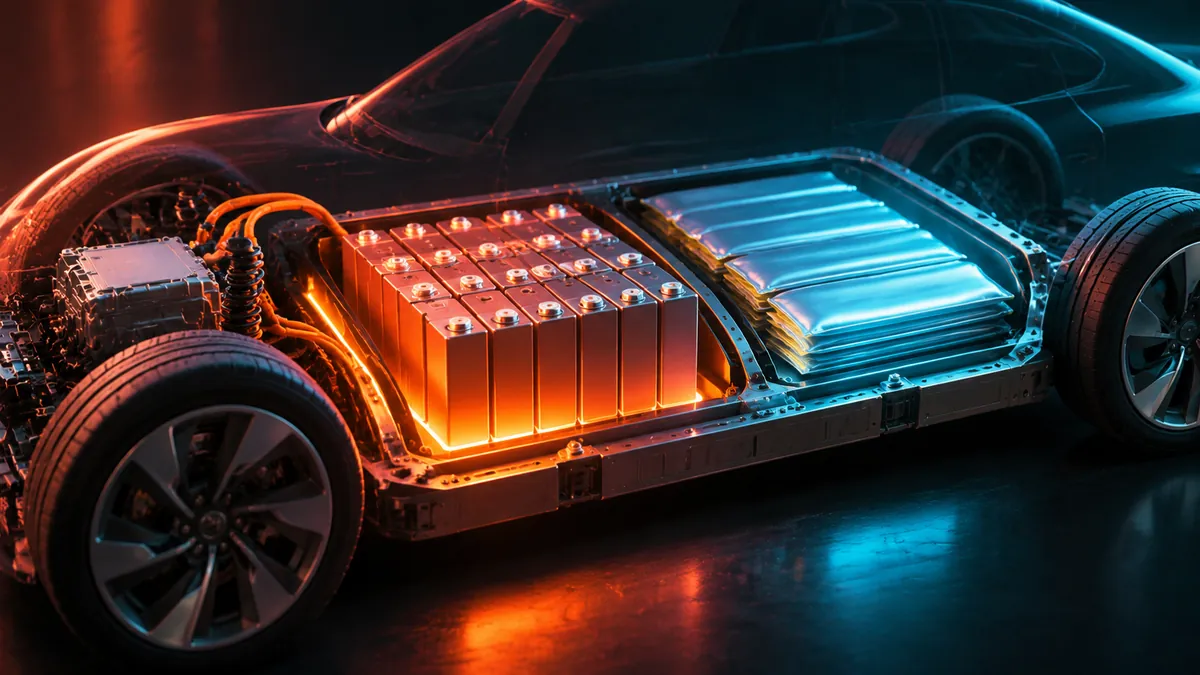
LFP and NMC are two of the most widely used battery chemistries in electric vehicles, but they serve slightly different priorities. LFP (lithium iron phosphate) batteries generally cost less, offer longer cycle life and provide better thermal stability, while NMC (nickel manganese cobalt) batteries deliver higher energy density, which can support longer driving ranges in similarly sized battery packs. The better option depends on your driving habits, climate and charging requirements.
What is the difference between LFP and NMC batteries?
Both LFP and NMC are lithium-ion battery technologies. Their main difference lies in the materials used in their cathodes, which influence energy density, cost, lifespan, charging behaviour and thermal stability.
An LFP battery uses lithium iron phosphate (LiFePO4) as its cathode material. Iron and phosphate are relatively abundant materials, and the chemistry does not require nickel or cobalt. This contributes to its lower manufacturing cost and strong thermal stability.
An NMC battery uses a combination of nickel, manganese and cobalt in its cathode. Manufacturers can adjust the proportions of these materials to influence energy density, stability and cost. Higher-nickel formulations generally provide greater energy density, making NMC attractive for vehicles where range and battery packaging are important.
LFP vs NMC: Key differences compared
| Parameter | LFP battery | NMC battery |
|---|---|---|
| Cathode material | Lithium iron phosphate | Lithium nickel manganese cobalt oxide |
| Energy density | Generally lower | Generally higher |
| Manufacturing cost | Lower | Higher |
| Cycle life | Generally longer | Generally shorter |
| Thermal stability | Higher | Lower, particularly in high-nickel formulations |
| Cold-weather performance | Generally weaker | Generally better |
| Charging to 100% | More tolerant of regular full charging | Usually better to limit daily charging to around 80% |
| Nickel and cobalt | Neither required in the cathode | Both used in the cathode |
Which battery lasts longer: LFP or NMC?
LFP batteries generally have an advantage in cycle life, meaning they can withstand more charge and discharge cycles before their capacity declines significantly. Their stable phosphate-based cathode structure helps limit certain degradation mechanisms during repeated cycling. This makes them particularly attractive for vehicles that cover high annual distances, including taxis, ride-hailing vehicles and commercial fleets.
NMC batteries also offer substantial operating lifetimes, but their degradation characteristics depend on the nickel content, charging conditions, operating temperature and battery management system. High-nickel formulations can deliver excellent energy density, although they require careful thermal and charging management.
Battery cycle-life figures should not be treated as guaranteed vehicle lifespans. Laboratory testing conditions can differ considerably from real-world driving, where temperature fluctuations, fast charging, depth of discharge and time spent at high states of charge influence degradation. The complete battery pack, including its cooling system and management software, also affects long-term performance.
For buyers planning to keep an EV for many years or drive substantial distances, LFP offers an attractive durability advantage. However, a well-managed NMC battery can also remain usable for many years, so chemistry alone cannot predict the lifespan of an individual vehicle.
Which battery offers better driving range?
NMC batteries generally win when energy density is the priority. They can store more energy for a given battery weight or volume, allowing manufacturers to develop longer-range vehicles without increasing battery-pack dimensions excessively.
According to the International Energy Agency’s Global EV Outlook 2025, LFP battery packs have approximately 20% lower energy density by mass and one-third lower energy density by volume compared with NMC packs. The difference has narrowed as manufacturers have improved LFP cell designs and pack integration.
For example, consider two hypothetical electric cars with battery packs of similar physical dimensions. The NMC-equipped vehicle could accommodate more usable energy, potentially delivering greater driving range. The LFP-equipped vehicle might need a larger battery pack to achieve a comparable range.
However, energy density does not determine the final driving range by itself. Vehicle weight, aerodynamics, motor efficiency, tyre resistance, battery capacity and driving conditions all influence how far an EV travels on a charge. Modern LFP vehicles can already offer competitive everyday ranges, particularly in standard-range models.
Are LFP batteries safer than NMC batteries?
Thermal stability is one of LFP’s strongest advantages. Its iron-phosphate cathode structure is more resistant to the oxygen-release reactions associated with thermal runaway than conventional nickel-rich layered oxide cathodes. This makes LFP batteries less susceptible to certain dangerous heat-related failure processes.
NMC batteries have higher energy density, but their chemistry requires more careful thermal management. Under severe abuse conditions, such as internal short circuits, overheating or physical damage, NMC cells can experience thermal runaway and release substantial heat.
Research published in the journal Applied Energy has found that LFP batteries generally exhibit greater thermal-runaway tolerance and lower associated hazards than NMC batteries. However, neither chemistry is completely immune to battery fires.
It is also important to distinguish cell chemistry from complete vehicle safety. Battery-pack construction, cooling systems, electrical protection, cell spacing and battery management software all influence the risk of a thermal event. A well-engineered NMC vehicle can have extensive safety protections, just as an LFP vehicle still requires appropriate battery safeguards.
How do LFP and NMC batteries perform in cold weather?
Cold temperatures affect both LFP and NMC batteries, but LFP generally experiences a more pronounced performance disadvantage. Low temperatures slow the movement of lithium ions and increase internal resistance, reducing the energy and power that batteries can deliver.
In cold conditions, LFP vehicles can experience reduced driving range, slower charging and lower regenerative braking availability. The extent of the reduction depends on the battery temperature, vehicle design, heating system and whether the battery has been preconditioned.
NMC batteries generally retain their usable performance better in cold climates, although they are not immune to winter-related range losses. Battery heating and thermal management can make a substantial difference for both chemistries.
Preconditioning is particularly useful before rapid charging in winter. It allows the vehicle to bring its battery closer to the appropriate operating temperature, improving charging performance and helping protect the cells. Drivers in consistently cold regions may therefore find NMC more convenient, especially when they regularly depend on public fast-charging infrastructure.
Should you charge an LFP battery to 100%?
One of the practical advantages of LFP technology is its greater tolerance for being charged to a full state of charge. Unlike many NMC batteries, which benefit from avoiding prolonged periods at very high charge levels, LFP batteries can generally be charged to 100% more frequently without the same degradation penalty.
There is also a battery-management consideration. LFP has a relatively flat voltage curve, which makes it more difficult for a battery management system to estimate the state of charge accurately using voltage alone. Periodic full charging can help certain vehicle systems calibrate their displayed charge estimates.
Tesla provides a useful example. Its owner guidance for vehicles equipped with LFP batteries recommends a 100% charge limit, including for daily use, and a full charge at least once a week. This recommendation is specific to the applicable Tesla vehicles and should not automatically be applied to every LFP-equipped EV.
NMC owners are generally advised to maintain a lower daily charging limit, often around 80%, and reserve 100% charging for longer journeys. Tesla’s guidance for vehicles with an 80% recommended daily charge limit follows this approach. Always consult the charging recommendations for your particular vehicle rather than assuming that every battery pack follows identical rules.
Which battery charges faster?
Neither LFP nor NMC is automatically faster to charge in every situation. Charging speed depends on the cell design, battery architecture, charging curve, temperature, state of charge and maximum power supported by the vehicle.
NMC batteries can benefit from their higher energy density and established fast-charging designs. LFP batteries have also made significant progress, with newer cell-to-pack architectures and improved charging technology allowing some vehicles to achieve competitive charging performance.
One important consideration is that charging power generally decreases as a battery approaches full capacity. This is why charging from 10% to 80% can take considerably less time than charging from 80% to 100%, even when the same charging station is used.
For frequent road trips, compare the vehicle’s actual charging curve and manufacturer-published charging times rather than relying exclusively on its battery chemistry.
Why are LFP batteries cheaper than NMC batteries?
LFP batteries generally cost less because their cathodes do not require nickel or cobalt. These materials have complex supply chains and can experience significant price fluctuations, increasing the manufacturing costs of nickel-based battery chemistries.
BloombergNEF’s 2025 Lithium-Ion Battery Price Survey, published in December 2025, reported average pack prices of approximately $81 per kWh for LFP and $128 per kWh for NMC across battery applications. The figures illustrate the substantial cost advantage of LFP, although actual prices vary by region, manufacturer, vehicle application and production scale.
The cost difference has helped LFP gain market share, particularly in China, where large-scale manufacturing and integrated supply chains have supported competitive battery prices. Automakers increasingly use LFP in more affordable electric vehicles, while retaining NMC for applications where energy density and range justify the additional expense.
Frequently asked questions
Is LFP better than NMC for electric cars?
LFP is generally better for buyers prioritising affordability, long cycle life and thermal stability. NMC is often preferable for buyers who need higher energy density, longer range from a similarly sized battery pack or better cold-weather performance. Neither chemistry is universally superior.
Can LFP batteries last 10 years or more?
Yes, an LFP battery can remain in service for 10 years or longer, depending on its design, operating conditions and degradation rate. Its relatively long cycle life makes it attractive for long-term ownership, although the actual lifespan of an individual battery cannot be guaranteed by chemistry alone.
Do NMC batteries lose capacity faster than LFP batteries?
NMC batteries generally have shorter cycle-life characteristics under comparable conditions, but real-world degradation varies by cell formulation, temperature, charging habits and battery management. A well-managed NMC battery can still provide many years of reliable service.
Can LFP batteries work in freezing temperatures?
Yes. LFP batteries can operate in cold climates, but their available energy and charging performance can decline significantly at low temperatures. Battery preconditioning and thermal management help reduce these effects. Charging a cold lithium-ion battery at inappropriate rates can also increase the risk of lithium plating.
Are sodium-ion batteries replacing LFP batteries?
No. Sodium-ion batteries are an emerging alternative that can offer advantages in material availability and certain cost-sensitive applications. However, their lower energy density in many current designs limits their suitability for some long-range EV applications. They are developing alongside LFP rather than replacing it across the electric vehicle market.
LFP batteries offer lower costs, longer cycle life and greater thermal stability, while NMC batteries provide higher energy density and generally better cold-weather performance. The choice ultimately depends on whether affordability and durability matter more than maximum range and energy efficiency in a compact battery pack. If you were buying an electric vehicle today, would you choose the longer-lasting LFP battery or the higher-energy-density NMC option?