India’s flex-fuel ethanol policy changed on October 26, 2026, when MoRTH amended the Central Motor Vehicles Rules to include E100 alongside E85 in emission-certification provisions for flex-fuel vehicles. The change applies to newly designed compatible vehicles and does not require owners of existing petrol cars to switch fuels or modify their engines.
The update establishes a regulatory route for vehicles specifically engineered to run on high ethanol blends. It also clarifies the difference between flex-fuel vehicles and ordinary petrol cars that may support lower blends such as E10 or E20 but are not automatically compatible with E85 or E100. For consumers, this is a certification change for suitable vehicles, not a mandatory switch to a different fuel.
What changed in India’s flex-fuel rules in 2026?
The Ministry of Road Transport and Highways amended the Central Motor Vehicles Rules, 1989, on October 26, 2026. The notification expressly brought E100 into the emission-certification framework alongside E85 for flex-fuel vehicles. The rules came into effect immediately from the date of publication in the Official Gazette.
The amendment also updated biodiesel-related rules and made technical corrections to existing motor-vehicle regulations. For consumers, the ethanol-related change does not introduce a mandatory fuel switch. It establishes how newly designed flex-fuel vehicles using high-ethanol fuels can be certified under India’s motor-vehicle framework.
What is E85 fuel?
E85 is defined under the updated framework as a petrol-ethanol blend containing up to 85% ethanol by volume. Vehicles intended to use E85 need to be engineered specifically for high ethanol content. The fuel has different characteristics from conventional petrol blends, so compatibility cannot be assumed simply because a vehicle already supports lower ethanol percentages.
The certification rules therefore focus on flex-fuel vehicles designed to operate across a broader range of ethanol concentrations rather than standard petrol cars. Higher ethanol content requires compatible fuel-system components and an appropriate engine-management strategy. E85 compatibility is a specific technical capability and should not be treated as an automatic extension of E10 or E20 compatibility.
What is E100 fuel?
E100 is defined as fuel consisting of 100% ethanol. By expressly including E100 in the emission-certification provisions, MoRTH has established a formal regulatory route for vehicles designed to use pure ethanol. This does not make E100 suitable for every petrol-powered vehicle currently operating on Indian roads.
The policy applies to vehicles specifically designed and certified to handle the fuel. Compatibility depends on the engine, fuel system, materials and control strategy used by the manufacturer. The new certification provisions therefore do not establish universal E100 compatibility across existing vehicles.
Do existing car owners have to switch to E85 or E100?
No. The 2026 amendment applies to newly designed vehicles and does not require existing vehicle owners to switch to E85 or E100. The notification also does not require current petrol-car owners to modify their engines for high-ethanol fuel use.
This distinction matters because changes to ethanol regulations can be mistaken for compulsory fuel-conversion requirements. The amendment creates no such obligation for existing owners. Drivers should continue using the fuels approved by their vehicle manufacturer, since the new certification provisions do not change the technical limits of cars already in use.
Does E20 compatibility mean a car can run on E85?
No. MoRTH has clarified that compatibility with standard E10 or E20 blends does not automatically establish compatibility with E85. A vehicle designed for lower ethanol blends should not be assumed to support substantially higher ethanol concentrations.
The difference between E20 and E85 requires attention to vehicle engineering. Flex-fuel vehicles need hardware and engine-management systems capable of adjusting to significant changes in fuel composition. The same distinction applies to E100, which is intended for vehicles specifically engineered and certified to use pure ethanol.
How does flex-fuel technology work?
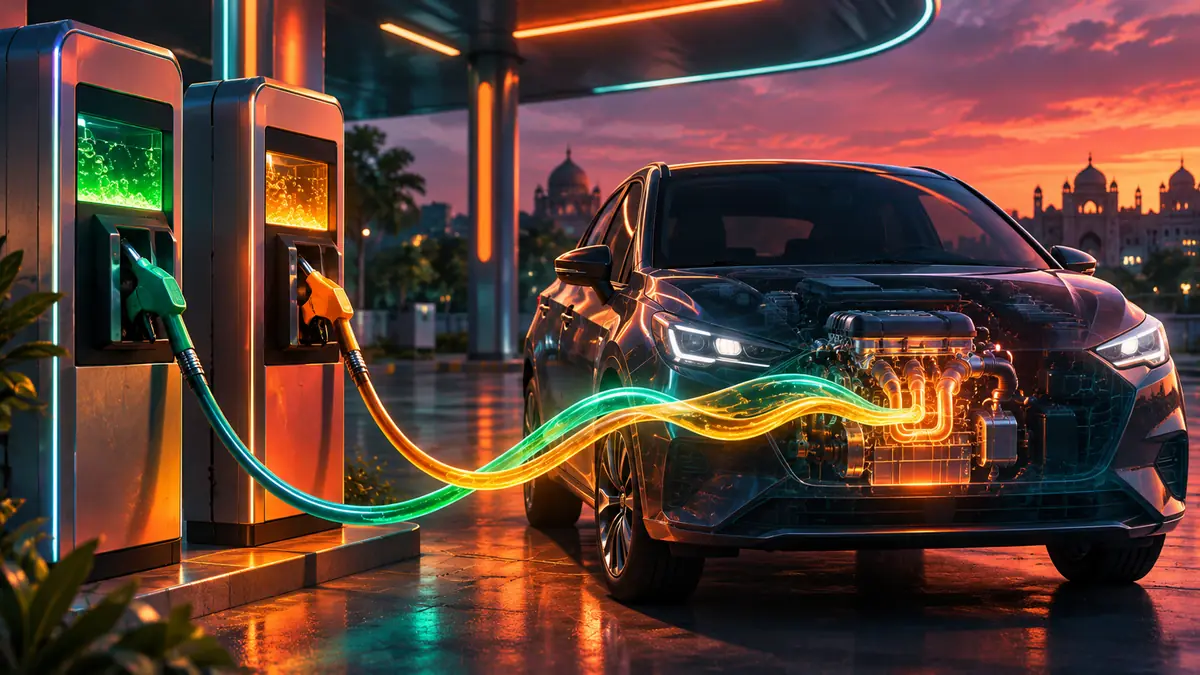
Flex-fuel technology allows a vehicle to operate on fuels containing different petrol-ethanol compositions using a single fuel tank. The engine-management system automatically adjusts operating parameters according to the fuel mixture being used. This ability distinguishes a flex-fuel vehicle from a conventional petrol vehicle calibrated for a narrower range of ethanol blends.
The system recognizes changes in fuel characteristics and adjusts engine controls accordingly. For drivers, these adjustments happen through the vehicle’s fuel and control systems. They do not need to manually select a different engine mode whenever the ethanol content changes.
Why does India need separate certification for E85 and E100?
Emission certification is necessary because vehicle emissions can vary depending on fuel composition and engine calibration. A car approved for conventional petrol or a lower ethanol blend cannot automatically be considered compliant when operating on a substantially different fuel. By adding E100 alongside E85, the 2026 framework provides manufacturers with a formal route to certify vehicles developed for higher ethanol concentrations.
The change supports vehicle development without treating all petrol-powered cars as technically equivalent. Manufacturers can identify the applicable certification requirements for vehicles designed around these fuels. The amendment provides a regulatory basis for recognizing specific vehicle and fuel combinations before wider deployment.
Will current petrol cars need engine modifications?
The notification does not require owners of existing petrol vehicles to modify their engines. E85 and E100 certification applies to vehicles specifically designed for those fuels. Retrofitting a conventional vehicle is a separate matter because engine components, fuel lines, calibration and other systems may be designed for particular fuel characteristics.
Using a different fuel does not make a conventional petrol car a certified flex-fuel vehicle. Owners should use only the fuel blends approved for their specific vehicle unless the manufacturer explicitly confirms wider compatibility. The 2026 policy does not introduce any requirement to alter existing cars.
Does the policy mean E100 will immediately replace petrol?
No. The notification establishes a certification framework rather than requiring E100 to replace petrol or lower ethanol blends across the market. It also does not mandate that all future passenger vehicles must become flex-fuel vehicles.
The introduction of E85 or E100 vehicles would depend on manufacturers developing compatible products and obtaining certification under the applicable rules. Fuel availability and broader market adoption are separate considerations. The amendment enables certification for these vehicles but does not establish an immediate transition across India’s passenger-car fleet.
What does the rule mean for carmakers?
For manufacturers, the amendment clarifies the regulatory requirements for developing vehicles engineered to use high-ethanol fuels. E85 was already part of the flex-fuel framework, while the explicit addition of E100 provides a certification route for pure-ethanol-capable designs. Carmakers must still design compatible vehicles and demonstrate compliance with the relevant emission rules.
The updated regulation does not remove existing engineering requirements. It formally recognizes the additional fuel category within the certification framework. Manufacturers planning future flex-fuel programmes can use these provisions when developing vehicles intended to support very high ethanol concentrations.
Why is the distinction between flex-fuel and normal petrol cars important?
One possible misunderstanding is that a car either supports ethanol or does not support it at all. In practice, compatibility depends on the ethanol concentration the vehicle was designed to handle. A car certified for E20 is not automatically compatible with E85, and an E85-capable vehicle is not automatically certified for E100 unless it has been engineered and approved accordingly.
These fuel labels represent different compositions and technical requirements. At QuirkyByte, we think the distinction is worth emphasizing because the 2026 policy expands the types of vehicles manufacturers can certify. It does not change which fuels every existing petrol car can safely use.
What should Indian car owners know right now?
Current vehicle owners do not need to take immediate action because of the October 2026 amendment. There is no requirement to convert an existing petrol car, start using E85 or switch to E100. Drivers should continue following the fuel-compatibility instructions provided by their vehicle manufacturer.
If a car is designed for E10 or E20, that remains the relevant specification unless the manufacturer provides different approval. For future buyers, flex-fuel compatibility may become another feature to check when comparing new models. The relevant detail is the exact fuel range for which a vehicle has been designed and certified.
Frequently asked questions
When did India’s E100 flex-fuel rules change?
MoRTH notified the amendment to the Central Motor Vehicles Rules on October 26, 2026. The changes took effect immediately from the date of publication in the Official Gazette. The amendment formally added E100 alongside E85 within the relevant flex-fuel emission-certification provisions.
What is the difference between E85 and E100?
E85 is a petrol-ethanol blend containing up to 85% ethanol by volume, while E100 consists of 100% ethanol. Vehicles need to be specifically designed and certified for the fuel they are intended to use. Compatibility with one blend does not automatically establish compatibility with a substantially higher ethanol concentration.
Can an E20-compatible car use E85?
Not automatically. MoRTH has clarified that compatibility with E10 or E20 does not establish compatibility with E85. High-ethanol flex-fuel vehicles require specific engineering and certification for the broader fuel range they are designed to handle.
Do existing car owners need to modify their engines?
No. The 2026 amendment does not require existing vehicle owners to convert or modify their engines for E85 or E100. It applies to newly designed vehicles intended for those fuels. Current owners should continue following the fuel-compatibility guidance provided by their vehicle manufacturer.
How does a flex-fuel vehicle handle different ethanol blends?
A flex-fuel vehicle uses engine-control systems that automatically adjust operation according to the fuel composition in the tank. This allows a single vehicle and fuel tank to accommodate different compatible petrol-ethanol blends. The automatic adjustment capability distinguishes a flex-fuel vehicle from a conventional petrol vehicle designed for a narrower blend range.