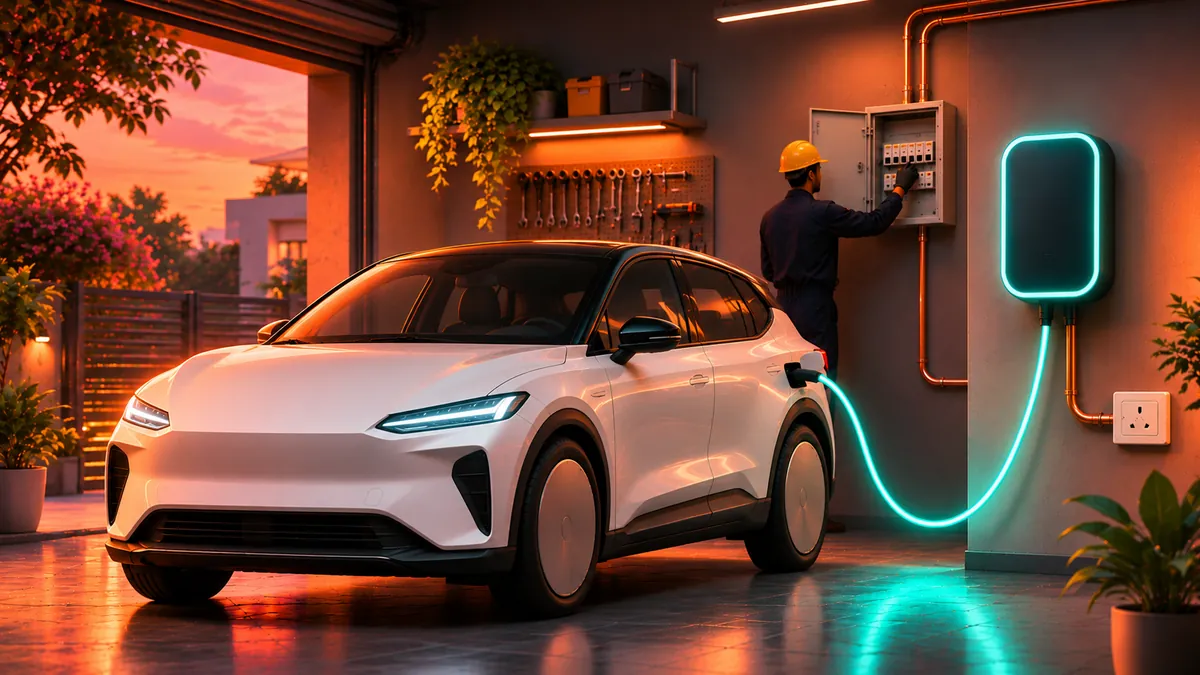
To charge an EV at home in India, most owners use the charger that comes with the car or add a 7.2 kW AC wall box, and have a licensed electrician or the manufacturer’s installer connect it. The Ministry of Power’s 2024 guidelines say owners can charge at home on their existing electricity connection, and that they must apply to their electricity distribution company for a higher sanctioned load if the charger needs more power than they currently have. Never wire a high-current charger yourself, and always follow the charger and car manuals.
Key takeaways
- Existing connection first: the Ministry of Power’s 2024 guidelines state that owners can use their existing electricity connection to charge EVs at home.
- Load check: if the charger needs more power than your sanctioned load, you apply to your distribution licensee for an increase.
- Tariff: the guidelines say domestic electricity rates apply when you charge at home.
- Apartments: residents can install private charging in their designated parking spaces, and the distribution licensee supplies power through the existing meter or a separate sub-meter, as the resident chooses.
- Example costs: Tata offers a 3.3 kW home charger with the Punch EV and a 7.2 kW AC wall box for ₹49,000 extra, according to CarDekho.
- Safety: use a licensed electrician or authorised installer, and never DIY high-current wiring.
Do you need a wall box or is a socket enough?
The answer depends on your car’s AC charging capability and your parking location. Check the car’s owner’s manual or the manufacturer’s charger guidance first, because that tells you which type of supply the car supports. Then ask a licensed electrician or the manufacturer’s authorised installer to assess the wiring where you park.
Some manufacturers supply a portable or basic home charger with the car, while others sell a faster wall box separately. For example, CarDekho reports that Tata includes a 3.3 kW home charger in the Punch EV’s ex-showroom price and offers a 7.2 kW AC fast charger for an additional ₹49,000. Autocar India lists the 40 kWh Punch EV at 5.3 hours from 10% to 100% on a 7.2 kW AC supply. A wall box suits owners who want faster overnight charging, and the portable charger can be enough if you drive short distances.
What do the Ministry of Power guidelines say about home charging?
The Ministry of Power issued its Guidelines for Installation and Operation of Electric Vehicle Charging Infrastructure 2024 on September 17, 2024. Under the section on charging at a residence, owners can request a separate metered connection from the distribution licensee with a dedicated EV charging tariff, to be granted within the timelines of the Electricity (Rights of Consumers) Rules, 2020. They can also simply use their existing electricity connection to charge at home.
If the charger needs more power than your current sanctioned load, the owner applies to the distribution licensee for an increase in the sanctioned load. The same section states that domestic electricity rates apply to charging EVs at home. Those provisions come directly from the guidelines, but your local utility may have its own application forms and procedures, so check with your electricity provider.
What changes if you live in an apartment?
The guidelines have a separate section on community charging for residents of group housing. It says residents can install private EV charging stations in their designated parking spaces, and that the distribution licensee will ensure electricity supply through the resident’s existing meter or a separate sub-meter, depending on the consumer’s choice. Resident welfare associations and housing societies can also set up community chargers in consultation with the distribution licensee.
The guidelines do not describe a society no-objection certificate process, and we have not found a single national procedure for one. In practice, many residents still discuss cable routes through shared areas with their society, because bylaws and building layouts differ. Raising the plan early with the society committee and the utility is usually the quickest way to avoid delays.
What should the installer check before installation?
A qualified installer should confirm that the building’s wiring, protection equipment and sanctioned load can handle the charger’s continuous load. They should work from the charger’s specification sheet and your car’s supported AC charging rate, not from assumptions. If a load increase is needed, apply for it before you begin regular charging. Ask for a written quote that lists the charger, the length of cable run, any earthing or protection work, and any extras. Manufacturers sometimes bundle a site survey or limited cabling with a charger purchase, and sometimes do not, so ask your dealer exactly what is included, for how long, and what is charged separately.
How much does a home charger installation cost?
Costs vary with the charger, the cable run and the building’s electrical setup, so there is no single national price. The one firm figure we can cite is the Punch EV’s ₹49,000 extra charge for the 7.2 kW wall box, which CarDekho reported in May 2026. Installation, extra cabling, earthing and any load upgrade are separate and depend on your site. We recommend getting at least two written quotes, one from the manufacturer’s installer and one from a licensed electrician, and checking what each one includes. Treat any figure you see in an online guide as a rough guide only until a professional has inspected your parking spot.
What is the home EV charging safety checklist?
Safety matters more than speed when you are connecting a charger to mains power. Use this checklist before the first charge. The steps below apply to any home or society charging setup and should be treated as a minimum rather than a complete safety manual.
- Hire a licensed electrician or authorised installer. Do not modify mains wiring yourself.
- Follow the manuals. Use the charger type and settings your car’s manufacturer recommends.
- Check the load. The circuit and the sanctioned load should suit the charger’s continuous draw.
- Confirm permissions. Apply for a load increase with your distribution company where needed, and speak to your society if cables cross shared spaces.
- Avoid improvised setups. Do not use extension cords, multi-plugs or worn sockets for regular charging.
- Keep it dry and protected. Install the unit as the manufacturer directs and have protective devices fitted by the electrician.
FAQ
Can I charge my EV from a normal home connection in India?
Yes. The Ministry of Power’s 2024 guidelines state that owners can use their existing electricity connection to charge their EVs at home. If the charger needs more power than your sanctioned load, you apply to the distribution licensee to increase it.
Do I pay a special tariff to charge at home?
The guidelines say domestic electricity rates apply when you charge an EV at home. You can also request a separate metered connection with a dedicated EV charging tariff, which the guidelines say should be provided within the timelines of the Electricity (Rights of Consumers) Rules, 2020.
Can I install a charger in my apartment parking spot?
The guidelines say residents can install private EV charging in their designated parking spaces, with power supplied through the existing meter or a separate sub-meter. Discuss your plan with your housing society early, since cable routes and building rules vary.
How much does a 7.2 kW home charger cost?
It depends on the manufacturer and site. Tata charges ₹49,000 extra for the 7.2 kW AC wall box on the Punch EV, according to CarDekho, and installation extras are separate. Get written quotes before you commit.
Is a DIY installation safe?
No. High-current wiring should be done only by a licensed electrician or the manufacturer’s authorised installer. Wiring that is not rated for continuous high current can overheat, so avoid DIY installations for regular charging.