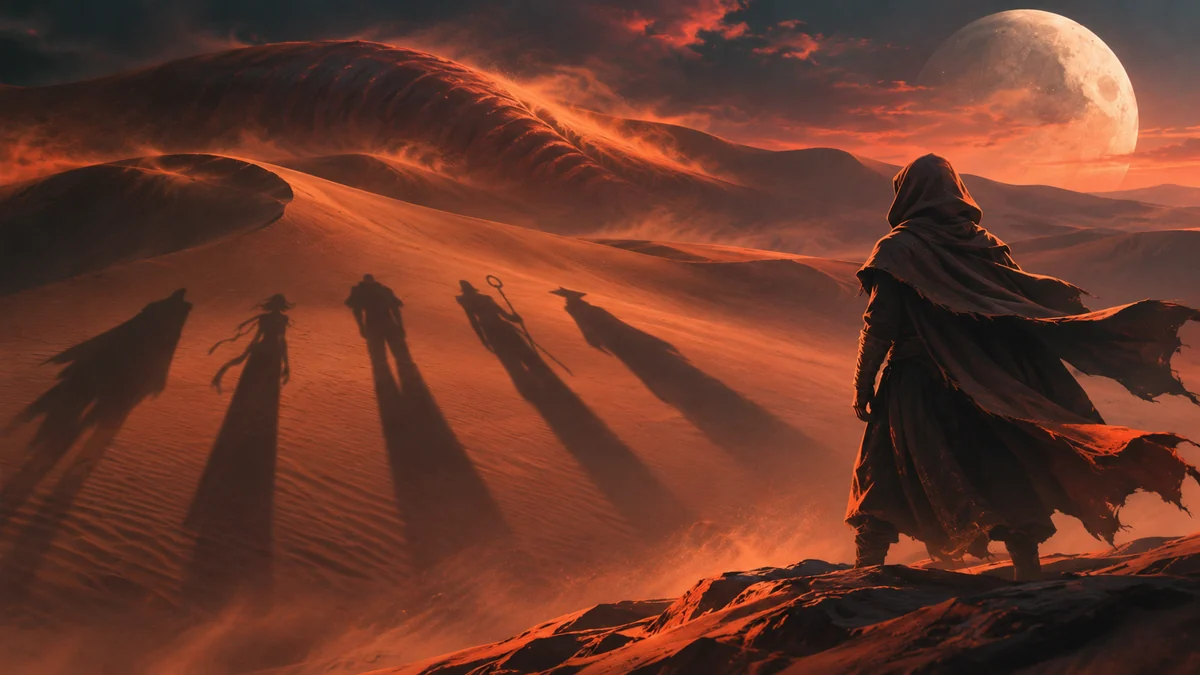
Paul Atreides conquered the Imperium. Unfortunately for Paul, conquering the Imperium may turn out to have been the easy part. The official synopsis for Dune: Part Three describes Timothée Chalamet’s Paul as a “ruthless Emperor” facing the consequences of his reign nearly two decades after taking power. A conspiracy is closing around him, Chani is somehow at its center, and enemies are finally learning the one lesson that matters when fighting Muad’Dib: trying to overpower a man who can see the future is probably the wrong strategy.
You attack everything around him instead. That is where Frank Herbert’s Dune Messiah becomes essential reading for anyone trying to work out what Denis Villeneuve might be planning. Warner Bros. confirms that the third film draws on Herbert’s novels, and several characters central to Messiah are now officially part of the movie, including Robert Pattinson’s Scytale and Jason Momoa’s Hayt.
But this is clearly not going to be a page-for-page adaptation. The official Dune: Part Three site says the film takes place nearly twenty years after Paul’s rise, while Villeneuve has already changed important pieces of Herbert’s story across the first two movies. So we’re not treating the novel as a plot leak.
We’re using it as a warning. And based on what Herbert created — plus what Warner Bros. has actually confirmed — these are the five forces most capable of destroying Paul Atreides.
5. Princess Irulan
Florence Pugh’s Princess Irulan is probably the easiest person on this list to underestimate. That is exactly why she is dangerous. At the end of Dune: Part Two, Paul agrees to marry Irulan after defeating House Harkonnen and Emperor Shaddam IV. It is a political marriage, not a romantic one, and Chani walks away furious at what Paul has become.
Now imagine living inside that marriage for years. The new film appears ready to make considerably more of Irulan. Pugh has spoken about her character’s fear and disillusionment, telling SYFY Wire that Irulan has watched Paul change and is terrified by the position she occupies around him. That immediately makes her more interesting than a simple conspirator.
In Dune Messiah, however, Irulan absolutely is part of the plot against Paul. She secretly administers contraceptives to Chani in an attempt to prevent her from producing Paul’s heir, turning succession itself into a weapon. That is the kind of threat armies cannot easily solve.
Paul can command Fremen legions across the known universe, but Irulan is already inside his household. She knows the politics surrounding his throne, carries the Corrino bloodline and has connections to the Bene Gesserit. Her greatest weapon isn’t physical strength. It’s proximity.
Villeneuve may completely reshape the contraceptive storyline, especially because his Chani-Paul relationship ended Part Two in a dramatically different place from Herbert’s first novel. But Irulan becoming politically dangerous feels almost inevitable. Paul married her to secure an empire. That decision could end up helping destroy it.
4. The Bene Gesserit
Paul may be the Bene Gesserit’s greatest achievement and their greatest nightmare at the same time. They spent generations manipulating bloodlines in pursuit of the Kwisatz Haderach. Then Paul arrived one generation earlier than expected, survived their tests, gained enormous prescient power and stopped behaving like something they could control. That is a catastrophic outcome for an organisation whose entire philosophy revolves around control.
Charlotte Rampling officially returns in Dune: Part Three as Reverend Mother Gaius Helen Mohiam, and Rebecca Ferguson is also back as Lady Jessica. The official character material continues to emphasize Jessica’s Bene Gesserit identity, which could make the Sisterhood’s role even more complicated than it is in the novel. In Dune Messiah, Mohiam represents the Bene Gesserit within the conspiracy against Paul alongside Irulan, Scytale and the Spacing Guild’s Edric. Their problem is bigger than simply disliking Paul.
He has disrupted the breeding program they spent centuries constructing. Worse, his control over the Imperium means the future of the Atreides bloodline is increasingly happening outside their authority. That makes Paul’s children enormously important.
And the Bene Gesserit do not need to assassinate Paul personally to win. They think in generations. Controlling what comes after him can be more valuable than controlling the man himself.
Villeneuve has consistently made the Bene Gesserit feel almost frighteningly patient. Dune: Part Two expanded that quality through Lady Margot Fenring and Reverend Mother Mohiam’s manipulation of multiple bloodlines. Against Paul, patience may be their best weapon.
3. The Spacing Guild — especially if Edric appears
Paul’s most frightening ability isn’t his army. It’s prescience. If your enemy can perceive possible futures, planning a secret conspiracy becomes slightly inconvenient. Frank Herbert’s solution to that problem was brilliant: put another prescient being in the room.
In Dune Messiah, the Spacing Guild is represented by Edric, a Guild Navigator whose own limited prescience creates interference around the conspirators. As summaries of Herbert’s novel from sources including Radio Times explain, Edric effectively helps shield the conspiracy from Paul’s future sight. That changes the entire battlefield.
Paul doesn’t necessarily lose his powers. He loses certainty. For someone who has built his reign around knowing where different paths lead, blind spots may be more dangerous than weapons.
There is one major caveat: Warner Bros. has not announced Edric among the film’s confirmed characters. The official site lists Paul, Chani, Irulan, Hayt, Scytale, Jessica, Alia, Farok and Stilgar among its highlighted characters, but no Edric.
Villeneuve could still use him. He could combine his function with another character. Or he could invent a completely different mechanism for hiding the conspiracy from Paul. But if Part Three retains the fundamental idea of people finding a way to operate outside Muad’Dib’s prescience, it becomes one of the greatest threats Paul has ever faced. For once, he might not know what happens next.
2. Hayt
Jason Momoa returning was never going to be a normal resurrection. Warner Bros. now officially identifies his character as Hayt, a ghola of Duncan Idaho created through the mysterious technology of the Bene Tleilax. That distinction is everything.
Duncan died protecting Paul and Jessica in the first Dune. He wasn’t merely Paul’s soldier; he was one of the few people Paul genuinely loved and trusted before becoming Muad’Dib. Now someone has brought Duncan’s body back. Imagine trying to assess that rationally.
The face belongs to your dead friend. The voice belongs to your dead friend. Somewhere inside that body may even be pieces of the man you lost. But the people who created him may have designed him specifically to destroy you.
That is why Hayt is arguably more dangerous than any conventional assassin. In Herbert’s Messiah, the ghola is weaponized psychologically against Paul. Hayt becomes part of a Bene Tleilax experiment involving whether a ghola can recover the memories of the original person. And ultimately, Duncan does begin to re-emerge.
That makes Hayt both a threat and a tragedy. A knife-wielding assassin is easy for Paul to identify as an enemy. Duncan Idaho walking back into his life is something else entirely. The official Dune: Part Three description of Hayt specifically highlights questions of “identity, memory, loyalty” and outside forces attempting to influence the Atreides.
That wording alone tells us Villeneuve understands where the real power of this character lies. Paul’s enemies aren’t just sending him a weapon. They’re sending him someone he misses.
1. Scytale
Robert Pattinson’s Scytale is our number-one threat because he represents practically everything capable of defeating Paul at once: infiltration, psychological warfare, shape-changing and ruthless understanding of human weakness. Warner Bros. officially describes Scytale as a Face Dancer associated with the Bene Tleilax, whose presence introduces hidden agendas into the struggle surrounding Paul. If Villeneuve keeps even part of Scytale’s Messiah role, Pattinson is walking into one of the juiciest villain parts in the entire Dune saga.
Face Dancers can imitate other people. That makes Scytale dangerous before he ever attacks anyone. But Herbert goes much further. In Dune Messiah, Scytale manipulates events through disguise, participates in the conspiracy against Paul and ultimately attacks the Emperor where prescience offers surprisingly little comfort: his grief.
One of the novel’s darkest developments comes after Chani dies giving birth. Scytale offers Paul something almost impossible to refuse — the possibility that the Bene Tleilax could recreate Chani as a ghola. Think about what that means for a man who can see futures.
Paul may understand that he is being manipulated. He may know Scytale is his enemy. But knowledge doesn’t eliminate grief.
Scytale’s genius is recognizing that you don’t need to fool Paul if you can offer him something he desperately wants even while knowing the price. The novel escalates the confrontation further by putting Paul’s children at risk, forcing Paul into a brutally personal final choice. Whether Villeneuve reproduces any of those events is unknown.
In fact, the official synopsis strongly suggests major structural changes. It says Part Three occurs nearly two decades into Paul’s reign and describes the “reappearance of his long-lost love,” with Chani at the heart of the conspiracy. That alone tells us we should not expect Herbert’s sequence of events to survive unchanged. But Scytale remains perfectly suited to whatever version Villeneuve builds.
Paul’s empire has armies. Scytale has faces. Paul has prescience. Scytale has uncertainty.
Paul has people he loves. Scytale understands how to turn those people into leverage. That is why he takes the top spot.
Villeneuve has already changed the game from Dune Messiah
There is another reason we’re being careful about predicting exactly how these five threats operate. The movie is clearly making bold adaptation choices. Warner Bros.’ official synopsis places the story nearly two decades after Paul takes control of the Imperium. Chani is described as his “long-lost love,” suggesting their separation after Dune: Part Two has consequences lasting far beyond the ending of that film.
Jason Momoa is confirmed as Hayt. Pattinson is confirmed as Scytale. Florence Pugh and Charlotte Rampling return as Irulan and Mohiam. Anya Taylor-Joy is back as Alia.
The wider cast also includes Nakoa-Wolf Momoa as Leto II and Ida Brooke as Ghanima, according to current cast listings. Those pieces resemble Dune Messiah, but they don’t fit neatly enough to assume Villeneuve is simply filming the book. And that’s exciting. Herbert’s genius in Messiah was making Paul’s greatest enemy the consequences of becoming Paul Atreides.
His jihad. His religion. His political marriage. His prescience. His love for Chani. His memories of Duncan. His children. His attempts to control a future that becomes increasingly impossible to escape.
Every one of the threats above attacks one of those pressure points. Irulan attacks his dynasty. The Bene Gesserit attack his bloodline and political control. The Guild attacks his ability to see.
Hayt attacks his heart. Scytale attacks everything. Paul conquered the universe because almost nobody could surprise him.
Dune: Part Three may be about what happens when everyone finally learns how. Denis Villeneuve’s trilogy concludes when Dune: Part Three opens across North America on December 18, 2026, with its international rollout beginning December 16, according to the official film site. And if Robert Pattinson’s Scytale is even half as dangerous as Herbert’s version, Emperor Paul Atreides should probably enjoy the throne while he still has it.