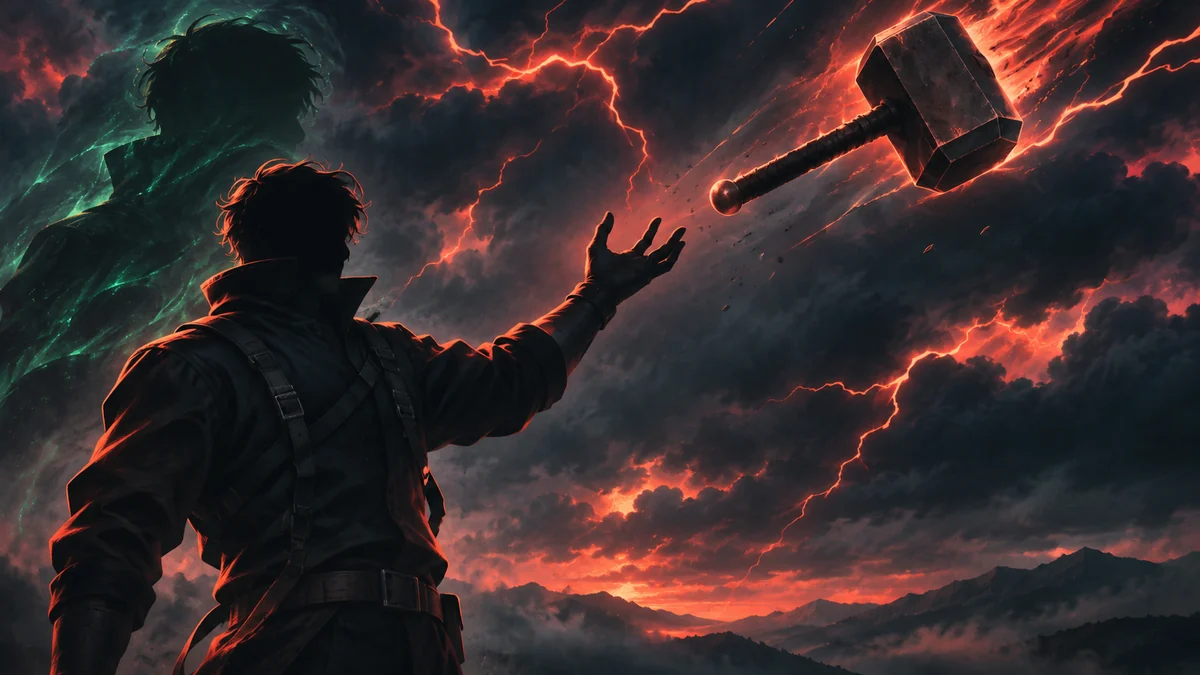
Marvel has spent years teaching MCU fans one dangerous lesson: when something looks suspiciously simple, start looking for the trick. So when Chris Evans suddenly appeared again as a younger Steve Rogers in Avengers: Doomsday footage — long hair, Mjolnir in hand, casually standing beside Thor as though Avengers: Endgame never gave him one of the franchise’s most definitive farewells — theories were inevitable. And one has become especially irresistible: what if that isn’t Steve Rogers at all? What if we’re looking at Loki?
It’s the kind of theory that feels wonderfully Marvel. Loki can change his appearance. Doomsday is playing with multiple universes, returning characters and realities colliding. The latest footage even contains another shapeshifter in Mystique.
Unfortunately for conspiracy-loving fans like us, the actual evidence currently points in a much simpler direction. Marvel appears to be showing us Steve Rogers. That doesn’t make his comeback any less mysterious.
The new footage makes Steve’s return impossible to ignore
The newest round of speculation exploded after Marvel released a short Avengers: Doomsday TV spot in late October. As ComicBook.com reported, the footage opens with Evans’ long-haired Steve telling Thor, “Let’s go,” before summoning Mjolnir into his hand. That’s already enough to send an MCU fan’s brain in about twelve different directions.
Later, Steve holds the hammer up while talking to Thor and jokingly asks whether seeing him use it still bothers him. Thor’s wonderfully petty response is essentially yes. It’s a tiny interaction, but it feels very deliberately built around the relationship these two characters already have. That matters.
This isn’t somebody merely looking like Steve from across a battlefield. The scene plays like Marvel wants us to remember Steve and Thor’s history together — especially one of the loudest crowd-pleasing moments in MCU history. Steve Rogers can wield Mjolnir. We already watched him do it.
Mjolnir is actually a problem for the Loki theory
If Marvel wanted us suspicious of Steve’s ability to summon Mjolnir, there would be an obvious issue: Avengers: Endgame already answered that question. During the final battle against Thanos, Steve proved worthy of wielding Mjolnir, finally paying off the famous moment in Avengers: Age of Ultron when the hammer appeared to move slightly beneath his hand. So Steve calling Mjolnir in Doomsday isn’t evidence that something supernatural is pretending to be him. It’s evidence consistent with Steve being Steve.
Could Loki create an illusion of himself holding the hammer? Possibly. Could Marvel invent some magical explanation allowing him to fake the entire interaction? Absolutely.
But once a theory requires us to invent abilities or plot mechanics that the footage itself never establishes, we’re no longer following evidence. We’re reverse-engineering evidence to fit the theory. And that’s where the Loki idea currently struggles.
Why fans think Steve could secretly be Loki
Because Steve Rogers being here at all is weird. That’s the part of the theory that genuinely works. Endgame didn’t leave Steve trapped in another dimension or missing in space. It gave him closure.
Steve returned the Infinity Stones, apparently chose to remain in the past and live the life he never got to have with Peggy Carter, then reappeared as an old man before passing the Captain America shield to Sam Wilson. It was about as close to “the end” as a superhero franchise ever gets. Now a younger Steve is standing inside another Avengers movie.
Marvel has not yet publicly explained how. That unexplained gap creates perfect conditions for theories, and Loki is an obvious candidate because deception has always been part of his toolkit. Tom Hiddleston’s character can change appearances, and after Loki Season 2, he is more deeply entangled with the state of the multiverse than almost anyone in the MCU.
The series ended with Loki taking responsibility for the branching timelines, transforming his role in the MCU from mischievous trickster into something much bigger. So yes, if Marvel wanted Loki to appear disguised as Steve, the character’s history gives the writers somewhere to start. The missing piece is evidence that this is actually happening. Right now, there isn’t any.
Mystique’s transformation makes the theory more fun — not more likely
The same Doomsday spot contains one detail that theory hunters immediately seized on. Mystique briefly appears to transform into Yelena Belova. That is fascinating because it places visual deception directly inside Marvel’s marketing for the movie. According to ComicBook.com’s breakdown, the transformation is extremely quick, but it’s there. And once a trailer shows one character impersonating another, fans understandably start questioning everybody.
Except Mystique shapeshifting tells us something about Mystique. It doesn’t tell us Loki is pretending to be Steve. If anything, Marvel openly showing one transformation may actually demonstrate the distinction. When the studio wants us to understand that a character is shapeshifting, it can simply show the transformation.
Steve’s scenes have been presented differently. We see Chris Evans behaving like Steve, interacting with Thor like Steve and using a weapon Steve has already proved worthy of wielding. That’s why the straightforward explanation still wins for us.
The Captain America joke also treats Steve like the real Steve
Another part of the promotional footage makes the disguise theory even harder to accept at face value. Doomsday now has a hilariously crowded Captain America situation. Sam Wilson is the current Captain America. Steve Rogers is back. John Walker was briefly given the title before becoming U.S. Agent.
According to 9to5Marvel’s breakdown of the TV spot, Scott Lang gets caught in the confusion over who “Cap” refers to, while Walker brings up his own brief history with the mantle. The scene works because everybody understands who Steve is. Marvel appears to be using his return to create awkwardness around a title that has moved on without him. That could become much more important than the Loki theory.
If Steve Rogers genuinely returns, what does that mean for Sam Wilson? Not necessarily anything bad. Sam doesn’t need Steve to disappear for his Captain America identity to remain legitimate. Steve himself chose Sam. But putting them together again gives Marvel a fascinating emotional dynamic that simply wouldn’t exist if “Steve” were revealed as Loki wearing his face.
The real mystery isn’t who Steve is — it’s where he came from
This is where we think the conversation should move. Instead of asking, “Is Steve secretly Loki?” the much more interesting question is: Which Steve Rogers are we looking at? Marvel now has plenty of ways to bring Chris Evans back without undoing Endgame.
Maybe something happened to the Steve who lived with Peggy. Maybe Doomsday reaches into another point in his timeline. Maybe this is a Steve from another universe. Maybe Doctor Doom’s actions have destabilized reality badly enough that characters who should never occupy the same moment suddenly can.
Those are possibilities, not confirmed explanations, and Marvel hasn’t provided enough information to choose among them. But Doomsday doesn’t exactly need to invent a Loki impersonation to justify an impossible comeback. The entire movie exists in the final stretch of a saga built around broken timelines, alternate realities and characters crossing universes. Steve’s return can be genuine and still be deeply strange.
Doctor Doom gives Steve a pretty good reason to pick up the hammer again
The TV spot also places Steve’s comeback against the much larger threat facing everyone. Thor warns that Doom will tear the world apart, while the promotion teases multiple groups being forced together against him. And that’s probably the biggest reason we’re inclined to believe Marvel is actually bringing Steve Rogers back.
Imagine the situation from a storytelling perspective. The MCU is approaching a crisis so enormous that Avengers, Fantastic Four characters, mutants and heroes from radically different corners of Marvel’s universe are colliding. If there were ever a story where Marvel could justify putting Steve Rogers back onto the battlefield one more time, this is it.
Chris Evans beside Chris Hemsworth, with Steve calling Mjolnir into his hand again, isn’t merely nostalgia. It’s Marvel reminding audiences what kind of hero Steve was when reality reached its breaking point before. The interesting part will be whether Doomsday can make that comeback feel necessary rather than simply familiar.
We’re betting on Steve — but Marvel could still make us regret saying that
The Loki theory is exactly the kind of fan theory we love because it takes one unexplained detail and tries to turn it into a giant MCU twist. And technically, Marvel hasn’t given us enough information to declare it impossible. But based strictly on what the studio has shown, there is currently no compelling reason to believe Loki is hiding underneath Steve Rogers’ face. Steve using Mjolnir isn’t suspicious. He’s worthy.
Thor recognising him isn’t suspicious. They’re old friends. Scott Lang treating him as Steve isn’t suspicious. That’s who Marvel is presenting him as.
The mystery is his age and his return after Endgame, and the multiverse gives Doomsday countless ways to explain both without Loki needing another disguise. So our money is on the guy holding Mjolnir actually being Steve Rogers. Which leaves Marvel with a much bigger question to answer when Avengers: Doomsday arrives in theaters on December 18, 2026: If Steve’s story really ended in Endgame, what happened in the multiverse that was powerful enough to bring Captain America back?