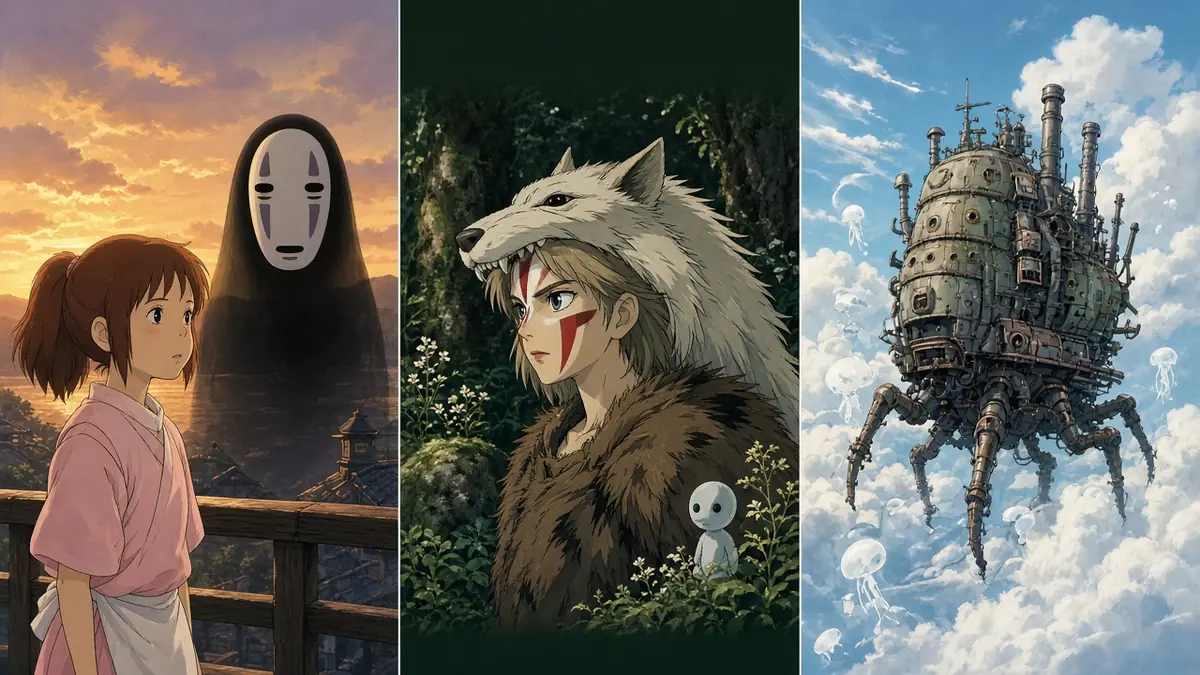
Some animated movies entertain us for two hours. Studio Ghibli movies make us wish we could stay inside their worlds forever. Whether it is a mysterious bathhouse filled with spirits, a magical castle walking across the countryside or a forest protected by ancient gods, these films have a remarkable ability to make the impossible feel familiar. Founded in 1985 by Hayao Miyazaki, Isao Takahata and producer Toshio Suzuki, Studio Ghibli has created some of animation’s most beloved cinematic experiences. The best Studio Ghibli movies combine extraordinary artwork with deeply human stories about childhood, friendship, courage, nature and growing up.
Picking just 10 films from the studio’s extraordinary filmography is no easy task. Miyazaki’s imagination is obviously a major part of its appeal, but Isao Takahata and other filmmakers have also given us stories that feel completely different from the usual fantasy adventure. We have ranked these films based on their storytelling, animation, emotional impact and lasting appeal. There are magical adventures, heartbreaking historical dramas and quiet stories about ordinary people discovering their place in the world.
10. The Wind Rises (2013)
Not every Studio Ghibli adventure needs witches, talking animals or mysterious forest spirits. Directed by Hayao Miyazaki, The Wind Rises tells the fictionalised story of Jiro Horikoshi, an aviation engineer who dreams of designing beautiful aircraft. Inspired by the Italian aircraft designer Giovanni Battista Caproni, Jiro pursues his ambitions during a period when Japan is experiencing enormous political and technological change. Hideaki Anno voices Jiro in the Japanese version, while Miori Takimoto plays Naoko, the woman he falls in love with. Their relationship gives the film an emotional centre that balances its fascination with engineering and flight.
What makes The Wind Rises particularly interesting is its complicated relationship with ambition. Jiro loves aviation, but the aircraft he helps create eventually become instruments of war. Miyazaki does not offer easy answers about the relationship between artistic ambition and its consequences. The film is also one of the studio’s most visually beautiful productions, with its depiction of clouds, aircraft and open landscapes creating an almost dreamlike experience. It received an Academy Award nomination for Best Animated Feature at the 86th Academy Awards. This is an excellent choice for viewers who prefer thoughtful historical storytelling over conventional fantasy.
9. Whisper of the Heart (1995)
Whisper of the Heart is one of those films that makes ordinary life feel extraordinary. Directed by Yoshifumi Kondo, the movie follows Shizuku Tsukishima, a schoolgirl who loves reading and discovers that another student has borrowed almost every book she has taken from the library. Her curiosity leads her towards Seiji Amasawa, a boy who dreams of becoming a violin maker. The Japanese voice cast includes Yoko Honna as Shizuku and Issei Takahashi as Seiji. Their developing friendship becomes the foundation for a story about creativity, ambition and the uncomfortable process of discovering what we actually want from life.
Unlike many Ghibli films, Whisper of the Heart does not rely on enormous fantasy sequences or supernatural creatures. Its magic comes from small details: a quiet neighbourhood, a beautiful antique shop, music playing in the background and the excitement of finding someone who understands your dreams. Shizuku’s determination to write a novel, despite her uncertainty about her abilities, is particularly relatable. The film also features the mysterious Baron, a figurine that would later inspire The Cat Returns. It is a gentle reminder that growing up does not mean abandoning imagination.
8. Ponyo (2008)
Few animated films capture the excitement of childhood quite like Ponyo. Hayao Miyazaki directs this colourful adventure about a young fish-like creature who escapes from the ocean and befriends a five-year-old boy named Sosuke. Their friendship becomes the centre of a magical story involving underwater kingdoms, powerful ocean forces and Ponyo’s desire to become human. Yuria Nara voices Ponyo in the Japanese version, while Hiroki Doi plays Sosuke. The film also features Tomoko Yamaguchi and Kazushige Nagashima as Sosuke’s parents.
The animation is one of the film’s greatest pleasures. Miyazaki uses hand-drawn artwork to make the ocean feel alive, with enormous waves, colourful sea creatures and imaginative underwater sequences that constantly surprise us. Ponyo’s transformation is particularly entertaining because it is driven by the simple excitement of wanting to experience the human world. The film received an Academy Award nomination for Best Animated Feature in 2010, although it lost to Up. Its storytelling is considerably simpler than Princess Mononoke or Spirited Away, but that is part of its charm. Ponyo is the perfect introduction to Ghibli for younger viewers and anyone looking for a cheerful cinematic escape.
7. The Tale of the Princess Kaguya (2013)
Isao Takahata’s The Tale of the Princess Kaguya is one of the most visually distinctive animated films ever made. Based on the Japanese folktale The Tale of the Bamboo Cutter, it follows an old bamboo cutter who discovers a tiny girl inside a glowing bamboo stalk. The child grows at an extraordinary pace and becomes a beautiful young woman, attracting the attention of powerful suitors. Aki Asakura voices Kaguya in the Japanese version, with Kengo Kora playing Sutemaru and Takeo Chii voicing the bamboo cutter. The story gradually reveals that Kaguya’s extraordinary arrival is connected to a world far beyond the countryside where she grows up.
The film’s artwork looks almost like an animated watercolour painting. Takahata deliberately uses loose lines, expressive brushwork and changing visual styles to communicate Kaguya’s emotions. One particularly unforgettable sequence sees her running through the countryside in frustration, with the animation becoming increasingly raw and energetic as her emotions overwhelm her. The film received an Academy Award nomination for Best Animated Feature in 2015. Its final act is deeply heartbreaking, but that sadness gives the story its extraordinary emotional power. Anyone who appreciates animation as an art form should experience this film at least once.
6. Kiki’s Delivery Service (1989)
Imagine being thirteen years old, leaving home for the first time and having to build an entirely new life in a city where you know absolutely nobody. That is the starting point of Hayao Miyazaki’s Kiki’s Delivery Service. The film follows Kiki, a young witch who must spend a year living independently as part of her training. Accompanied by her sarcastic black cat Jiji, she settles in a beautiful coastal town and starts a flying delivery service. Minami Takayama voices Kiki in Japanese, while Rei Sakuma plays Jiji. Their relationship provides plenty of humour as Kiki navigates the challenges of becoming independent.
What makes the film so relatable is its understanding of self-doubt. Kiki initially enjoys flying and helping people, but gradually struggles when her confidence disappears and she loses her ability to communicate with Jiji. Anyone who has experienced creative burnout, a difficult career transition or the pressure of becoming independent can understand her frustration. The beautiful coastal setting and Joe Hisaishi’s music make the entire experience feel wonderfully comforting. Kiki’s Delivery Service is one of Ghibli’s warmest films, and its message about rediscovering confidence feels just as relevant to adults as it does to children.
5. My Neighbor Totoro (1988)
There are very few animated characters as instantly recognisable as Totoro. Directed by Hayao Miyazaki, My Neighbor Totoro follows two young sisters, Satsuki and Mei, who move to the countryside with their father while their mother receives medical treatment in a nearby hospital. Their new home introduces them to mysterious creatures living in the surrounding forests, including the enormous, friendly forest spirit known as Totoro. Noriko Hidaka voices Satsuki, Chika Sakamoto plays Mei and Shigesato Itoi voices their father Tatsuo. The film also introduces the famous Catbus, one of the most imaginative creatures in Ghibli history.
What makes My Neighbor Totoro so special is its ability to find magic in ordinary experiences. Waiting for a bus in the rain, exploring an unfamiliar garden or watching trees move in the wind suddenly become exciting adventures. The film does not need a conventional villain or an elaborate plot twist because its greatest strength lies in the relationship between the sisters and their changing surroundings. Totoro himself represents the comfort and wonder that children can discover when adults are not explaining everything to them. The character became an enduring symbol of Studio Ghibli, and the film remains one of the most comforting animated experiences ever created.
4. Grave of the Fireflies (1988)
Not every Studio Ghibli film leaves us feeling happy, and Grave of the Fireflies is perhaps the clearest example. Directed by Isao Takahata, this devastating historical drama follows two siblings, Seita and Setsuko, struggling to survive in Japan during the final months of World War II. Their mother is killed during an American air raid, and the children are forced to navigate a world where food, shelter and kindness become increasingly difficult to find. Tsutomu Tatsumi voices Seita in the Japanese version, while Ayano Shiraishi plays Setsuko. Their performances make the characters’ relationship feel painfully real.
The film’s most heartbreaking quality is its refusal to turn the siblings into conventional heroes. They are children trying to survive circumstances they cannot understand, and their decisions are shaped by fear, pride and desperation. Takahata’s direction gives the story an intimate quality, allowing small moments of happiness to exist alongside the overwhelming tragedy. The fireflies themselves become a beautiful and painful visual symbol of how brief and fragile life can be. Based on Akiyuki Nosaka’s semi-autobiographical short story, Grave of the Fireflies is an extraordinary anti-war film, although it is emotionally demanding viewing. We would recommend it to anyone who appreciates serious historical cinema, but perhaps not as someone’s first introduction to Ghibli.
3. Howl’s Moving Castle (2004)
A giant mechanical castle wandering across a magical landscape, a mysterious wizard with a complicated personality and a young woman transformed by a curse: Howl’s Moving Castle has everything we love about Studio Ghibli. Directed by Hayao Miyazaki and loosely adapted from Diana Wynne Jones’ novel, the film follows Sophie, a young hat-maker who is transformed into an elderly woman by the Witch of the Waste. She eventually finds refuge inside the moving castle belonging to the powerful wizard Howl. Chieko Baisho voices Sophie, Takuya Kimura plays Howl and Akihiro Miwa voices the Witch of the Waste in the Japanese version.
The film’s central relationship is what makes it particularly memorable. Sophie initially believes that her transformation has taken away her youth and opportunities, but her journey gradually reveals a confidence and strength she never realised she possessed. Howl is equally fascinating, combining extraordinary magical abilities with insecurity and an almost childish fear of losing his appearance. The moving castle itself is a masterpiece of imaginative design, filled with strange mechanisms, magical doors and the wonderfully grumpy fire demon Calcifer. The film received an Academy Award nomination for Best Animated Feature in 2006. Its combination of romance, fantasy and anti-war themes makes it one of the studio’s most rewatchable adventures.
2. Princess Mononoke (1997)
Princess Mononoke is Studio Ghibli at its most ambitious and intense. Hayao Miyazaki directs this epic fantasy about Ashitaka, a young prince who becomes cursed after fighting a corrupted boar god. His search for a cure takes him to a region where industrial development is destroying ancient forests inhabited by powerful animal gods. There he encounters San, a human girl raised by wolves who fiercely protects the forest, and Lady Eboshi, the leader of Iron Town. Yōji Matsuda voices Ashitaka, Yuriko Ishida plays San and Yūko Tanaka voices Lady Eboshi in the Japanese version.
What separates Princess Mononoke from many other fantasy adventures is its refusal to create simple heroes and villains. Lady Eboshi is destroying the forest, but she is also providing shelter and employment to people who have been rejected by society. San protects nature, yet her hatred of humanity makes peaceful coexistence difficult. Ashitaka becomes the emotional centre of this conflict because he wants to understand both sides rather than simply destroy one. The film’s enormous creatures, breathtaking forest sequences and spectacular action make it visually unforgettable, but its environmental themes give the adventure genuine depth. It was also a major commercial success in Japan, becoming the country’s highest-grossing film at the time of its release. For fans who want Ghibli at its grandest and most challenging, this is an essential experience.
1. Spirited Away (2001)
At the top of our ranking is the film that introduced countless international audiences to the extraordinary world of Studio Ghibli. Spirited Away, directed by Hayao Miyazaki, follows ten-year-old Chihiro as she enters a mysterious spirit world after her parents are transformed into pigs. Trapped in a strange bathhouse run by the powerful witch Yubaba, Chihiro must find work, protect her identity and discover a way to rescue her family. Rumi Hiiragi voices Chihiro in Japanese, alongside Miyu Irino as Haku, Mari Natsuki as Yubaba and Bunta Sugawara as Kamaji.
Spirited Away is filled with extraordinary characters and unforgettable moments. The mysterious No-Face, the enormous bathhouse, the strange river spirit and the train journey across the flooded landscape all create an atmosphere that feels completely different from anything else in animation. Yet the story never loses sight of Chihiro’s personal development. She begins as a frightened child who depends on her parents for everything, but gradually becomes resourceful, compassionate and courageous. Her relationship with Haku also adds a beautiful emotional dimension to the adventure.
The film won the Academy Award for Best Animated Feature at the 75th Academy Awards in 2003 and received the Golden Bear at the 2002 Berlin International Film Festival, becoming the first animated film to share that honour. Its international success helped establish Studio Ghibli as a major force in global cinema. What makes Spirited Away our number one choice is the way it combines an imaginative fantasy world with a deeply relatable coming-of-age story. It is a film that children can enjoy for its magical creatures and adults can revisit for its themes of identity, courage and growing up. If someone has never watched a Studio Ghibli movie, this is where we would begin.
Studio Ghibli’s greatest achievement is that its films never feel restricted to one age group or one kind of audience. If you want an unforgettable fantasy adventure, start with Spirited Away or Howl’s Moving Castle; if you prefer thoughtful storytelling, Princess Mononoke and The Tale of the Princess Kaguya deserve your attention, while Totoro and Kiki’s Delivery Service offer the kind of warmth that makes a difficult day feel lighter. Grave of the Fireflies is the choice for viewers ready for a deeply emotional experience. And if these films leave you wanting more animation, our best anime movies of all time and best Pixar movies rankings are excellent places to continue, while our best shonen anime list offers something considerably more action-packed. Whatever you choose, Ghibli’s hand-drawn worlds are always worth returning to.