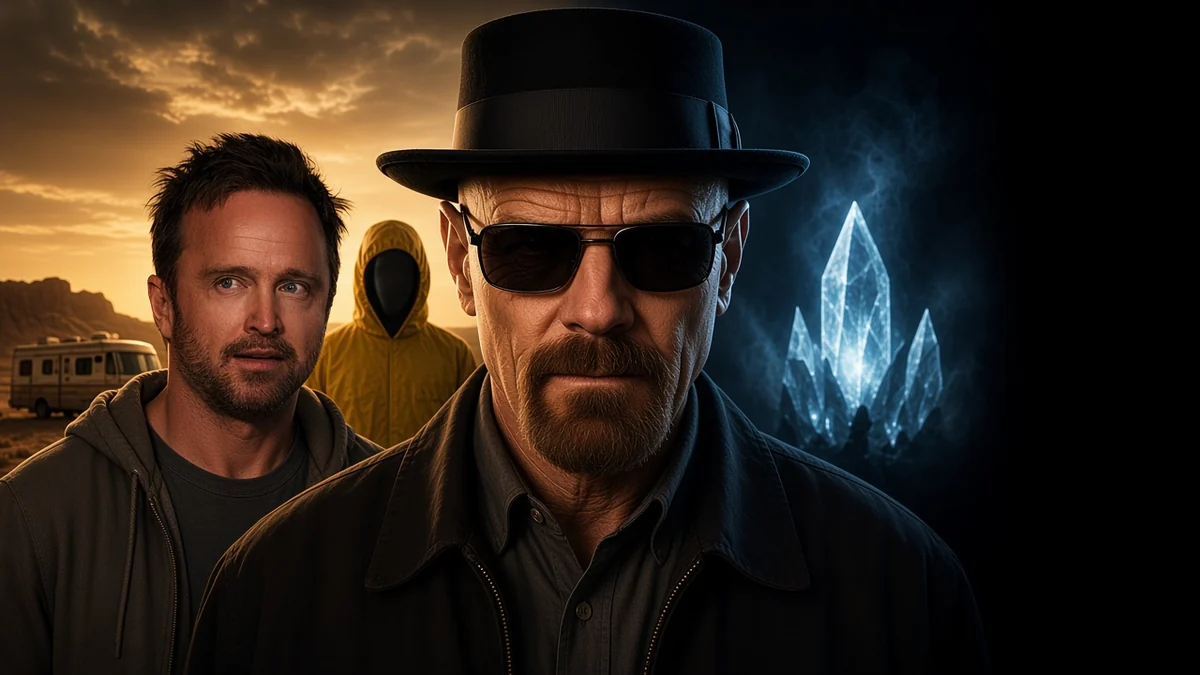
There are great television episodes, and then there are Breaking Bad episodes that make you forget you are watching television. Vince Gilligan’s crime drama gave us five seasons of Walter White’s transformation from an underappreciated chemistry teacher into one of television’s most frightening criminals. Along the way, it delivered unforgettable confrontations, shocking betrayals and character deaths that still hurt years later. The best Breaking Bad episodes are remarkable because they rarely depend on action alone. They make every decision feel dangerous, every silence uncomfortable and every consequence impossible to escape.
Choosing just 10 episodes from a 62-episode series is difficult, especially when seasons three, four and five contain some of the show’s finest storytelling. We have considered character development, writing, direction, emotional impact and the moments that permanently changed the story. From Jesse’s breaking point to Heisenberg’s final reckoning, these are the episodes that remind us why Breaking Bad remains one of the greatest crime dramas ever made.
10. 4 Days Out (Season 2, Episode 9)
Before Walter White became the man who could command an entire criminal empire, he was a chemistry teacher trying to make enough money to secure his family’s future. “4 Days Out”, directed by Michelle MacLaren and originally broadcast on May 3, 2009, takes Walt and Jesse into the desert for an extended meth-cooking session. Their RV breaks down, leaving the unlikely partners stranded with limited supplies and a serious problem. What begins as a relatively straightforward business trip quickly becomes a survival exercise.
What makes this episode special is the relationship between Walt and Jesse. Away from Skyler, the DEA and the constant threat of discovery, we get to see the two characters work together, argue, improvise and occasionally enjoy each other’s company. The chemistry between Bryan Cranston and Aaron Paul carries the episode, while the desert setting creates an unusual sense of isolation. It is also an important reminder that Breaking Bad could be genuinely funny before turning around and delivering something devastating. For fans who love the partnership between Walt and Jesse, this is essential viewing.
9. Half Measures (Season 3, Episode 12)
Mike Ehrmantraut has some of the best dialogue in Breaking Bad, and “Half Measures” gives Jonathan Banks one of his finest moments. Directed by Adam Bernstein and first aired on June 6, 2010, the episode explores Jesse’s growing anger towards the drug dealers responsible for Combo’s death. Walt wants to protect Jesse, but the situation becomes increasingly dangerous as Jesse plans his revenge. Mike, meanwhile, tells Walt a story from his past that explains why compromising with dangerous people can have terrible consequences.
The episode’s final confrontation is where everything changes. When Walt discovers that Jesse is about to be killed, he drives straight into the dealers, runs them over and shoots the surviving man. It is a shocking decision, particularly because Walt has spent so much time trying to maintain control over his criminal activities. His final instruction to Jesse is even more chilling. “Half Measures” is a perfect example of how Breaking Bad builds tension through character decisions rather than relying on elaborate action sequences. It also sets up the devastating events of the following episode, “Full Measure”.
8. One Minute (Season 3, Episode 7)
Hank Schrader spent much of the early series providing comic relief through his loud personality and endless jokes. “One Minute”, directed by Michelle MacLaren and originally broadcast on May 2, 2010, changes that perception completely. After Hank brutally attacks Jesse, his professional life begins falling apart. He loses his badge and faces serious consequences for his actions, while the Salamanca twins are preparing to kill him. A mysterious phone call gives Hank exactly one minute to escape an approaching assassination attempt.
The resulting parking-lot confrontation is among the most suspenseful sequences in the entire series. Hank is badly outnumbered, injured and without his usual police equipment, yet his determination and quick thinking help him survive. Dean Norris delivers an outstanding performance, making us feel every injury and desperate decision. The episode also reveals how dangerous the Salamanca family can be when they have a target. Michelle MacLaren’s direction deserves particular credit here, and her discussion of the sequence in a Directors Guild of America interview offers an interesting look at the show’s approach to action filmmaking.
7. Dead Freight (Season 5, Episode 5)
Walter White’s criminal operation reaches a new level of ambition in “Dead Freight”. Directed by George Mastras and originally aired on August 12, 2012, the episode follows Walt, Jesse and Mike as they attempt to steal a massive quantity of methylamine from a moving freight train. Their plan requires careful timing, technical knowledge and a surprisingly elaborate operation involving an isolated stretch of railway. For a while, everything appears to be working perfectly. The crew has calculated almost every possible complication, and their confidence grows with each passing minute.
Then comes the ending. Just when the operation seems like another successful Heisenberg victory, a young boy on a dirt bike appears near the tracks. Todd shoots him without hesitation, leaving the others horrified. It is one of the most disturbing endings in Breaking Bad because it exposes the difference between Walt’s increasingly casual approach to violence and Jesse’s remaining sense of morality. The episode also establishes Todd as a genuinely frightening addition to the story. The train sequence is exciting, but its final moments are what make “Dead Freight” unforgettable.
6. To’hajiilee (Season 5, Episode 13)
By the time we reach “To’hajiilee”, the relationship between Walter White and Jesse Pinkman has become almost impossible to repair. Directed by Michelle MacLaren and written by George Mastras, the episode originally aired on September 8, 2013. Jesse teams up with Hank and Gomez to bring Walt down, using the location of the buried money as part of their plan. Walt initially believes he can manipulate the situation, but his carefully constructed criminal identity is beginning to collapse around him.
The desert confrontation is particularly effective because it brings together several storylines that have been developing for years. Hank finally gets close to proving that his brother-in-law is Heisenberg, while Jesse finds himself working with the very authorities he once feared. The arrival of Uncle Jack and his gang turns the situation into a terrifying standoff. The episode ends on a cliffhanger that leaves the audience desperate to know what happens next. It is one of those rare episodes where every character seems to be making a decision that could permanently change their life.
5. Crawl Space (Season 4, Episode 11)
Walter White has always believed that he can find a solution to almost any problem. “Crawl Space”, directed by Scott Winant and originally aired on September 25, 2011, puts that belief to its most terrifying test. Gus Fring has become increasingly suspicious of Walt, Jesse is being pulled further into Gus’s operation, and Skyler’s efforts to solve Ted Beneke’s financial problems have created another dangerous complication. Walt discovers that the money he needs to escape is no longer available, leaving him trapped between Gus and the consequences of his own decisions.
The episode’s final sequence is extraordinary. Walt desperately crawls beneath his house searching for the money, only to discover that Skyler has used it to pay Ted’s debts. His reaction gradually turns from disbelief into uncontrollable laughter, while Marie’s phone call to Skyler adds another layer of tension. The camera slowly pulls away as Walt loses control, and the sound design makes the scene even more disturbing. Bryan Cranston is magnificent here. It is one of the clearest examples of Heisenberg discovering that even his intelligence cannot protect him from everything he has created.
4. Face Off (Season 4, Episode 13)
Gustavo Fring is arguably the most calculating villain in Breaking Bad, which makes “Face Off” such a satisfying confrontation. Directed by Vince Gilligan and originally broadcast on October 9, 2011, the fourth-season finale brings Walt’s conflict with Gus to its breaking point. After months of manipulation, threats and failed attempts to eliminate each other, Walt devises an extraordinary plan involving Hector Salamanca. Jesse also finds himself caught between his loyalty to Walt and his growing connection with Gus’s operation.
The nursing-home explosion is one of the show’s most memorable sequences. Gus appears to survive the blast, only for the camera to reveal the horrifying damage to his face. Giancarlo Esposito’s performance throughout the series makes the moment especially powerful because Gus has always seemed almost impossible to frighten. His death brings an end to one of television’s most memorable villain arcs, while Walt’s subsequent actions reveal just how far he has travelled from the man we met in the pilot. “Face Off” also received a Primetime Emmy nomination for Outstanding Directing for a Drama Series in 2012. It is a brilliantly constructed season finale.
3. Felina (Season 5, Episode 16)
How do you end a series as complicated as Breaking Bad? Vince Gilligan’s answer was “Felina”, the September 29, 2013 finale that brings Walter White’s story to its conclusion. After spending months hiding in New Hampshire, Walt returns to Albuquerque to settle unfinished business. He makes arrangements for his money to reach his son, confronts Gretchen and Elliott Schwartz, visits Skyler one final time and prepares to deal with Uncle Jack’s gang. Every scene feels like a piece of a much larger plan coming together.
The finale works because it gives Walt an opportunity to acknowledge the truth about his motivations. His confession to Skyler that he pursued the drug business for himself is one of the most important moments in the entire series. The final confrontation with Jack’s gang is equally satisfying, particularly because Walt’s ingenious machine-gun mechanism demonstrates that his scientific mind has remained intact. Jesse’s escape provides the emotional release that his character deserves, while Walt’s final moments in the meth lab bring the story full circle. The episode received a Primetime Emmy nomination for Outstanding Writing for a Drama Series in 2014. We could hardly imagine a more fitting farewell.
2. Granite State (Season 5, Episode 15)
Many crime dramas would end with their protagonist losing everything in a spectacular shootout. Breaking Bad takes a different approach in “Granite State”, directed by Peter Gould and first aired on September 22, 2013. Following the disastrous events of “Ozymandias”, Walt is forced to disappear with the help of Ed Galbraith, the vacuum-shop owner who provides new identities for criminals. He ends up isolated in a remote New Hampshire cabin, separated from his family, his money and almost every connection he once had. The man who once controlled an entire drug operation now struggles to get through ordinary days.
The episode is especially effective because it removes the distractions that previously surrounded Walt. There are no elaborate business arrangements, no criminal partners and no empire to manage. There is simply a dying man confronting the consequences of his choices. Jesse’s captivity under Jack’s gang adds another disturbing dimension, while Walt’s brief attempt to surrender himself after learning about his son’s rejection reveals how desperately he still wants to control his family’s perception of him. The final decision to return to Albuquerque sets up the finale beautifully. It is a quieter episode than many on this list, but its emotional weight is enormous.
1. Ozymandias (Season 5, Episode 14)
There is a reason “Ozymandias” is so frequently mentioned whenever people discuss the greatest television episodes ever made. Directed by Rian Johnson and written by Moira Walley-Beckett, the episode originally aired on September 15, 2013. Picking up immediately after the devastating events of “To’hajiilee”, it delivers the consequences of Walt’s criminal life in the most brutal way possible. Hank is dead, Jesse has been captured, and Walt’s carefully maintained image of a family man is finally destroyed. There is no clever scheme capable of putting everything back together.
Bryan Cranston delivers one of his finest performances as Walt desperately tries to hold on to whatever remains of his family. His confrontation with Skyler becomes physically violent, while his attempt to take Holly away leads to one of the most heartbreaking sequences in the series. The moment Walt finally tells Jesse the truth about Jane is equally devastating. Every revelation feels earned because the show has spent years building these relationships and allowing their damage to accumulate. The title itself references Percy Bysshe Shelley’s poem about the collapse of a once-great ruler’s empire, making it an especially fitting choice for Heisenberg’s downfall.
“Ozymandias” won Moira Walley-Beckett the Primetime Emmy Award for Outstanding Writing for a Drama Series in 2014, and its reputation has only grown since its original broadcast. It is a devastating hour of television that manages to make the consequences of Walt’s decisions feel more frightening than any criminal rival ever could. The episode also captures what made Breaking Bad so exceptional: its willingness to let characters suffer the full consequences of their actions. For viewers who enjoy morally complicated protagonists, our greatest TV antiheroes of all time, ranked, explores more characters who blur the line between hero and villain. Fans of equally meticulous character-driven television should also explore our best Mad Men episodes ranking and our list of the best Stranger Things characters. But when it comes to a single hour that captures the brilliance, tragedy and sheer brutality of Breaking Bad, nothing beats watching Walter White’s empire finally fall apart.