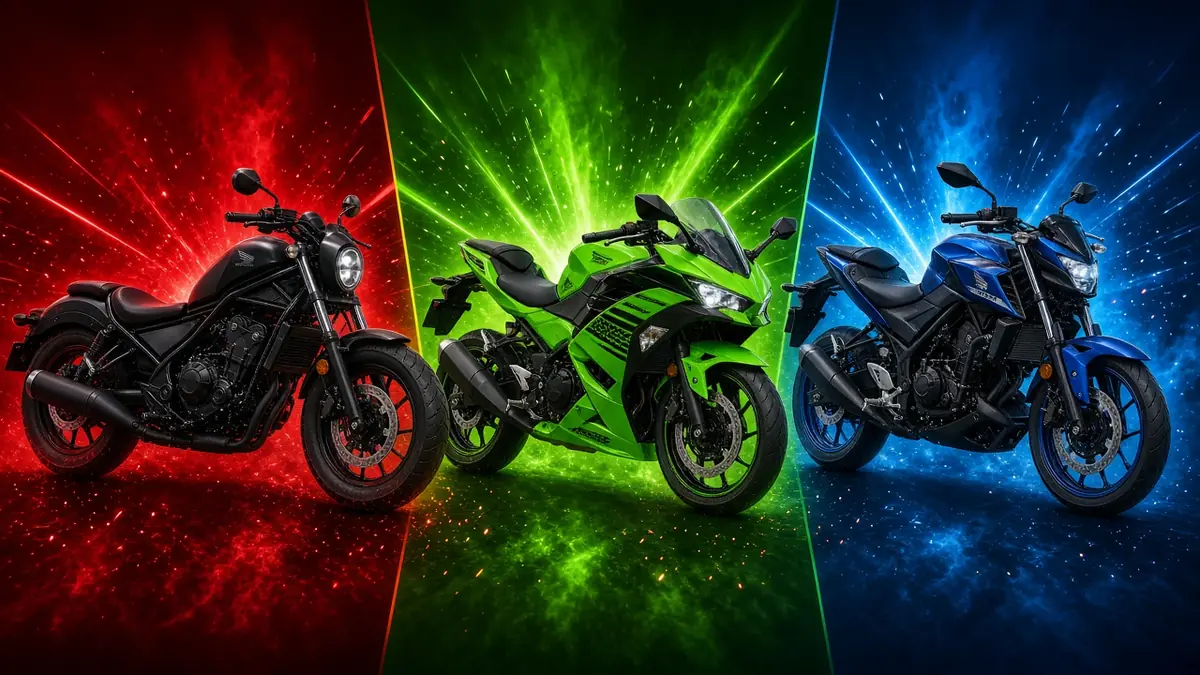
The best beginner motorcycles of 2026 include the Honda Rebel 500, Kawasaki Ninja 500, Yamaha MT-03, and Triumph Speed 400. These bikes combine manageable power with accessible ergonomics and modern safety features. Our top pick is the Rebel 500, thanks to its exceptionally low seat, predictable twin-cylinder engine, and suitability for everyday riding.
How we ranked the best beginner motorcycles of 2026
Choosing a first motorcycle involves more than comparing engine sizes or horsepower figures. A lightweight motorcycle with predictable throttle response can be easier to learn on than a heavier machine with similar power. Seat height, braking assistance, riding position, and operating costs also influence how comfortable a new rider feels.
For this ranking, we prioritized manageable performance, ease of low-speed handling, ABS availability, affordability, and versatility. We compared 2026 manufacturer specifications and US starting prices, while considering the different needs of shorter riders, commuters, and aspiring sportbike owners. Prices are approximate US manufacturer suggested retail prices before destination charges, taxes, registration, and dealer fees; international pricing and specifications vary.
10. Suzuki SV650 ABS (2026)
The Suzuki SV650 has earned a long-standing reputation as an accessible middleweight roadster, but its 645cc V-twin places it at the more demanding end of this ranking. The 2026 SV650 ABS has a 30.9-inch (785 mm) seat height and weighs approximately 437 pounds (198 kg) ready to ride. Its US starting MSRP is $8,149, making it one of the more expensive motorcycles here.
Suzuki’s Low RPM Assist system helps maintain engine speed during takeoffs and slow maneuvering, reducing the likelihood of stalling. The bike also features ABS and a relatively narrow chassis that helps riders reach the ground. However, its stronger acceleration and greater weight mean we would place it below smaller motorcycles for someone with absolutely no riding experience.
The SV650 makes more sense for a beginner who has completed formal training and wants a motorcycle suitable for several years of development. Its comfortable roadster layout supports commuting and longer rides, but careful throttle control remains essential. In markets with A2 licensing restrictions, buyers should investigate the availability of an appropriately restricted version.
9. CFMOTO 450SS (2026)
The CFMOTO 450SS, known as the 450SR in several international markets, provides a fully faired sportbike experience without entering supersport territory. Its 449cc parallel-twin engine uses a 270-degree crankshaft arrangement, giving it a distinctive exhaust character. The motorcycle has a 31.3-inch (795 mm) seat height, with US pricing starting around $5,699.
The 450SS offers a six-speed transmission, slipper clutch, TFT instrumentation, and ABS. Its sport-oriented bodywork will appeal to riders who want a machine that resembles larger racing-inspired motorcycles. However, the riding position and relatively responsive engine demand more care than the relaxed layout of a traditional commuter.
It is particularly relevant for beginners interested in progressing toward sport riding. We would recommend sitting on the motorcycle before purchasing because reach to the handlebars and footpeg placement matter as much as the published seat height. Equipment and braking components can also differ between regional versions.
8. KTM 390 Duke (2026)
The KTM 390 Duke is one of the most technically equipped motorcycles in the beginner-friendly category. Its 399cc liquid-cooled single-cylinder engine delivers approximately 45 PS in international specifications, while the 2026 US model has a listed starting price of $5,499. The Duke combines compact dimensions with a responsive engine and upright streetfighter ergonomics.
Its electronics include selectable riding modes, cornering ABS, and a five-inch TFT instrument display. Adjustable suspension adds flexibility for riders who want to tailor the motorcycle to their weight and preferences. These features distinguish the KTM from simpler machines, although new riders will still need time to become familiar with the controls.
The 390 Duke’s relatively tall riding position may be less reassuring for shorter beginners than the Rebel 500 or Kawasaki Eliminator. It also has a sharper, sportier character than some lower-powered alternatives. For riders who prefer quick steering and modern electronic assistance, it remains a strong candidate.
7. Royal Enfield Hunter 350 (2026)
The Royal Enfield Hunter 350 approaches beginner motorcycling with a simpler formula. Its 349cc air-and-oil-cooled single-cylinder engine produces approximately 20 horsepower, emphasizing accessible low-speed performance rather than high-speed acceleration. The motorcycle has a 31.1-inch (790 mm) seat height, and the 2026 US model starts at approximately $4,299.
Its retro-inspired design combines an upright seating position with 17-inch wheels and a compact roadster chassis. Dual-channel ABS helps manage braking, while the five-speed transmission keeps the mechanical package relatively straightforward. The modest engine output makes the Hunter particularly suited to urban streets and moderate-speed roads.
Its main limitation is highway performance, especially when carrying a passenger or climbing steep gradients. The Hunter is also heavier than some motorcycles with significantly more power. For beginners who expect most of their riding to involve city commutes and shorter journeys, those compromises may be acceptable.
6. Kawasaki Eliminator (2026)
The 2026 Kawasaki Eliminator combines a low cruiser-style seating position with a 451cc parallel-twin engine. Its 28.9-inch (735 mm) seat height is among the lowest on this list, making it worth considering for riders concerned about reaching the ground. US prices start at $6,499 without ABS and $6,799 for the ABS version.
Unlike traditional cruisers built around larger engines, the Eliminator uses a relatively compact powertrain with smooth acceleration. Its relaxed riding position and low seat can make stationary balancing and routine stops less intimidating. The engine also provides considerably more highway capability than a typical 350cc single-cylinder cruiser.
We would prioritize the ABS-equipped version for a new rider. Its lower seat is helpful, but buyers should also examine handlebar reach and footpeg positioning during a test sit. The Eliminator is an alternative to the Honda Rebel 500 for riders who want a low cruiser with a slightly different ergonomic layout.
5. Triumph Speed 400 (2026)
The Triumph Speed 400 offers classic British roadster styling around a modern 398cc liquid-cooled single-cylinder engine. It produces approximately 39.5 horsepower and has a 31.1-inch (790 mm) seat height. The motorcycle weighs around 375 pounds (170 kg) ready to ride, with US pricing starting at approximately $5,495.
Standard equipment includes ride-by-wire throttle control, switchable traction control, ABS, and a slip-and-assist clutch. The clutch helps reduce lever effort, while its upright riding position suits routine commuting. These features make the Speed 400 accessible without requiring buyers to move into the heavier middleweight category.
Its engine has more performance than the Royal Enfield Hunter 350, but remains within a capacity class that many new riders consider manageable. The Speed 400 is particularly attractive to those who want traditional styling without giving up contemporary electronics. Buyers should still confirm licensing eligibility and seat comfort in their own market.
4. Honda CB300R (2026)
For riders concerned about motorcycle weight, the Honda CB300R deserves serious attention. Its 286cc liquid-cooled single-cylinder engine sits in a motorcycle weighing just 316 pounds (approximately 143 kg) with a full tank of fuel. The seat measures 31.6 inches (803 mm), and the 2026 model starts at $4,499 in the United States.
The relatively low weight makes the CB300R easier to maneuver through parking spaces and during slow-speed exercises than many larger motorcycles. Honda includes ABS as standard, alongside a six-speed transmission and upright handlebars. Its narrow construction also helps compensate for a seat that is taller than those of several cruisers.
Honda reduced the CB300R’s US MSRP for 2026 without changing its basic mechanical package. The motorcycle offers enough performance for city commuting and some highway use, although prolonged high-speed travel may be less comfortable than on a larger twin-cylinder machine. For smaller or lighter riders, its manageable mass is a considerable advantage.
3. Yamaha MT-03 (2026)
The Yamaha MT-03 combines approachable dimensions with a 321cc liquid-cooled parallel-twin engine. Its 30.7-inch (780 mm) seat height is relatively accessible for a naked sport motorcycle, while its wet weight is approximately 373 pounds (169 kg). The 2026 US model carries a starting MSRP of $4,999.
Yamaha equips the MT-03 with an assist-and-slipper clutch, an inverted front fork, and upright handlebars. The 2026 version also offers smartphone connectivity through Yamaha’s Y-Connect system. Its twin-cylinder engine provides smooth low-speed operation while retaining enough performance for riders developing their confidence on faster roads.
We rank the MT-03 highly because it avoids the extreme riding posture of a fully faired sportbike. Its compact dimensions are useful in city traffic, and the relatively modest engine capacity keeps its performance accessible. For someone who wants a versatile first naked motorcycle, it is among the strongest choices available.
2. Kawasaki Ninja 500 (2026)
The Kawasaki Ninja 500 is our highest-ranked beginner sportbike for 2026. Its 451cc parallel-twin engine offers stronger acceleration than many smaller entry-level motorcycles, while the chassis remains relatively light. The ABS version has a 30.9-inch (785 mm) seat height and weighs approximately 377 pounds (171 kg), with US prices starting at $5,399 for the non-ABS model and $5,799 with ABS.
Despite its aggressive appearance, the Ninja 500 uses a more approachable riding position than dedicated supersport motorcycles. Kawasaki also includes an assist-and-slipper clutch to reduce clutch effort and help manage aggressive downshifts. Its fairing provides additional wind protection compared with an equivalent naked motorcycle.
For beginners interested in sport riding, the Ninja 500 offers enough capability to remain useful as skills develop. However, its acceleration requires restraint, especially during the first months of riding. We would choose the ABS configuration and prioritize a professional training course before attempting demanding roads.
1. Honda Rebel 500 (2026)
The Honda Rebel 500 takes our top position because it combines accessible ergonomics with predictable performance. Its 471cc liquid-cooled parallel-twin engine provides smooth acceleration, while the exceptionally low 27.2-inch (690 mm) seat height helps riders establish stable footing at stops. The 2026 model weighs 414 pounds (approximately 188 kg) ready to ride and starts at $6,799 in the United States.
Honda equips every 2026 Rebel 500 trim with ABS and a six-speed transmission featuring a slipper clutch. Its narrow design makes the motorcycle easier to straddle, even for riders who might struggle with taller roadsters. The upright cruiser-oriented seating position also avoids the forward-leaning posture associated with more aggressive sport motorcycles.
The Rebel is heavier than the Yamaha MT-03 and Honda CB300R, so beginners should still practice low-speed control and parking maneuvers. Nevertheless, its combination of low seat height, manageable power, and highway capability makes it a strong all-round first motorcycle. Riders who prioritize confidence at a standstill over sporty styling may find it particularly suitable.
Which beginner motorcycle should you choose?
There is no universally perfect first motorcycle because physical fit and riding requirements differ. A shorter rider may prioritize a low seat, while someone commuting through traffic may place more value on low weight. The following choices summarize the strengths of the leading models.
| Rider priority | Recommended motorcycle |
|---|---|
| Best all-round beginner cruiser | Honda Rebel 500 |
| Best beginner sportbike | Kawasaki Ninja 500 |
| Best lightweight motorcycle | Honda CB300R |
| Best affordable naked bike | Yamaha MT-03 |
| Best retro-style roadster | Triumph Speed 400 |
| Best low-seat alternative | Kawasaki Eliminator |
| Best relaxed urban roadster | Royal Enfield Hunter 350 |
Before purchasing, account for protective riding equipment, insurance, registration, servicing, and rider training. In many countries, motorcycle licensing also depends on age, engine capacity, or power output. A motorcycle that fits your license and allows comfortable control at walking speed is generally a better starting point than one chosen solely for its advertised performance.
Frequently asked questions
What is the best motorcycle for a complete beginner in 2026?
The Honda Rebel 500 is our top overall choice because of its low 27.2-inch seat and manageable twin-cylinder performance. However, the Honda CB300R may be easier to maneuver for riders who prioritize low weight. Both are worth comparing during a dealership visit before committing to a purchase.
Is a 500cc motorcycle too powerful for a beginner?
Not necessarily. Engine displacement alone does not determine how demanding a motorcycle will be, because power delivery, weight, and throttle response also matter. A moderate-output 500cc twin can be approachable with proper training, while high-performance motorcycles of similar capacity may be less forgiving.
Which beginner motorcycle is best for shorter riders?
The Honda Rebel 500 has the lowest seat among our ranked choices at 27.2 inches (690 mm). The Kawasaki Eliminator follows at 28.9 inches (735 mm). However, seat width, suspension compression, and rider inseam affect whether both feet can comfortably reach the ground.
How much should a beginner spend on a motorcycle?
Several new motorcycles in this ranking have US starting prices between approximately $4,300 and $5,800, although some cost considerably more. The final purchase price can increase after taxes, destination charges, registration, insurance, and accessories. Beginners should reserve part of their budget for a properly fitted helmet, protective clothing, and professional instruction.
Should a beginner buy a motorcycle with ABS?
ABS is strongly worth prioritizing because it helps prevent wheel lockup during braking. It can be particularly valuable when a rider encounters unexpected hazards or slippery road surfaces. ABS does not replace proper braking technique, but it provides an additional safety measure that benefits both new and experienced riders.
The best beginner motorcycles of 2026 cover several riding styles, from the lightweight Honda CB300R and sporty Kawasaki Ninja 500 to the low-seat Honda Rebel 500. Each offers a different balance of weight, performance, comfort, and price. If you were buying your very first motorcycle in 2026, would you choose the Rebel 500’s accessible cruiser design or the Ninja 500’s sportbike performance?