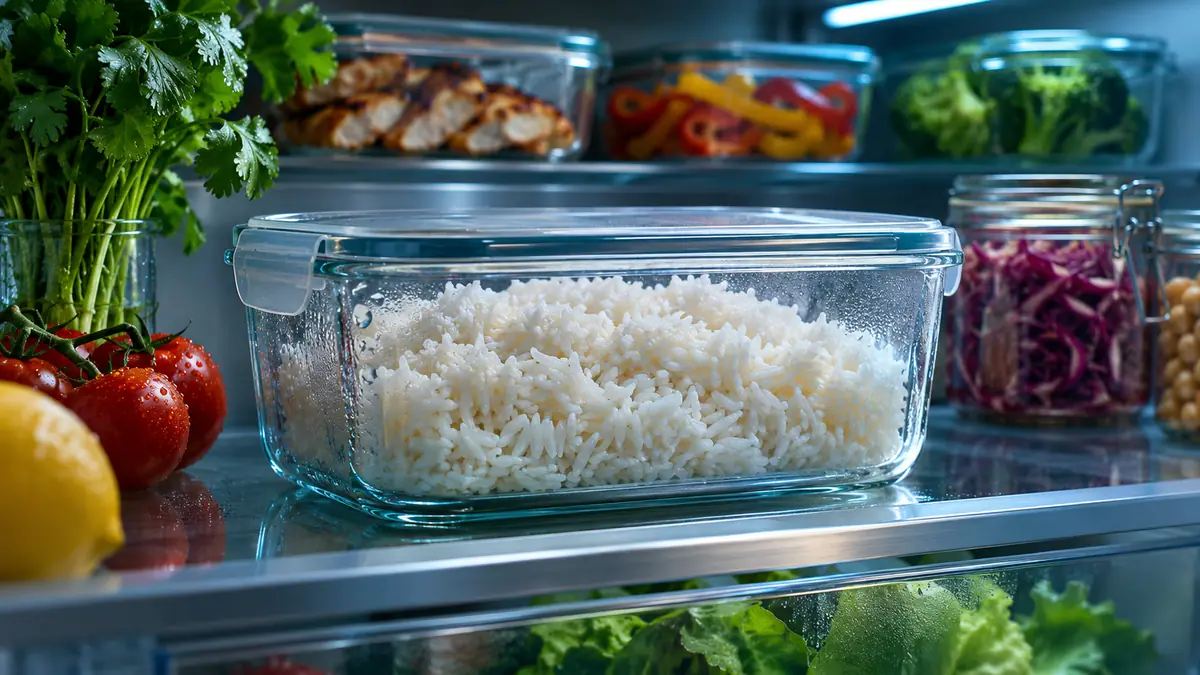
Cooked rice generally lasts 3 to 4 days in the fridge under US food-safety guidance, provided it was refrigerated promptly and kept at 40°F (4°C) or below. However, the UK’s Food Standards Agency recommends eating refrigerated rice within 24 hours. Rice left at room temperature for too long should be discarded, even if it smells normal.
How long can you safely keep cooked rice in the refrigerator?
The United States Department of Agriculture and FoodSafety.gov recommend consuming properly refrigerated cooked leftovers within 3 to 4 days. Their guidance explicitly includes cooked rice, which should be placed in the refrigerator within two hours of cooking or serving. After four days, the recommended storage period has passed, even if the rice appears perfectly normal.
There is an important difference between international food-safety recommendations. The UK’s Food Standards Agency advises cooling cooked rice quickly, ideally within one hour, and keeping it refrigerated for no more than 24 hours before eating or reheating. That is stricter than the US recommendation, so travelers and households should be aware that the two authorities do not use the same storage limit.
| Storage condition | Recommended action |
|---|---|
| Refrigerated at 40°F (4°C) or below | Use within 3–4 days under US guidance |
| Refrigerated under UK FSA guidance | Consume within 24 hours |
| Left at room temperature | Discard after more than 2 hours |
| Exposed to temperatures above 90°F (32°C) | Discard after more than 1 hour |
| Frozen promptly at 0°F (-18°C) or below | Suitable for longer storage |
Why can leftover rice cause food poisoning?
Cooked rice can become unsafe because uncooked rice may contain spores of Bacillus cereus, a bacterium associated with foodborne illness. These spores can survive ordinary cooking temperatures. When cooked rice remains at unsuitable temperatures, surviving spores may germinate, allowing bacteria to multiply and potentially produce harmful toxins.
The US Food and Drug Administration identifies cereulide as a toxin produced by certain strains of Bacillus cereus. It is unusually resistant to heat, acid and digestive enzymes. This means reheating rice that was stored incorrectly cannot reliably eliminate every food-safety risk, even if the rice becomes extremely hot.
Food poisoning associated with Bacillus cereus can produce different symptoms. The Centers for Disease Control and Prevention lists an incubation period of 1 to 6 hours for its vomiting-toxin form and 6 to 24 hours for its diarrheal-toxin form. Vomiting is characteristic of the first, while diarrhea and abdominal cramps are common with the second.
How long can cooked rice sit out at room temperature?
FoodSafety.gov recommends discarding cooked rice that has remained at room temperature for more than two hours. When the surrounding temperature exceeds 90°F (32°C), that window falls to one hour. These limits apply to perishable leftovers generally, and the agency specifically identifies cooked rice among foods that should be discarded after excessive time without refrigeration.
Leaving rice in a switched-off rice cooker or on a kitchen counter to cool overnight is therefore unsafe. Refrigeration slows bacterial growth, but it cannot reverse improper storage that has already allowed toxins to develop. If rice has exceeded the recommended unrefrigerated time, reheating it is not a reliable solution.
What is the safest way to store leftover rice?
Proper storage begins immediately after cooking, rather than when the rice has completely cooled on the counter. The USDA recommends dividing leftovers into smaller portions and using shallow containers to help food cool quickly and evenly. The FDA also confirms that placing hot food directly into the refrigerator does not damage the appliance.
- Divide freshly cooked rice into smaller portions rather than leaving it in one large pot.
- Transfer the portions into clean, shallow food-storage containers.
- Refrigerate promptly, following the applicable one-hour or two-hour guidance.
- Keep the refrigerator at 40°F (4°C) or below.
- Cover the containers and record the preparation date so the storage period is easy to track.
A refrigerator thermometer can help confirm that the appliance is maintaining the correct temperature. The FDA recommends 40°F (4°C) or below for refrigerators and 0°F (-18°C) or below for freezers. Storage time alone is insufficient if the refrigerator has been operating above its recommended temperature.
Can you safely reheat cooked rice?
Yes, cooked rice can be reheated when it has been cooled and stored safely. USDA guidance recommends heating leftovers to an internal temperature of at least 165°F (74°C). The UK’s Food Standards Agency advises reheating rice until it is steaming hot throughout and recommends reheating rice no more than once.
Microwaves can leave unevenly heated areas in food, so the USDA recommends covering leftovers and stirring or rotating them during reheating. Allow the food to stand briefly afterward, then use a food thermometer to confirm that it has reached the required temperature throughout. Reheat only the portion you intend to eat to reduce repeated cooling and warming.
The USDA does not recommend using slow cookers, steam tables or chafing dishes to reheat cold leftovers. These methods can leave food too long between 40°F and 140°F (approximately 4°C to 60°C), the temperature range in which many bacteria multiply rapidly. Once rice has been improperly stored, heating it to 165°F does not guarantee that existing heat-resistant toxins have been destroyed.
Can you tell if cooked rice has gone bad by smelling it?
No. Rice can contain harmful bacteria or toxins without developing an unusual smell, color or appearance. Utah State University Extension specifically warns that leftover rice may look and smell normal even when it is unsafe to eat.
A sour smell, visible mold or other obvious deterioration is a reason to discard rice, but the absence of those signs does not prove safety. Time and temperature records are much more useful than a smell test. If you cannot establish how long cooked rice has been sitting unrefrigerated, discarding it is the safer choice.
Can you freeze cooked rice instead of refrigerating it?
Yes. Freezing cooked rice is an option when you do not plan to eat it within the recommended refrigerator storage period. FoodSafety.gov recommends freezing leftovers that will not be consumed soon, while the UK’s Food Standards Agency advises cooling rice quickly and dividing it into smaller containers before freezing.
For safe handling, store rice in suitable covered containers and maintain the freezer at 0°F (-18°C) or below. The UK agency recommends defrosting frozen rice in the refrigerator before reheating it until steaming hot throughout and eating it immediately. Freezing is a way to preserve properly handled rice, not to rescue rice that has already spent too long at room temperature.
Frequently asked questions
Can you eat cooked rice after five days in the fridge?
Five-day-old cooked rice exceeds the US recommendation of 3 to 4 days for refrigerated leftovers and the UK’s stricter 24-hour rice guidance. It should be discarded rather than reheated. A normal smell or appearance cannot establish that it remains safe.
Can you eat refrigerated rice without reheating it?
Yes, provided it was cooked, cooled and refrigerated correctly and remains within the applicable storage period. The UK’s Food Standards Agency explicitly says cooked rice may be eaten cold when it has been cooled quickly and refrigerated, with consumption recommended within 24 hours. Cold rice should not be eaten if its previous storage conditions are uncertain.
Can you leave cooked rice out overnight?
No. Rice left at room temperature overnight exceeds the two-hour limit recommended by FoodSafety.gov. Bacillus cereus can multiply when cooked rice is stored improperly, and some strains can produce heat-resistant toxins. The rice should be discarded rather than refrigerated the following morning.
Does reheating rice kill Bacillus cereus?
Heating can destroy many bacterial cells, but Bacillus cereus presents an additional concern because its spores can survive cooking and certain strains produce heat-resistant toxins. The FDA confirms that cereulide resists heat. This is why correct storage before reheating is essential.
How many times can you reheat rice?
The UK’s Food Standards Agency recommends reheating rice no more than once. Repeated cooling and reheating creates further opportunities for unsafe temperature exposure. A practical approach is to keep unused rice refrigerated and reheat only the amount needed for a meal.
Under US guidance, properly refrigerated cooked rice should be consumed within 3 to 4 days, while UK guidance recommends using it within 24 hours. Both approaches depend on prompt cooling, appropriate storage temperatures and careful handling before reheating. When you prepare extra rice, do you usually refrigerate it for another meal or freeze individual portions for later?