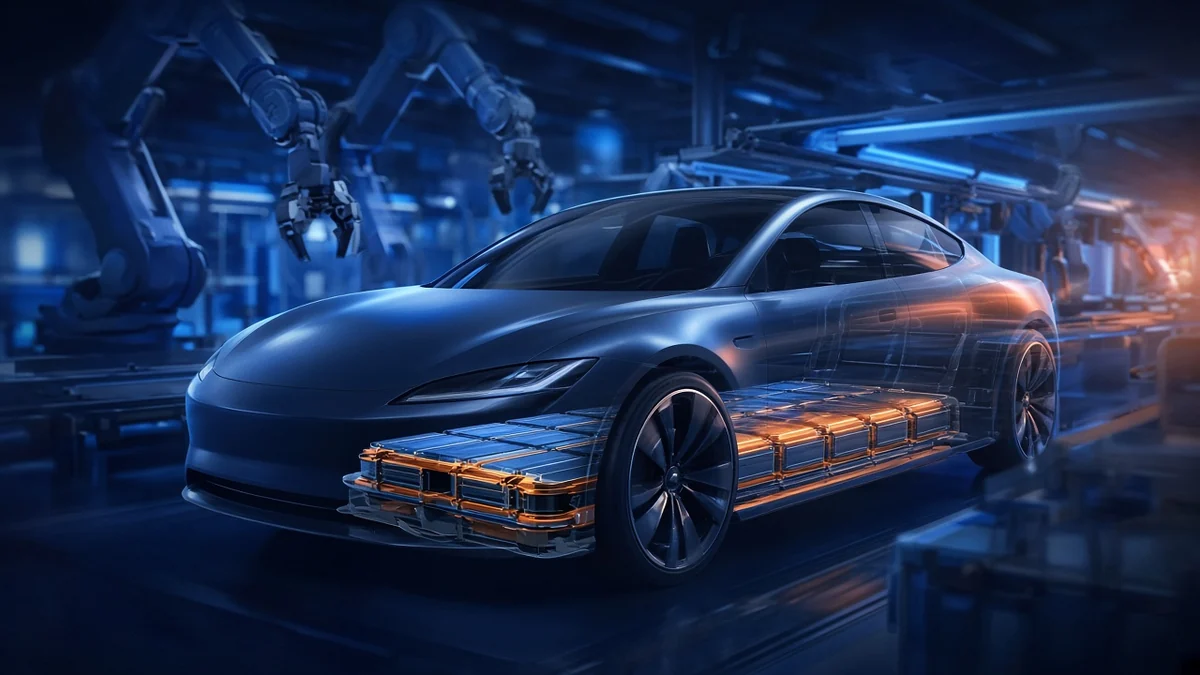
Solid-state batteries could begin appearing in production electric vehicles between 2027 and 2028, but widespread availability will take longer. Toyota is targeting its first applications by the end of 2028, Samsung SDI aims for mass production in 2027, and QuantumScape is moving from pilot manufacturing towards customer testing. Early vehicles are likely to be expensive, limited-production models rather than affordable mainstream EVs.
When will solid-state batteries be available in electric cars?
The automotive industry is approaching an important stage in solid-state battery development. Companies that spent years working on laboratory prototypes are now investing in pilot production lines, material suppliers and automotive testing programmes. However, demonstrating that a battery works in a prototype vehicle is very different from manufacturing millions of reliable cells at a competitive price.
Three companies are particularly important to watch: Toyota, Samsung SDI and QuantumScape. Mercedes-Benz has also demonstrated the technology in a road-going EQS prototype, providing evidence that solid-state battery systems can operate outside laboratory conditions.
| Company | Latest announced target or milestone | Current development stage |
|---|---|---|
| Toyota | Introduction targeted by the end of 2028 | Battery and supply-chain development |
| Samsung SDI | Mass production targeted for 2027 | Pilot production and customer testing |
| QuantumScape | Scaling through 2026 and beyond | Automated pilot production and customer sampling |
| Mercedes-Benz | No confirmed commercial launch date | Road-tested prototype |
These dates describe company targets, not guaranteed showroom launch dates. Battery qualification, manufacturing yields, vehicle integration and regulatory testing can all affect when customers actually receive the technology.
Why are solid-state batteries different from conventional EV batteries?
Most electric cars currently use lithium-ion batteries containing a liquid electrolyte. This electrolyte allows lithium ions to move between the battery’s electrodes during charging and discharging. Solid-state batteries replace the liquid electrolyte with a solid material.
This change could improve energy density, reduce certain fire risks and allow faster charging. It may also enable battery designs that use lithium-metal anodes, potentially storing more energy within the same physical space.
However, solid electrolytes introduce their own engineering challenges. Maintaining stable contact between different battery layers, preventing cracks during repeated expansion and contraction, and achieving consistent manufacturing quality are difficult tasks. A promising laboratory cell does not automatically translate into a reliable automotive battery.
Toyota solid-state battery: Is 2027 or 2028 the launch date?
Toyota is among the most closely watched companies in the solid-state battery race. Its original target was to commercialise all-solid-state batteries for battery electric vehicles in 2027–2028. In November 2026, Toyota’s latest public update continued to point towards introduction in a future model by the end of 2028.
The company is working with Idemitsu Kosan to develop the solid electrolyte materials required for production. Their collaboration focuses on sulfide-based solid electrolytes, improving manufacturing productivity and establishing a supply chain capable of supporting automotive applications.
What is Toyota and Idemitsu doing in 2026?
On January 29, 2026, Idemitsu announced a final investment decision and the beginning of construction of a large pilot facility for solid electrolytes. The facility is intended to supply materials for Toyota’s planned solid-state EV batteries.
This is an important manufacturing milestone, but it should not be confused with the opening of a fully operational, mass-production battery factory. The facility is part of the process of developing production methods and building a reliable supply chain.
Toyota has previously discussed ambitious performance targets, including significantly improved driving range and charging times of approximately 10 minutes or less under specified conditions. These remain development objectives rather than verified specifications for a commercially available Toyota EV.
The company’s immediate challenge is turning its battery technology into a dependable product that can be manufactured consistently. If its timeline holds, the first applications could arrive in a premium electric vehicle before the technology reaches more affordable models.
QuantumScape: Can Volkswagen bring solid-state EVs to market?
QuantumScape is developing lithium-metal solid-state battery technology and working with Volkswagen Group’s battery subsidiary, PowerCo. Its QSE-5 battery cells use an anode-free lithium-metal architecture and a proprietary solid separator. The company reported energy density exceeding 800 watt-hours per litre and fast-charging capability of less than 15 minutes from 10% to 80% for its B-sample cells.
These figures are important because energy density influences how much energy can be stored within a given battery volume. Higher energy density could allow manufacturers to develop longer-range vehicles without proportionately increasing battery size and weight.
What is the QuantumScape Eagle Line?
On February 4, 2026, QuantumScape inaugurated its Eagle Line pilot production facility in San Jose, California. The highly automated manufacturing line incorporates its Cobra separator production process and is designed to support cell development, customer sampling and product integration.
The Eagle Line is intended to demonstrate how QuantumScape’s technology can be manufactured at greater scale. It is not a gigafactory producing automotive batteries in commercial volumes. Its output is intended to support development and validation activities before larger manufacturing operations become possible.
PowerCo also holds licensing rights to QuantumScape technology, giving Volkswagen Group a potential route towards manufacturing the cells at industrial scale. The collaboration has been expanded through additional development and licensing arrangements.
However, the relationship has also encountered commercial uncertainty. QuantumScape’s September 2026 regulatory filing disclosed that the companies were negotiating a revised scope of work and payments. This is an important reminder that technical progress and commercial production agreements must advance together.
Samsung SDI solid-state batteries: What is the 2027 plan?
Samsung SDI is targeting mass production of all-solid-state batteries in 2027. The company completed its 6,500-square-metre pilot line, known as the S-Line, in 2023 and has since supplied prototype cells to customers for evaluation. Its technology uses a proprietary solid electrolyte and an anode-free battery design.
Samsung SDI has discussed energy-density targets of approximately 900Wh/L for its solid-state technology. The company has also presented charging performance objectives involving charging to 80% in approximately nine minutes. These are technology performance claims, not confirmed specifications for a production BMW or other customer vehicle.
Is BMW working with Samsung SDI on solid-state batteries?
Yes, although the partnership needs some clarification. In October 2025, BMW, Samsung SDI and US battery developer Solid Power announced a collaboration to develop and validate all-solid-state battery technology for automotive applications.
Under the arrangement, Solid Power supplies sulfide-based solid electrolyte material, Samsung SDI develops battery cells, and BMW participates in evaluation and vehicle integration. BMW had already integrated large-format solid-state cells supplied by Solid Power into a BMW i7 technology test vehicle.
This is a development and validation programme, not an announcement that BMW will launch a Samsung SDI solid-state production car in 2027. Samsung’s broader mass-production target and the BMW collaboration are related developments, but their timelines should not be treated as interchangeable.
Mercedes-Benz has already tested a solid-state electric car
Mercedes-Benz has provided one of the clearest demonstrations of solid-state battery technology in a real vehicle. In September 2025, the company announced that an EQS prototype equipped with a lithium-metal solid-state battery had completed a 1,205-kilometre journey from Stuttgart to Malmö without recharging.
The vehicle arrived with a reported remaining range of 137 kilometres. The demonstration showed how a solid-state battery system could potentially extend the driving range of an existing luxury electric vehicle.
However, this was a modified test vehicle rather than a commercially available EQS. Mercedes-Benz has not established a confirmed showroom launch date for a production solid-state model. The demonstration is evidence of engineering progress, not proof that the same battery can already be manufactured affordably at high volumes.
Will the first solid-state electric cars be expensive?
Almost certainly. The first production applications are likely to appear in premium vehicles because manufacturers can initially absorb higher battery development and manufacturing costs in expensive models. Limited production volumes will also make it difficult to achieve the economies of scale associated with conventional lithium-ion batteries.
Several challenges must be addressed before solid-state batteries become suitable for mass-market vehicles:
- Manufacturing costs: New materials and production equipment can make early cells expensive.
- Production yields: Manufacturers must produce consistent cells with very low defect rates.
- Battery durability: Cells must withstand repeated charging, discharging and temperature changes over years of use.
- Supply chains: Solid electrolytes and specialised electrode materials need reliable industrial suppliers.
- Vehicle integration: Battery packs must meet automotive safety, performance and reliability requirements.
Consequently, a 2027 or 2028 introduction should not be interpreted as the beginning of an immediate industry-wide replacement of conventional lithium-ion batteries. More affordable adoption will depend on manufacturing progress over subsequent years.
Solid-state battery timeline: What should EV buyers expect?
The following timeline separates announced development targets from the broader commercial adoption that remains dependent on manufacturing progress.
| Period | Expected development |
|---|---|
| 2026 | Pilot production, customer sampling and manufacturing validation |
| 2027 | Samsung SDI’s targeted mass-production start |
| 2027–2028 | Toyota’s targeted commercialisation window |
| By end of 2028 | Toyota’s stated target for introduction in a future model |
| Around 2030 | Potential expansion into additional vehicle segments, depending on costs and production scale |
The 2030 timeframe is an industry adoption expectation rather than a confirmed launch commitment from every manufacturer. Conventional lithium-ion batteries will continue to dominate EV production while solid-state technology progresses through automotive qualification and industrial scale-up.
Frequently asked questions
When will solid-state batteries be available in normal electric cars?
The first applications are targeted for 2027–2028, with Toyota and Samsung SDI among the companies pursuing commercial production. Initial vehicles are likely to be limited-production models. More affordable mass-market availability will depend on manufacturing costs and production capacity.
Is Toyota launching a solid-state battery car in 2027?
Toyota’s original target was 2027–2028, but its latest public update in November 2026 points towards introducing the technology in a future model by the end of 2028. A specific production vehicle and customer delivery date have not been confirmed.
Is QuantumScape already manufacturing solid-state batteries?
QuantumScape has installed and inaugurated its Eagle Line pilot production facility, which is designed to manufacture cells for customer sampling and development. This is not equivalent to operating a full-scale commercial battery factory.
Are solid-state batteries safer than conventional lithium-ion batteries?
They have the potential to reduce certain fire risks because they replace conventional liquid electrolytes with solid materials. However, safety depends on the complete battery design, materials, manufacturing quality and operating conditions. Solid-state batteries should not be described as completely fireproof.
Will solid-state batteries make EVs charge in 10 minutes?
Some manufacturers have demonstrated or targeted charging times around this level under specified testing conditions. Toyota and Samsung SDI have discussed ambitious fast-charging objectives, but actual charging performance in production vehicles will depend on battery design, temperature, charger capability and charging infrastructure.
Toyota, Samsung SDI, QuantumScape and Mercedes-Benz have all moved beyond basic laboratory research, but their achievements represent different stages of commercial readiness. The 2027–2028 period could bring the first meaningful production applications, while affordability and large-scale availability remain longer-term challenges. Which development are you watching most closely: Toyota’s planned launch, Samsung SDI’s production target or QuantumScape’s Volkswagen partnership?