Major spoilers for Clayface from this point forward. For most of its runtime, Clayface looks like the story of Matt Hagen destroying everyone else. The ending reveals that Matt has really been destroying himself.
James Watkins’ DCU horror movie takes Tom Rhys Harries’ struggling actor from horrific disfigurement to miraculous recovery, shape-shifting murderer and, finally, something that barely resembles the human being we met at the beginning. By the time Dr. Caitlyn Corr activates the failsafe inside his experimental nanites, the movie seems to have found the bleakest possible ending: Matt literally melts away. Except he doesn’t die.
And somehow, what happens after he survives is even darker. The final sewer sequence doesn’t simply confirm that Clayface can return. It shows us exactly what Matt Hagen has become — a man who can look like anybody, create almost anything from his own body and still cannot recreate the one thing he actually wants: a genuine human connection.
Caitlyn finally discovers what Matt has become
The final confrontation works because Caitlyn, played by Naomi Ackie, is one of the few people who initially sees Matt as something other than his ruined face. She is the doctor behind the experimental nanite treatment that repairs his injuries. The procedure succeeds far beyond anything she intended, allowing Matt not only to heal but eventually to alter his appearance, voice and physical form. That gift quickly turns into a weapon.
As Radio Times’ detailed ending breakdown confirms, Matt murders the people he blames for destroying his life, including his former manager Frank Fitzpatrick, childhood friend Corey Bowery and the people connected to crime boss Markos Szabo. Then he crosses the line that makes any fantasy of a future with Caitlyn impossible. Matt kills her partner, Gotham detective John Borrelli, and impersonates him.
Max Minghella’s John has spent much of the film investigating the trail of murders Matt leaves behind. Matt’s response isn’t merely to remove the detective threatening him. He steals John’s identity because he wants what John has: Caitlyn. It is one of the ugliest expressions of Matt’s powers in the movie.
He can reproduce John’s face. He can reproduce John’s voice. He cannot reproduce the relationship. Caitlyn eventually realizes that the man standing in front of her isn’t John at all.
The nanite kill switch appears to destroy Matt
Once the truth comes out, Matt still seems convinced there is some version of reality where Caitlyn will choose him. There isn’t. Caitlyn rejects him and activates the termination mechanism built into the nanite technology that transformed him.
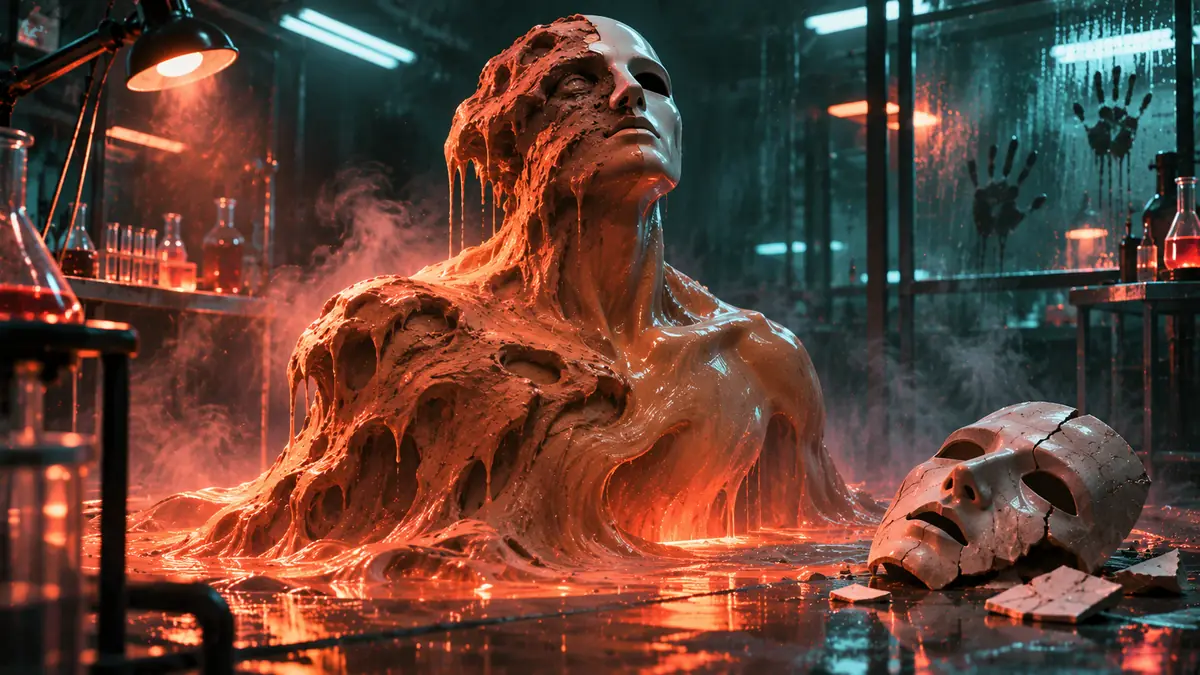
The exact chaos surrounding that moment is part of the film’s body-horror climax, but the important result is clear: Matt loses control of his form and appears to break apart. His liquefied body disappears through the drainage system and into Gotham’s sewers. For a moment, Clayface lets us believe that’s the end.
And the movie gives the authorities almost the same uncertainty. There is no conventional body to recover. Matt Hagen is ultimately treated as missing rather than definitively dead.
For anybody who knows what movie they’re watching, that should immediately set off alarms. No body is superhero-movie language for “we’re not done yet.” In Matt’s case, the movie doesn’t even make us wait until a sequel to prove it.
The unhoused man is Matt Hagen
Some time later, Caitlyn encounters an unhoused man and gives him money. At first, the exchange seems insignificant. Then he makes a familiar gesture. Matt is hiding in plain sight.
The sequence confirms that the failsafe did not kill him and, crucially, did not remove his powers. He remains capable of taking another person’s appearance even after the nanite shutdown. The movie never stops to give us a laboratory explanation for exactly why. And it doesn’t need one.
The treatment has already moved far beyond what Caitlyn designed. Matt’s body is no longer behaving like a human body with some helpful medical nanotechnology inside it. He is Clayface now.
Trying to reduce that transformation to a clean scientific rule would almost undermine the horror. The important fact is that Caitlyn’s kill switch fails to permanently destroy him. Matt survives.
The Caitlyn in the sewer isn’t Caitlyn
Then Clayface gives us its nastiest trick. Matt retreats into the Gotham sewers, and the movie initially appears to show Caitlyn finding him there. For a brief moment, it looks like we’re watching an impossibly forgiving reunion. Caitlyn seems to accept Matt. She expresses affection. The two embrace.
After everything he has done, the scene feels wrong — because it is. The woman is not Caitlyn. As both Radio Times and Parade explain, Matt has created a version of Caitlyn himself.
That is the true horror of the ending. Earlier in the film, shape-shifting lets Matt become other people. Now his power has evolved to the point where he can manifest a separate imitation of the person he wants beside him.
But it isn’t love. It isn’t forgiveness. It isn’t even really companionship. Matt is performing both sides of a relationship because reality has rejected the version he wants.
For an actor obsessed with faces and identity, it is a brutally fitting fate. Matt can finally create the perfect scene. There is just nobody else in it.
That final Clayface form is the real ending
The movie then strips away whatever illusion remains. Matt abandons the ordinary human appearance he has spent so much of the story trying to preserve and assumes his enormous, grotesque Clayface form. That transformation isn’t simply sequel bait. It completes the character arc.
The official DC description of the film frames Matt’s story as a descent from rising Hollywood actor into revenge and psychological collapse after an experimental treatment changes him. His entire identity was once tied to being seen. His face made his career possible. Losing it destroyed his life.
Getting it back seemed like salvation. Then his new powers gave him every face imaginable. By the ending, none of them matters.
He has murdered the people who hurt him. He has killed innocent people. He has lost Caitlyn. He has retreated beneath Gotham and replaced real intimacy with something he can manufacture from himself.
Physically, Matt has become more powerful than ever. Emotionally, he has never been more alone. That is why the grotesque Clayface reveal feels less like a villain’s triumphant birth and more like the final stage of a tragedy.
Clayface doesn’t need a post-credits scene
DC fans trained by years of superhero movies may instinctively stay seated once the credits begin. This time, there is nothing waiting. Clayface has no post-credits scene, something confirmed by both Digital Spy and director James Watkins’ comments about the film.
And that is absolutely the right decision. A Batman silhouette would have weakened the ending. A teaser for some unrelated DCU project would have been even worse.
Watkins designed the film to work as its own horror story rather than functioning as a two-hour advertisement for whatever comes next. He told TechRadar that he deliberately avoided forcing Batman into the movie as stunt casting. There is no Batman cameo. There doesn’t need to be. The final image already contains the only sequel tease that matters: Clayface exists.
Matt Hagen will return in the DCU
This is one area where we no longer have to say “maybe.” James Gunn has publicly confirmed that Clayface is not the last time we’ll see the character. Speaking ahead of the movie’s release, Gunn said the fun of the DCU is being able to tell radically different stories that eventually intersect, before confirming that Clayface will appear again. Digital Spy reported his comments while covering the movie’s ending and lack of a credits tease.
Exactly where Matt appears next remains unknown. Director James Watkins has been much more careful about the future. He told Radio Times that he approached this film as a complete experience rather than building it around the question of what comes next.
That explains why the ending works. Matt survives, but the movie doesn’t suddenly stop being his story to introduce Batman or set up a crossover. The DCU can use Clayface later because Clayface first bothered to turn him into a character worth using.
The ending is really about identity, not survival
So yes, Matt Hagen is alive. But that is almost the least interesting thing about the final scene. Matt spends the movie believing that if he can restore his face, punish everyone who humiliated him and somehow win Caitlyn’s love, he can recover the life that was stolen from him.
Instead, his powers destroy the very concept of a fixed identity. He can become John. He can become strangers. He can create Caitlyn. He can reshape himself almost endlessly. And none of those forms gives him Matt Hagen’s old life back.
That’s what makes the sewer ending so much darker than simply revealing the villain survived. The man who wanted his face back ends the movie without needing a face at all. The actor who once depended on other people watching him ends it performing for himself underground.
And the person who wanted Caitlyn’s love has become powerful enough to create an imitation of her — but not powerful enough to make the real woman love him. Matt Hagen survives Clayface. The tragedy is that by the end, survival is about the only thing he has left.