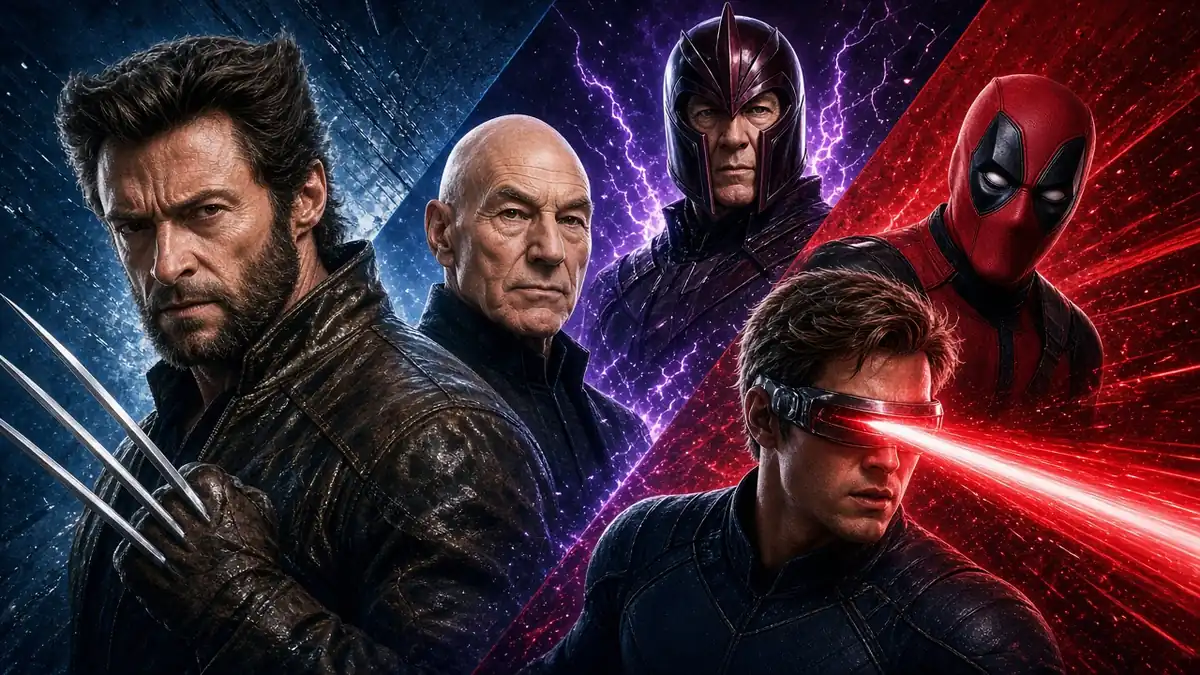
Before the Marvel Cinematic Universe became the superhero franchise everyone wanted to join, the X-Men were already fighting for their place on the big screen. From Hugh Jackman’s legendary Wolverine to Patrick Stewart’s compassionate Professor X and Ian McKellen’s unforgettable Magneto, the Fox movies gave us some of the most recognisable characters in superhero cinema. They also gave us spectacular battles, questionable timelines, a few genuinely heartbreaking endings and Ryan Reynolds breaking the fourth wall every chance he gets. With Avengers: Doomsday bringing several familiar mutant actors back together on December 18, 2026, there has never been a better time to revisit the franchise. We’ve ranked all 14 theatrical Fox X-Men films, including the Deadpool movies and their spectacular crossover with Wolverine.
14. The New Mutants (2020)
We wanted a genuinely terrifying X-Men movie, but The New Mutants never quite decides what kind of horror story it wants to tell. Directed by Josh Boone, the film follows five young mutants held inside a mysterious medical facility, where their supernatural abilities are connected to increasingly disturbing experiences. The cast includes Maisie Williams as Wolfsbane, Anya Taylor-Joy as Magik, Charlie Heaton as Cannonball, Blu Hunt as Mirage and Henry Zaga as Sunspot. Its relatively isolated setting offers a welcome change from the usual superhero spectacle, and Taylor-Joy makes an especially entertaining Magik. However, the character development feels rushed, the horror elements rarely become frightening enough, and the story struggles to give its ensemble enough room. The film deserved a more confident identity, especially with characters as interesting as Magik and Wolfsbane. It is an interesting experiment, but easily the weakest entry in our ranking.
13. X-Men: Dark Phoenix (2019)
Jean Grey is one of the most powerful and emotionally complicated characters in X-Men mythology. Unfortunately, Dark Phoenix struggles to do justice to the character’s most famous comic-book storyline. Simon Kinberg directed this second attempt at adapting the Dark Phoenix Saga, with Sophie Turner returning as Jean alongside James McAvoy, Michael Fassbender, Jennifer Lawrence and Nicholas Hoult. The film explores Jean’s growing powers after a space mission exposes her to an extraordinary cosmic force, creating a conflict that threatens both her friends and the wider world. There are some worthwhile moments, particularly when Jean begins questioning whether the people closest to her truly understand her. However, the story moves too quickly through its emotional developments, and its antagonists never become particularly memorable. The disappointing reception was reflected in its worldwide box office of approximately $252 million, according to Box Office Mojo. For a storyline that once defined an entire era of X-Men comics, this deserved considerably more.
12. X-Men Origins: Wolverine (2009)
Wolverine deserved a solo movie, and X-Men Origins: Wolverine gave Hugh Jackman the opportunity to explore the character’s mysterious past. Directed by Gavin Hood, the film follows Logan through his childhood, military experiences, relationship with Victor Creed and eventual involvement in the Weapon X programme. Liev Schreiber is a major highlight as Sabretooth, while Ryan Reynolds makes his first theatrical appearance as Wade Wilson. The film also introduces several familiar mutant characters, including Gambit, played by Taylor Kitsch. There is plenty of action, and the early exploration of Logan and Victor’s relationship gives the story an interesting foundation. Unfortunately, the infamous version of Deadpool, whose mouth is literally sewn shut, remains one of the franchise’s most baffling creative decisions. The final act also relies too heavily on spectacle instead of developing its characters. It has interesting pieces of Wolverine mythology, but we would happily erase certain creative decisions from the timeline.
11. X-Men: The Last Stand (2006)
The original trilogy deserved a stronger ending, and X-Men: The Last Stand remains one of the franchise’s biggest missed opportunities. Directed by Brett Ratner, the third film introduces a controversial mutant cure while bringing Jean Grey back as the immensely powerful Phoenix. Hugh Jackman, Patrick Stewart, Ian McKellen, Halle Berry and Famke Janssen return, while Kelsey Grammer makes his memorable debut as Beast. The central conflict presents two opposing visions of mutant identity: accepting a cure or embracing the abilities that make mutants different. That premise could have supported a genuinely fascinating story about prejudice, identity and personal choice. Instead, the film rushes through several major developments, including the deaths of important characters and Jean’s transformation. Grammer’s Beast and the action sequences provide some entertainment, but the emotional consequences rarely receive the attention they deserve. It is certainly not a disaster, but the franchise had much better stories waiting to be told.
10. X-Men: Apocalypse (2016)
When the world’s first mutant wakes up after thousands of years, you would expect something truly extraordinary to happen. X-Men: Apocalypse gives us exactly that premise, although its execution is rather uneven. Bryan Singer directs Oscar Isaac as Apocalypse, an ancient mutant who recruits powerful followers to help him reshape civilisation. James McAvoy, Michael Fassbender, Jennifer Lawrence and Nicholas Hoult return, while Sophie Turner, Tye Sheridan and Kodi Smit-McPhee join the younger generation as Jean Grey, Cyclops and Nightcrawler. Evan Peters also returns as Quicksilver, delivering another spectacular slow-motion sequence that steals the show. The film’s greatest strength is introducing younger versions of characters who would eventually become central to the franchise. However, Apocalypse himself never becomes as threatening as his comic-book counterpart deserves, and the enormous destruction occasionally overwhelms the character drama. We still enjoy watching the younger X-Men discover their powers, but this adventure could have used a considerably stronger villain.
9. Deadpool 2 (2018)
Deadpool returns with more jokes, bigger action sequences and an almost unreasonable number of references to other superhero franchises. Directed by David Leitch, the sequel follows Wade Wilson as he attempts to protect a young mutant named Russell Collins, played by Julian Dennison, from Cable, a time-travelling soldier portrayed by Josh Brolin. Ryan Reynolds once again dominates the film with his chaotic humour, while Zazie Beetz makes an excellent debut as Domino. The introduction of X-Force is another highlight, particularly because Deadpool’s idea of assembling a superhero team is predictably questionable. Beneath the comedy, however, the film has a surprisingly emotional storyline about loss, family and finding a reason to keep moving forward. Cable gradually becomes more than a conventional antagonist, and his relationship with Russell gives the story a stronger emotional foundation. It is not quite as fresh as the original, but the action, performances and sheer confidence make it an extremely entertaining sequel. Also, the film’s mid-credits sequence remains one of the funniest things the franchise has ever attempted.
8. The Wolverine (2013)
James Mangold’s The Wolverine takes Logan away from the familiar X-Mansion and places him in Japan, where he becomes involved in a complicated family conflict involving powerful business interests and the Yakuza. Hugh Jackman delivers another compelling performance as a hero who has become increasingly uncomfortable with his immortality and the memories he carries. The film also introduces characters such as Yukio, played by Rila Fukushima, and Mariko Yashida, played by Tao Okamoto. Its quieter approach gives Logan opportunities to show vulnerability, especially as he struggles with the emotional consequences of Jean Grey’s death. The Japanese setting also provides a distinctive atmosphere compared with the franchise’s usual American locations. While the final battle with the Silver Samurai becomes more conventional than the rest of the film, the journey itself is considerably more interesting. We particularly appreciate how Mangold uses this adventure to explore Wolverine as a character rather than treating him as an unstoppable fighting machine.
7. X-Men (2000)
Everything had to begin somewhere, and Bryan Singer’s X-Men helped establish the foundations of modern superhero cinema. Released in 2000, the film introduced audiences to a world where mutants are feared and discriminated against because of their extraordinary abilities. Hugh Jackman makes his debut as Wolverine, joining Patrick Stewart’s Professor X and Ian McKellen’s Magneto in a conflict over the future of mutantkind. The supporting cast includes Halle Berry as Storm, Famke Janssen as Jean Grey, James Marsden as Cyclops and Anna Paquin as Rogue. What makes the original film so important is its decision to treat mutant identity as a serious social and political issue rather than simply an excuse for spectacular superpowers. Wolverine and Rogue provide an accessible introduction to the X-Men universe, while the philosophical disagreement between Xavier and Magneto gives the story its emotional foundation. The visual effects have aged, and the costumes are certainly not what comic-book fans would call colourful, but the characters remain compelling. Without this movie, the superhero genre might have taken a very different route.
6. Deadpool (2016)
For years, superhero movies followed a familiar formula: a tragic origin story, a colourful costume, a villain threatening the world and a hero learning an important lesson. Then Deadpool arrived and cheerfully set fire to the entire rulebook. Directed by Tim Miller, the film follows Wade Wilson, a former special forces operative who undergoes an experimental treatment after being diagnosed with terminal cancer. Ryan Reynolds plays the character with extraordinary confidence, balancing outrageous humour with a surprisingly effective emotional storyline involving Vanessa, portrayed by Morena Baccarin. The supporting cast includes T.J. Miller as Weasel, Ed Skrein as Ajax and Brianna Hildebrand as Negasonic Teenage Warhead. What made the film such a refreshing experience was its willingness to embrace R-rated comedy without sacrificing the central love story. Deadpool’s relationship with Vanessa gives the chaos an emotional purpose, while his encounters with Colossus and Negasonic provide some excellent superhero comedy. The film earned approximately $782 million worldwide, according to Box Office Mojo, proving that audiences were ready for a very different kind of superhero.
5. X-Men: First Class (2011)
Rebooting a franchise after an uneven trilogy is never easy, but X-Men: First Class managed to give the mutants a fascinating new beginning. Directed by Matthew Vaughn, the film takes us back to the 1960s, exploring the early friendship between Charles Xavier and Erik Lehnsherr. James McAvoy and Michael Fassbender bring remarkable chemistry to the younger versions of Professor X and Magneto, making their eventual ideological separation genuinely heartbreaking. Jennifer Lawrence plays Mystique, Nicholas Hoult becomes Beast, and Kevin Bacon delivers an entertaining performance as the villainous Sebastian Shaw. The Cuban Missile Crisis provides an interesting historical backdrop, while the film explores how personal experiences shape the characters’ understanding of humanity. We particularly enjoy watching Charles and Erik develop their contrasting philosophies before their relationship becomes defined by conflict. The film also gives Mystique a more substantial emotional journey than the earlier movies allowed. It is stylish, entertaining and surprisingly thoughtful, making it one of the franchise’s most successful reinventions.
4. Deadpool & Wolverine (2024)
Putting Deadpool and Wolverine together was always going to create spectacular chaos, and Shawn Levy’s Deadpool & Wolverine delivers exactly that. Ryan Reynolds returns as Wade Wilson, while Hugh Jackman makes another appearance as Logan, bringing the character back after the emotional ending of Logan. The story follows Wade as he enters the multiverse and attempts to recruit a Wolverine variant to help save his reality. Emma Corrin plays Cassandra Nova, while the supporting cast features several surprising appearances from across Marvel’s cinematic history. The film’s greatest achievement is understanding that the relationship between these two characters is its real attraction. Deadpool’s endless chatter clashes beautifully with Wolverine’s permanently irritated personality, creating a dynamic that works even when the plot becomes increasingly complicated. The action is brutal, the comedy is outrageous, and the cameos provide plenty of entertainment for longtime fans. Its worldwide box office reached approximately $1.338 billion, making it the highest-grossing film in the X-Men franchise, according to Box Office Mojo. It is a celebration of superhero cinema’s stranger corners, and one that rewards fans who have followed these characters for years.
3. X2: X-Men United (2003)
Sequels often struggle to improve on their predecessors, but X2 is one of the rare superhero follow-ups that understands exactly what made the original work and expands it in meaningful ways. Bryan Singer returns as director, bringing back Hugh Jackman, Patrick Stewart, Ian McKellen, Halle Berry, Famke Janssen and James Marsden. The story begins with an attack on the White House by Nightcrawler, played by Alan Cumming, prompting a government crackdown against mutants. Colonel William Stryker, portrayed by Brian Cox, emerges as a dangerous enemy with a personal connection to Wolverine’s past. What follows is a story that explores mutant prejudice, loyalty and the complicated relationship between Charles Xavier and Magneto. The film also gives several supporting characters opportunities to shine, particularly Nightcrawler, whose opening attack remains one of the franchise’s most memorable action sequences. The relationship between Wolverine and the younger mutants adds emotional depth, while the finale sets up Jean Grey’s transformation in a genuinely powerful way. For many fans, this is where the original X-Men trilogy reached its creative peak.
2. X-Men: Days of Future Past (2014)
Bringing two generations of X-Men together was an ambitious idea, but Days of Future Past turns it into one of the franchise’s most satisfying adventures. Directed by Bryan Singer, the film follows Wolverine as he travels back to 1973 to prevent an event that could lead to the extinction of mutants. Hugh Jackman, James McAvoy, Michael Fassbender, Jennifer Lawrence and Nicholas Hoult share the screen with returning original-trilogy performers Patrick Stewart, Ian McKellen and Halle Berry. The introduction of Evan Peters as Quicksilver provides one of the greatest action sequences in the entire franchise, particularly during the extraordinary Pentagon escape. More importantly, the film gives Charles and Erik another opportunity to confront the ideological differences that have repeatedly divided them. Its time-travel narrative also offers a clever way to bring together characters from different generations without making the crossover feel forced. The film earned approximately $746 million worldwide, according to Box Office Mojo. For superhero fans, this is practically the ultimate X-Men ensemble experience.
1. Logan (2017)
There are superhero movies that make us cheer, and then there are superhero movies that leave us emotionally exhausted. Logan belongs to the second category. Directed by James Mangold, the film takes place in a bleak future where mutantkind is nearly extinct and an ageing Wolverine struggles to survive while caring for an increasingly vulnerable Professor X. Hugh Jackman and Patrick Stewart deliver two of their finest performances, while Dafne Keen makes an extraordinary debut as Laura, a young mutant with abilities remarkably similar to Logan’s. Their relationship gradually develops into something resembling a father-daughter bond, giving the story an emotional centre that extends far beyond its violent action sequences. Unlike the earlier X-Men adventures, this film is interested in what happens when superheroes grow old, lose their purpose and struggle to find something worth protecting. The restrained storytelling, western-inspired atmosphere and brutal action make it feel refreshingly different. Its achievements were recognised with an Academy Award nomination for Best Adapted Screenplay at the 90th Oscars. Most importantly, the ending gives Hugh Jackman’s Wolverine the farewell he deserved. We cannot think of a better film to take the number one position.
The X-Men franchise has delivered some extraordinary superhero experiences, even if its confusing timelines and occasional creative misfires have kept it from being consistently brilliant. We’d recommend First Class and Days of Future Past to anyone who loves mutant mythology, the Deadpool films to fans who prefer their superhero adventures completely unpredictable, and Logan to anyone who wants something genuinely emotional. The next chapter arrives with Avengers: Doomsday on December 18, 2026, with the officially announced cast including Patrick Stewart, Ian McKellen, James Marsden, Rebecca Romijn, Kelsey Grammer, Alan Cumming and Channing Tatum. We’ve already explored Patrick Stewart’s emotional final performance as Professor X and the Avengers: Doomsday final trailer’s return of Steve Rogers and the X-Men. Until that crossover reaches theatres, our favourite way to revisit superhero cinema is still to put on Logan, followed by Days of Future Past and, naturally, a little Spider-Man movie marathon. Because great superhero stories are about more than saving the world; sometimes, they’re about the people who make that world worth saving.