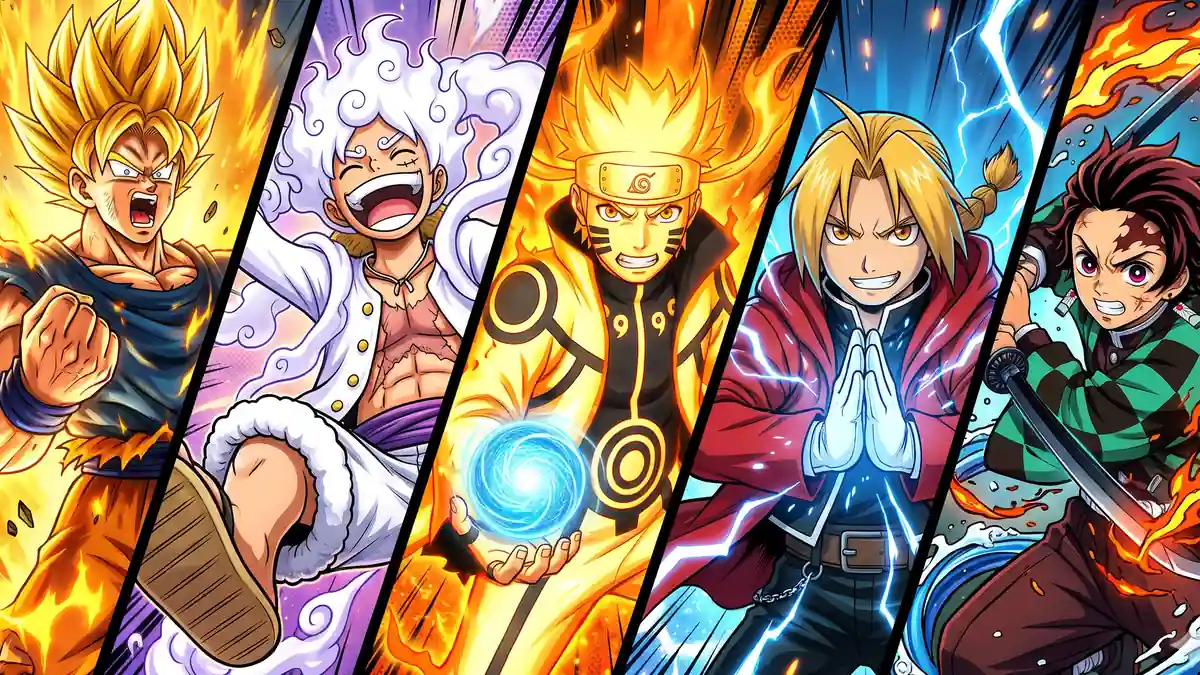
The best shonen anime have given fans some of the most unforgettable characters, emotional storylines and spectacular battles in animation history. From Goku’s legendary transformations and Naruto’s journey to becoming Hokage to Luffy’s search for the One Piece, these series have entertained generations of viewers. We have ranked 10 of the greatest shonen anime of all time based on their storytelling, character development, animation, cultural influence and lasting appeal.
One important distinction: shonen is technically a publishing demographic rather than a specific genre. These shows can include everything from supernatural adventures and fantasy battles to sports dramas and political conflicts. That variety is exactly what makes this category so exciting.
10. Haikyu!! (2014)
Not every great shonen anime needs supernatural abilities, world-ending threats or characters who can destroy entire cities. Haikyu!! proves that a high-school volleyball tournament can be just as exciting as a battle between powerful warriors. Based on Haruichi Furudate’s manga, the anime follows Shoyo Hinata, a short but incredibly determined student who dreams of becoming a great volleyball player despite his physical disadvantages.
After joining Karasuno High School, Hinata finds himself playing alongside Tobio Kageyama, a talented setter whose personality initially clashes with his own. Their partnership gradually becomes one of the series’ biggest strengths. The show introduces several rival schools and players, giving individual matches genuine emotional stakes rather than treating every opponent as another obstacle for the protagonists to overcome.
Produced by Production I.G and directed by Susumu Mitsunaka in its first season, Haikyu!! began airing in 2014. Its fourth television season arrived in 2020, followed by the theatrical release of Haikyu!! The Dumpster Battle in 2024. The series understands that winning is not the only reason people play sports. Personal growth, teamwork, disappointment and the relationships formed along the way matter just as much.
For viewers who enjoy competitive storytelling without fantasy powers, Haikyu!! is an easy recommendation. Its matches deliver tremendous excitement, while Hinata’s development provides the emotional foundation that keeps the audience invested.
9. Jujutsu Kaisen (2020)
Jujutsu Kaisen arrived at a time when anime fans were looking for a fresh supernatural action series, and Gege Akutami’s creation quickly became one of the biggest modern shonen franchises. The story follows Yuji Itadori, an ordinary high-school student whose life changes after he swallows a cursed object containing one of the most dangerous supernatural beings in existence: Ryomen Sukuna.
Yuji subsequently enters the world of Jujutsu Sorcerers, where he trains under Satoru Gojo alongside fellow students Megumi Fushiguro and Nobara Kugisaki. The series builds an interesting supernatural system around cursed energy, domain expansions and individual techniques. Its fights often depend on intelligence and strategy rather than simply giving the stronger character an easy victory.
The first season premiered in 2020, with animation production handled by MAPPA. Sunghoo Park directed the first season, while Shota Goshozono took over for the second. Jujutsu Kaisen 0, a prequel film focusing on Yuta Okkotsu, further expanded the franchise before the second season delivered the Shibuya Incident, one of its most consequential story arcs.
The series also stands out for its willingness to put major characters through devastating situations. Its humour can be surprisingly light, but the narrative rarely allows viewers to forget that its supernatural conflicts carry serious consequences. Jujutsu Kaisen earns its place among the best modern shonen anime through its action, memorable personalities and unpredictable storytelling.
8. Bleach (2004)
When discussing the biggest shonen franchises of the 2000s, Bleach deserves a place alongside Naruto and One Piece. Created by Tite Kubo, the series follows Ichigo Kurosaki, a teenager who can see ghosts and unexpectedly receives the powers of a Soul Reaper. His new responsibility involves protecting humans from dangerous spirits known as Hollows and helping lost souls reach the afterlife.
What makes Bleach particularly memorable is its supernatural world-building. The Soul Society, its powerful captains, the different divisions and the mysterious Arrancar create an extensive mythology that gives the series plenty of room to expand. Ichigo’s battles against characters such as Byakuya Kuchiki, Grimmjow Jaegerjaquez and Sosuke Aizen remain among the franchise’s most memorable confrontations.
The original television anime premiered in October 2004 and ran for 366 episodes. Studio Pierrot produced the series, which was followed years later by Bleach: Thousand-Year Blood War, adapting the manga’s final major storyline. The newer adaptation brought a noticeably updated visual presentation and gave longtime fans the opportunity to see some of the manga’s biggest confrontations animated.
Bleach occasionally struggles with pacing and filler episodes in its original television run, but its strongest story arcs remain excellent examples of supernatural shonen storytelling. Ichigo’s character, Kubo’s distinctive designs and the franchise’s unforgettable soundtrack make it an essential watch for anyone exploring anime classics.
7. Demon Slayer: Kimetsu no Yaiba (2019)
Demon Slayer became a global sensation remarkably quickly, thanks to its emotional storytelling and extraordinary animation. Based on Koyoharu Gotouge’s manga, the series follows Tanjiro Kamado, a kind-hearted boy whose family is slaughtered by demons. His younger sister Nezuko survives, but she is transformed into a demon herself. Determined to find a cure and avenge his family, Tanjiro joins the Demon Slayer Corps.
Produced by ufotable, the anime immediately attracted attention for its fluid action sequences and detailed visual presentation. The breathing techniques used by demon slayers give the battles their own visual identity, while the different demons introduce unusual abilities and tragic personal histories. Tanjiro’s companions, Zenitsu Agatsuma and Inosuke Hashibira, provide humour and contrasting personalities that make the central group entertaining to follow.
The 2020 film Demon Slayer: Kimetsu no Yaiba – The Movie: Mugen Train became a major international box-office success, continuing the story directly after the first television season. Subsequent arcs expanded the mythology, introducing increasingly powerful Hashira and revealing more about the demon hierarchy. Director Haruo Sotozaki has led the television adaptation, while the franchise’s Infinity Castle trilogy began with its first theatrical instalment in 2025.
Demon Slayer’s story is relatively straightforward compared with the enormous narratives of One Piece or Hunter x Hunter. However, its emotional accessibility is one of its biggest advantages. Tanjiro’s compassion gives the series a clear identity, while ufotable’s animation makes its battles spectacular viewing experiences.
6. Attack on Titan (2013)
Attack on Titan begins with a terrifyingly simple premise: humanity survives behind enormous walls because the outside world is dominated by man-eating giants called Titans. Created by Hajime Isayama, the story follows Eren Yeager, who joins the military after a devastating Titan attack destroys his home and takes his mother’s life. Alongside Mikasa Ackerman and Armin Arlert, he becomes part of humanity’s desperate struggle for survival.
The early episodes present Attack on Titan as a brutal survival story, but the series gradually reveals that its world is considerably more complicated than it initially appears. Political conspiracies, military secrets and discoveries about the Titans transform the narrative into something much larger. The changing perspective also forces viewers to reconsider their understanding of several characters and events.
The anime premiered in 2013, with its first three seasons produced by Wit Studio. MAPPA took over animation production for The Final Season, which began in 2020. Across its run, the series developed a reputation for dramatic confrontations, carefully planted revelations and an increasingly complex examination of freedom, revenge and the consequences of historical hatred.
Attack on Titan is particularly interesting because it challenges several familiar shonen conventions. Its protagonist does not remain a straightforward hero, and the story becomes increasingly uncomfortable as the consequences of his decisions emerge. Its conclusion generated plenty of discussion among fans, but the series remains one of the most ambitious anime productions of its generation.
5. Naruto (2002)
Few anime protagonists have inspired as many viewers as Naruto Uzumaki. Masashi Kishimoto’s creation follows a young ninja who grows up isolated from his village because a powerful Nine-Tailed Fox is sealed inside him. Despite being treated as an outsider, Naruto dreams of becoming the Hokage, the leader of the Hidden Leaf Village, and earning the respect of everyone around him.
The original Naruto anime premiered in 2002, with Studio Pierrot handling its animation production. Naruto Shippuden followed in 2007, continuing the story after a time skip and introducing more dangerous enemies, complicated political conflicts and larger-scale ninja battles. The relationship between Naruto and Sasuke Uchiha becomes the emotional centre of the franchise, with their contrasting ambitions driving some of its most important storylines.
One of Naruto’s biggest strengths is its supporting cast. Characters such as Kakashi Hatake, Itachi Uchiha, Jiraiya, Gaara and Shikamaru Nara have stories that extend far beyond their initial appearances. The series also explores the cycle of hatred, loneliness, forgiveness and the difficult choices involved in protecting others.
Its original television run does contain substantial filler material, which can make the viewing experience longer than necessary. However, the strongest arcs, particularly the Chunin Exams, Sasuke Retrieval and Pain’s Assault, remain unforgettable. Naruto is an excellent choice for anyone who wants a traditional shonen adventure with an enormous cast and an emotionally invested central hero.
4. Hunter x Hunter (2011)
Hunter x Hunter is one of those anime that becomes increasingly impressive as its story develops. Created by Yoshihiro Togashi, the series follows Gon Freecss, a young boy who discovers that his supposedly absent father is actually a legendary Hunter. Determined to find him, Gon leaves his home and begins a journey that introduces him to dangerous examinations, powerful enemies and extraordinary friendships.
The 2011 adaptation was produced by Madhouse and directed by Hiroshi Koujina. It introduces Killua Zoldyck, Kurapika and Leorio as Gon’s companions, with each character having personal motivations that gradually become important to the wider narrative. Their friendship provides the emotional foundation for a story that can shift from cheerful adventure to extremely dark territory.
Its power system, Nen, is one of the most carefully developed in shonen anime. Rather than relying on increasingly powerful attacks without explanation, the series establishes rules and limitations that make battles dependent on preparation, intelligence and psychological understanding. This becomes particularly impressive during the Yorknew City and Chimera Ant arcs, where the storytelling reaches an entirely different level of complexity.
Hunter x Hunter also refuses to follow a predictable formula. Characters who initially seem insignificant can become central to major developments, while seemingly straightforward adventures can reveal disturbing truths about human nature. The 2011 anime concludes before adapting the manga’s entire story, but its 148 episodes provide a remarkably satisfying journey. For fans who value strategic battles and layered character writing, it is essential viewing.
3. One Piece (1999)
One Piece is an extraordinary achievement in long-form storytelling. Created by Eiichiro Oda, the series follows Monkey D. Luffy, a young pirate whose dream is to become the King of the Pirates by finding the legendary treasure known as the One Piece. After eating a mysterious Devil Fruit, Luffy gains the ability to stretch his body like rubber, but loses the ability to swim.
His journey brings together the Straw Hat Pirates, a group of individuals with their own dreams, histories and reasons for joining the crew. Roronoa Zoro wants to become the world’s greatest swordsman, Nami dreams of creating a complete map of the world, and Sanji searches for the legendary All Blue. Their individual ambitions make the crew feel like a genuine family rather than a collection of characters who exist only to support the protagonist.
The anime began airing in 1999, with Toei Animation handling production. Its greatest strength is its world-building. Islands, kingdoms, pirate crews, political organisations and historical mysteries gradually connect to create an enormous fictional universe. Details introduced hundreds of episodes earlier can become important much later, rewarding viewers who follow the story closely.
One Piece has its pacing issues, especially during certain stretches of the original television adaptation. However, its strongest arcs, including Water 7, Enies Lobby, Marineford and Wano, demonstrate just how powerful its storytelling can become. Luffy is also a refreshing protagonist whose determination is matched by a genuine concern for the people he meets. For anyone willing to commit to a long adventure, One Piece offers one of anime’s most rewarding experiences.
2. Dragon Ball (1986)
It is almost impossible to discuss the history of shonen anime without giving Dragon Ball a prominent position. Created by Akira Toriyama, the franchise follows Goku, a cheerful martial artist with a mysterious background who begins his adventure searching for seven magical Dragon Balls. Gathering all seven allows their owner to summon a dragon capable of granting a wish.
The original Dragon Ball anime premiered in 1986 and introduced audiences to a world filled with martial arts tournaments, eccentric characters, strange creatures and powerful enemies. Dragon Ball Z subsequently expanded the franchise’s scope, bringing alien warriors, increasingly dangerous villains and some of the most recognisable transformations in anime history. Goku’s battles against Frieza, Cell and Majin Buu became defining moments for generations of viewers.
What makes Dragon Ball particularly important is the influence its storytelling had on the wider anime industry. The idea of a protagonist constantly training, facing stronger opponents and unlocking new abilities became a familiar part of battle shonen. Its tournaments, rivalries and dramatic power-ups helped establish conventions that countless later series would adopt and reinterpret.
However, Dragon Ball is more than a collection of legendary fights. Goku’s rivalry with Vegeta, Piccolo’s transformation from enemy to ally and the development of characters such as Gohan give the franchise an emotional dimension. Toriyama’s distinctive humour and character designs also help separate it from its successors. Even decades after its debut, Dragon Ball remains one of the most influential anime franchises ever created.
1. Fullmetal Alchemist: Brotherhood (2009)
Our number-one choice is Fullmetal Alchemist: Brotherhood, an anime that combines everything we love about shonen storytelling into one remarkably complete experience. Based on Hiromu Arakawa’s manga, the series follows brothers Edward and Alphonse Elric, who attempt to bring their deceased mother back to life using alchemy. Their experiment goes horribly wrong, costing Edward an arm and a leg while Alphonse loses his entire physical body.
Edward manages to bind his younger brother’s soul to a suit of armour, and the two begin searching for the Philosopher’s Stone in the hope of restoring their original bodies. Their journey gradually uncovers a much larger conspiracy involving the military, the government of Amestris and mysterious beings known as Homunculi. What initially appears to be a personal adventure develops into a carefully constructed story about power, sacrifice, corruption and the value of human life.
Produced by Bones and directed by Yasuhiro Irie, Fullmetal Alchemist: Brotherhood premiered in 2009 and ran for 64 episodes. Unlike the earlier 2003 Fullmetal Alchemist adaptation, Brotherhood follows the manga’s completed storyline more closely. Its relatively focused episode count also gives the narrative room to develop without requiring viewers to commit to hundreds of episodes.
Edward is an excellent protagonist because his intelligence and determination are balanced by his arrogance, emotional vulnerabilities and occasional immaturity. Alphonse provides a gentler contrast, while characters such as Roy Mustang, Riza Hawkeye, Scar and King Bradley bring additional depth to the story. Even the antagonists have motivations and histories that make the central conflict more interesting.
The series also handles its supporting cast exceptionally well. Individual storylines eventually connect to the central conspiracy, and seemingly minor details become important as the final episodes approach. Its action sequences are exciting, but the emotional consequences of the characters’ decisions are what make the story so memorable. Fullmetal Alchemist: Brotherhood is our pick for the best shonen anime because it delivers a compelling beginning, a consistently engaging middle and a genuinely satisfying conclusion.
Fullmetal Alchemist: Brotherhood takes our top spot because its 64 episodes offer the strongest complete package — character development, connected storylines, memorable antagonists and a satisfying ending — even if One Piece surpasses it in world-building and Dragon Ball remains more influential. For newcomers, start with Demon Slayer for spectacular animation, Hunter x Hunter for strategic battles, Haikyu!! for sports drama, Naruto for traditional ninja adventures or Attack on Titan for darker storytelling; One Piece is the best long-term commitment, and Dragon Ball is essential for the history of the genre. Plenty of other series, from JoJo’s Bizarre Adventure to My Hero Academia, could have made this list, and viewers who want films rather than TV can start with our ranking of the best anime movies. If we had to recommend just one series from this entire list, Brotherhood would still be our first choice.