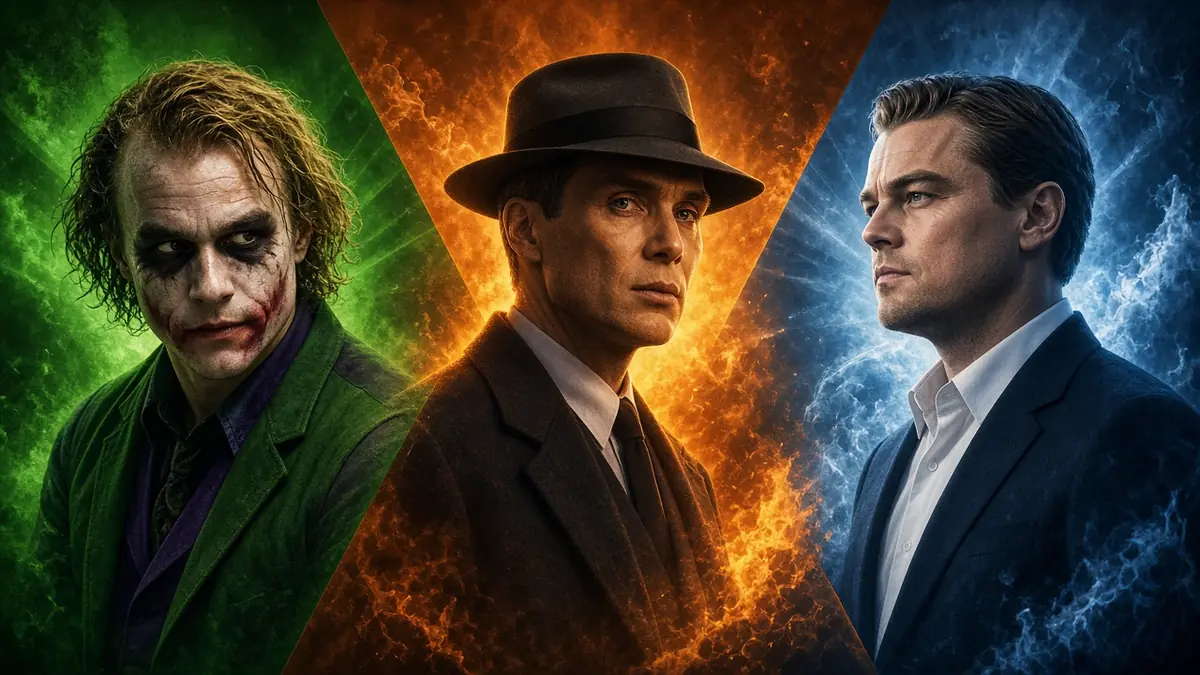
Christopher Nolan has spent nearly three decades making movies that demand our attention and reward repeat viewings. From mind-bending thrillers to superhero blockbusters and historical epics, his films combine ambitious storytelling with unforgettable theatrical experiences. Ranking the best Christopher Nolan movies is especially difficult now that 2026’s The Odyssey has joined his filmography. We’ve weighed each film’s writing, performances, originality, emotional impact and lasting influence to settle on ten favorites. Some of his biggest commercial successes make the cut, but spectacle alone doesn’t guarantee a high position.
10. Tenet (2020)
Tenet might be Nolan’s most divisive blockbuster, but its ambition is difficult to ignore. John David Washington stars as an unnamed CIA operative known as the Protagonist, who discovers a technology capable of reversing the entropy of objects and people. His investigation leads him into a dangerous conspiracy involving Russian arms dealer Andrei Sator, played by Kenneth Branagh. Robert Pattinson provides much-needed charm as Neil, while Elizabeth Debicki brings emotional weight to the role of Sator’s estranged wife, Kat.
The film’s complicated rules sometimes make its dialogue-heavy explanations exhausting, and its characters don’t always receive the attention they deserve. However, watching events unfold in opposite temporal directions produces some extraordinary action sequences. The inverted highway chase and climactic military operation demonstrate Nolan’s determination to explore ideas that conventional action films would avoid. Tenet won the Academy Award for Best Visual Effects, and its technical achievements remain impressive. It ranks tenth because its ingenious mechanics occasionally overwhelm the human story beneath them.
9. Batman Begins (2005)
Before The Dark Knight became a cultural phenomenon, Batman Begins completely reconsidered how Batman’s story could work on screen. Christian Bale stars as Bruce Wayne, a traumatized billionaire who travels the world searching for purpose before returning to Gotham City as a masked vigilante. Nolan grounds the character’s transformation in fear, discipline and moral responsibility rather than relying entirely on superhero spectacle. Michael Caine’s Alfred Pennyworth, Gary Oldman’s Jim Gordon and Liam Neeson’s Henri Ducard give Bruce a compelling network of allies and complicated mentors.
The movie’s greatest achievement is making Batman’s existence feel plausible within a recognizable urban environment. Gotham is plagued by organized crime and institutional corruption, creating problems that cannot simply be solved through extravagant gadgets. Cillian Murphy’s unsettling Scarecrow adds psychological horror to the story, while Hans Zimmer and James Newton Howard’s score establishes the trilogy’s distinctive sound. Batman Begins sometimes moves cautiously compared with its sequels, but its disciplined storytelling gives Nolan’s interpretation of Batman an exceptionally strong foundation.
8. Dunkirk (2017)
Most war movies rely on lengthy character introductions and detailed explanations of military objectives. Nolan takes a different approach in Dunkirk, his dramatization of the 1940 evacuation of Allied troops from France during World War II. The film follows soldiers stranded on the beach, civilians crossing the English Channel by boat and pilots defending the evacuation from the air. Fionn Whitehead, Mark Rylance, Tom Hardy, Kenneth Branagh and Harry Styles appear in an ensemble that communicates extraordinary tension through relatively restrained dialogue.
Its three interlocking timelines cover one week on land, one day at sea and one hour in the air. Nolan gradually brings these perspectives together, transforming the film’s unusual structure into a powerful suspense device. The practical filmmaking, intense sound design and Hans Zimmer’s relentless score make even quiet moments feel dangerous. Dunkirk won three Academy Awards for Film Editing, Sound Editing and Sound Mixing, and it earned Nolan his first Best Director nomination. Its emotional restraint may leave some viewers wanting more characterization, but the cinematic experience is remarkable.
7. The Odyssey (2026)
Nolan ventured into ancient mythology with The Odyssey, his ambitious adaptation of Homer’s epic poem. Released in July 2026, the film stars Matt Damon as Odysseus, the Greek warrior struggling to return home after the Trojan War. Anne Hathaway plays his wife Penelope, while Tom Holland portrays their son Telemachus. Robert Pattinson appears as Antinous, one of the suitors threatening Odysseus’ household. The extensive cast also includes Zendaya, Lupita Nyong’o and Charlize Theron.
What makes The Odyssey a fascinating addition to Nolan’s career is its shift toward mythological adventure without abandoning his familiar interests in time, survival and personal sacrifice. The film was shot entirely using IMAX cameras, bringing enormous physical scale to Odysseus’ perilous encounters with extraordinary creatures and hostile forces. Damon gives the central journey an emotional focus, particularly as the consequences of warfare continue to haunt his character. Some of the film’s grander sequences are more compelling than its quieter character interactions, but its technical ambition is undeniable. A higher placement may come with repeated viewings, though seventh feels appropriate for now.
6. Memento (2000)
Long before Nolan became associated with enormous blockbuster productions, Memento established his reputation for inventive storytelling. Guy Pearce stars as Leonard Shelby, a man living with an inability to form new long-term memories following a traumatic attack. Determined to find the person responsible, Leonard relies on photographs, handwritten notes and tattoos to preserve information about his investigation. Carrie-Anne Moss and Joe Pantoliano play characters whose intentions become increasingly difficult to understand.
Nolan’s screenplay unfolds through interconnected sequences that challenge the audience’s perception of cause and effect. The film alternates between color scenes presented in reverse chronological order and black-and-white sequences moving forward through time. This structure places viewers inside Leonard’s uncertainty, forcing us to question information we thought we understood. Inspired by a story from Nolan’s brother Jonathan, Memento earned Academy Award nominations for Original Screenplay and Film Editing. Its modest scale makes the screenplay’s precision even more impressive, and its final revelations completely transform the experience of watching it again.
5. The Prestige (2006)
Two rival magicians become consumed by their desire to outdo each other in The Prestige, one of Nolan’s most intricately constructed thrillers. Hugh Jackman plays Robert Angier, a charismatic illusionist whose increasingly dangerous obsession with perfection drives the story. Christian Bale portrays Alfred Borden, a technically brilliant magician hiding secrets that threaten his personal relationships. Michael Caine appears as stage engineer Cutter, while David Bowie delivers a memorable performance as inventor Nikola Tesla. Based on Christopher Priest’s novel, the film turns professional rivalry into a disturbing psychological battle.
What begins as a competition between talented entertainers gradually becomes an examination of obsession and the sacrifices people make for recognition. Every performance, conversation and seemingly insignificant detail contributes to the film’s elaborate construction. Nolan’s nonlinear storytelling feels particularly appropriate here because the movie itself operates like a magic trick, encouraging audiences to watch closely while concealing crucial information. Jackman and Bale give contrasting performances that make both characters fascinating and deeply flawed. The Prestige is one of Nolan’s most rewarding films to revisit because its secrets become even more disturbing once their consequences are understood.
4. Interstellar (2014)
Interstellar takes Nolan’s fascination with time and applies it to something profoundly personal: a father’s desperate desire to reunite with his children. Matthew McConaughey stars as Cooper, a former NASA pilot living on an increasingly uninhabitable Earth. When a secret mission offers humanity a possible escape, Cooper leaves his family behind to investigate potentially habitable worlds beyond a wormhole near Saturn. Anne Hathaway plays scientist Amelia Brand, while Jessica Chastain portrays Cooper’s daughter Murph as an adult.
The movie’s scientific ambitions are enormous, involving gravitational time dilation, black holes and interstellar travel. Yet its most unforgettable moments come from the emotional consequences of those ideas. Cooper’s reaction to years of missed messages from his children remains one of McConaughey’s finest scenes, and Hans Zimmer’s organ-driven score intensifies the film’s sense of wonder. Interstellar won the Academy Award for Best Visual Effects, with its depiction of the black hole Gargantua becoming especially celebrated. The final act’s ambitious concepts may divide audiences, but few science-fiction blockbusters have connected cosmic exploration with intimate family drama so effectively.
3. Inception (2010)
Inception might be the purest example of Nolan transforming a complicated original concept into an enormously entertaining blockbuster. Leonardo DiCaprio stars as Dom Cobb, a professional thief who specializes in extracting information from people’s dreams. He’s offered a chance to return to his children if he can accomplish something far more difficult: planting an idea inside someone’s subconscious. Joseph Gordon-Levitt, Elliot Page, Tom Hardy, Marion Cotillard and Cillian Murphy complete a cast that navigates an increasingly dangerous operation across multiple dream levels.
The film’s action sequences are astonishing, particularly the rotating hallway fight and the spectacular destruction of an imagined city. But Inception becomes more compelling when its elaborate dream mechanics expose Cobb’s unresolved guilt over his wife Mal. Hans Zimmer’s thunderous score and Wally Pfister’s cinematography help distinguish the different dream environments without sacrificing their connections. The movie earned eight Academy Award nominations and won four Oscars, including Cinematography and Visual Effects. Its famously ambiguous final shot remains an invitation to revisit the entire story, proving that Nolan can leave audiences debating a movie long after its credits finish.
2. Oppenheimer (2023)
Oppenheimer represented a major achievement for Nolan, transforming a dense historical biography into a gripping cinematic experience. Cillian Murphy stars as J. Robert Oppenheimer, the theoretical physicist who led the Manhattan Project’s Los Alamos Laboratory during the development of the atomic bomb. Emily Blunt portrays his wife Kitty, while Robert Downey Jr. plays Lewis Strauss, whose complicated relationship with Oppenheimer becomes central to the film’s political drama. Florence Pugh, Matt Damon and an extensive ensemble contribute to a story that stretches across several consequential periods of American history.
Rather than simply recount the creation of the atomic bomb, Nolan constructs a psychological portrait of ambition, guilt and political power. The film’s shifting timelines and contrasting visual perspectives build tension around events whose historical outcomes are already known. Murphy delivers an extraordinary lead performance, while Downey’s portrayal of Strauss gives the film a formidable antagonist without reducing its conflict to simple heroism and villainy. Oppenheimer received thirteen Academy Award nominations and won seven Oscars in 2024, including Best Picture, Best Director and Best Actor. Nolan’s first Best Director victory arrived with a film that demonstrated his ability to make an intellectually demanding historical subject feel as urgent as a thriller.
1. The Dark Knight (2008)
Our number one choice remains The Dark Knight, a superhero movie that operates with the intensity of a crime thriller. Christian Bale returns as Bruce Wayne, whose campaign against organized crime brings him into conflict with the Joker, played by Heath Ledger. Unlike conventional villains seeking money or control, the Joker wants to destroy Gotham’s faith in justice and expose the weaknesses of its protectors. Aaron Eckhart portrays district attorney Harvey Dent, whose transformation becomes central to the film’s examination of morality and corruption.
Ledger’s extraordinary performance dominates the movie without overshadowing Nolan’s carefully constructed story. The Joker’s escalating attacks force Batman, Gordon and Dent into increasingly desperate decisions, making the conflict feel genuinely unpredictable. The opening bank robbery, the nighttime truck chase and the hospital confrontation remain exceptional sequences because each serves a clear dramatic purpose. Ledger received a posthumous Academy Award for Best Supporting Actor, and the film also won the Oscar for Sound Editing. His Joker remains one of cinema’s most memorable villains because his frightening unpredictability challenges every principle Batman attempts to defend.
What elevates The Dark Knight above Nolan’s other films is the balance between its blockbuster ambitions and its moral complexity. Batman is repeatedly forced to confront situations where defeating an enemy may require compromising the values that define him. Harvey Dent’s downfall gives the story a tragic dimension, while the ending refuses to offer its hero an uncomplicated victory. Nolan delivers spectacular action without allowing it to replace character development, and the result remains compelling nearly two decades after its release. The Dark Knight takes our top position because its influence on superhero storytelling is matched by the strength of the film itself.
Nolan’s filmography now stretches from the intimate mystery of Memento to the mythological scale of The Odyssey, with each production approaching familiar themes through a different cinematic form. The Dark Knight, Oppenheimer and Inception occupy our top three positions, but their order is certain to inspire disagreement. Would you keep The Dark Knight at number one, or should Oppenheimer, Inception or The Odyssey claim the top spot?