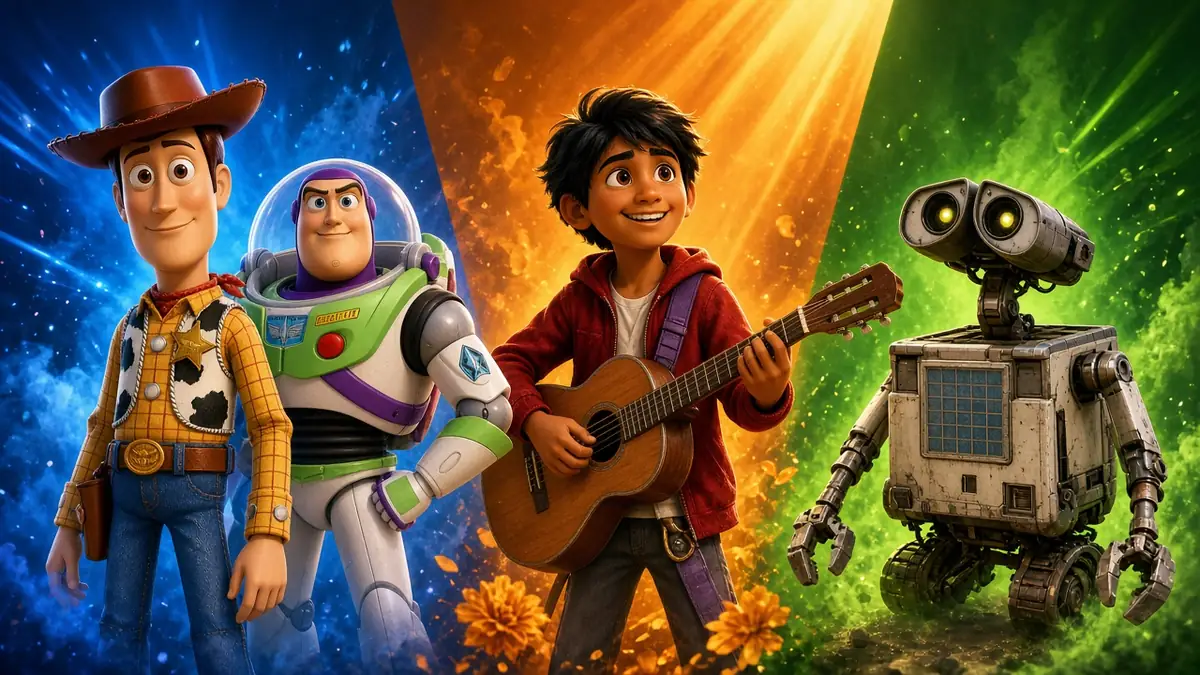
Pixar has spent more than three decades making audiences fall in love with toys, robots, monsters and even the emotions inside their own heads. Since Toy Story changed animation forever in 1995, the studio has produced some of the most imaginative and emotionally devastating films in Hollywood history. But choosing the best Pixar movies means looking beyond box office records and Oscar trophies. We’ve ranked ten of the studio’s finest films based on their storytelling, characters, originality, emotional impact and rewatch value. Some selections might surprise you, but every movie here demonstrates why Pixar became such a dominant force in animation.
10. Monsters, Inc. (2001)
Before Pixar made us cry over robots and imaginary friends, it convinced audiences that the terrifying creatures hiding inside children’s closets were simply employees trying to earn a living. Directed by Pete Docter, Monsters, Inc. follows James P. Sullivan, voiced by John Goodman, and Mike Wazowski, voiced by Billy Crystal, who work at a factory that converts children’s screams into energy. Their comfortable existence collapses when a little girl named Boo accidentally enters their world. Suddenly, the monsters discover that everything they’ve been taught about humans might be wrong.
The friendship between Mike and Sulley gives the movie its irresistible comedy, particularly when their different personalities collide under pressure. Steve Buscemi’s Randall provides an appropriately sinister villain, while Boo brings out a surprisingly gentle side of Sulley. The film’s inventive door-chase sequence remains one of Pixar’s most entertaining action set pieces. Randy Newman’s “If I Didn’t Have You” won the Academy Award for Best Original Song, but it’s the final reunion suggested by Sulley’s smile that gives this monster comedy its enduring emotional punch.
9. Up (2009)
Few animated films have delivered an opening as devastating as Up. Directed by Pete Docter, the movie introduces Carl Fredricksen and his wife Ellie through a largely wordless sequence that follows their relationship from childhood dreams to the end of their life together. It’s an extraordinary piece of visual storytelling that establishes the emotional foundation for everything that follows. Years later, the widowed Carl, voiced by Ed Asner, attaches thousands of balloons to his house and flies toward South America, determined to fulfill the adventure he and Ellie once planned.
What begins as a touching portrait of grief becomes a wonderfully strange adventure when young Wilderness Explorer Russell joins Carl’s journey. Their encounters with an enormous colorful bird, a talking dog named Dug and explorer Charles Muntz transform the film into a lively adventure. Christopher Plummer gives Muntz a menacing edge, while Michael Giacchino’s Oscar-winning score perfectly captures Carl’s longing for the past. Up earned a rare Best Picture nomination for an animated film and won Best Animated Feature. Its greatest achievement, however, is showing how someone can honor a lost relationship without allowing grief to consume the rest of their life.
8. Finding Nemo (2003)
Andrew Stanton’s Finding Nemo takes one of the simplest fears imaginable, losing someone you love, and turns it into an unforgettable underwater adventure. Albert Brooks voices Marlin, an overprotective clownfish who travels across the ocean after his son Nemo is captured by a diver. Along the way, he meets Dory, an exceptionally friendly blue tang with short-term memory loss, voiced by Ellen DeGeneres. Their unlikely partnership becomes the heart of a film filled with dangerous sharks, enormous jellyfish and unforgettable marine creatures.
The movie’s underwater environments were astonishing for 2003, but its spectacular animation would mean little without Marlin’s emotional journey. His fear of losing Nemo makes him understandable, even when his attempts to protect his son become suffocating. Dory provides much of the comedy, yet her vulnerability gives their friendship genuine depth. Finding Nemo won the Academy Award for Best Animated Feature and remains one of Pixar’s most accessible family adventures. Its message about trusting the people we love becomes more meaningful with every rewatch.
7. The Incredibles (2004)
Brad Bird delivered a superhero movie that understood family dysfunction as well as spectacular action. The Incredibles follows Bob Parr, voiced by Craig T. Nelson, a former superhero forced into an ordinary suburban existence after society turns against costumed crime-fighters. His wife Helen, voiced by Holly Hunter, has adapted to their new circumstances, but Bob desperately misses his glory days as Mr. Incredible. When an apparently mysterious assignment offers him another chance at heroism, he unknowingly places his entire family in danger.
What separates The Incredibles from conventional superhero adventures is how cleverly the Parr family’s powers reflect their personalities. Helen stretches herself to accommodate everyone, Violet wants to disappear, and Dash possesses more energy than he knows what to do with. Jason Lee’s Syndrome is an effective villain because his resentment connects directly to Bob’s earlier mistakes. The film won Oscars for Best Animated Feature and Sound Editing, but its greatest accomplishment is making a superhero family feel believable. More than two decades later, its action sequences and sharp domestic comedy remain remarkably entertaining.
6. Ratatouille (2007)
A rat who dreams of becoming a chef sounds like an idea that shouldn’t work. Under Brad Bird’s direction, Ratatouille turns that unlikely premise into one of Pixar’s most sophisticated stories. Patton Oswalt voices Remy, a food-loving rat whose extraordinary sense of taste leads him into the kitchens of an acclaimed Parisian restaurant. There, he forms an unusual partnership with Alfredo Linguini, a clumsy young worker voiced by Lou Romano. Together, they attempt to create remarkable food while hiding the fact that their culinary genius is actually a rodent.
The movie’s affection for cooking gives every kitchen sequence a wonderfully authentic energy, while Michael Giacchino’s music adds considerable charm. Peter O’Toole delivers an unforgettable performance as Anton Ego, a feared food critic whose intimidating reputation becomes central to the film’s final act. His response to Remy’s cooking produces one of Pixar’s most satisfying emotional payoffs. Ratatouille won the Academy Award for Best Animated Feature, and its central argument about creativity remains refreshingly generous. Talent can emerge from unexpected places, even when the world refuses to recognize it.
5. Inside Out (2015)
Pete Docter’s Inside Out takes the complicated experience of growing up and transforms it into an adventure inside a young girl’s mind. Riley, voiced by Kaitlyn Dias, struggles to adjust after her family moves from Minnesota to San Francisco. Inside her head, five emotions work together to guide her behavior, with Amy Poehler’s Joy desperately trying to maintain control. When Joy and Sadness, voiced by Phyllis Smith, accidentally become separated from headquarters, Riley’s emotional world begins to unravel.
The film’s brilliance comes from the way its imaginative setting makes difficult psychological experiences accessible to younger audiences. Personality islands, memory orbs and the unforgettable imaginary friend Bing Bong turn abstract ideas into meaningful storytelling devices. Joy’s determination to keep Riley happy initially seems admirable, but her refusal to accept sadness becomes the film’s central conflict. Inside Out won the Oscar for Best Animated Feature and earned a nomination for Original Screenplay. Its emotional honesty helped establish a foundation that the successful 2024 sequel, Inside Out 2, would later expand upon.
4. WALL-E (2008)
Andrew Stanton’s WALL-E remains one of Pixar’s boldest creative achievements. Set on an abandoned, garbage-covered Earth, the film follows a lonely waste-collecting robot who has spent centuries performing his programmed duties. With humanity living aboard enormous spacecraft, WALL-E develops an affection for discarded objects and finds companionship in a cockroach. His existence changes when EVE, an advanced robot searching for signs of plant life, arrives on the planet. Their growing connection sends WALL-E on a journey far beyond anything he has experienced.
The film’s opening stretch is extraordinary because it communicates personality, loneliness and affection through movement, sound and visual detail rather than conventional dialogue. Ben Burtt’s expressive robot vocalizations help transform WALL-E into an immediately lovable protagonist. Once the action moves aboard the Axiom, the story expands into a pointed critique of consumerism, environmental neglect and humanity’s growing dependence on technology. WALL-E won the Academy Award for Best Animated Feature and received six Oscar nominations in total. Its willingness to trust audiences with extended visual storytelling makes it one of the studio’s most daring films.
3. Coco (2017)
Pixar’s Coco explores family, memory and mortality through a spectacular adventure inspired by Mexico’s Día de los Muertos traditions. Directed by Lee Unkrich and co-directed by Adrian Molina, the film follows Miguel, a young boy voiced by Anthony Gonzalez who dreams of becoming a musician despite his family’s generations-old ban on music. After a mysterious encounter on Día de los Muertos, Miguel finds himself transported to the Land of the Dead. There, he meets Héctor, voiced by Gael García Bernal, and begins uncovering secrets about his family’s past.
The Land of the Dead is among Pixar’s most visually impressive creations, filled with extraordinary architecture, glowing marigold bridges and elaborate character designs. Yet the movie’s emotional center remains its exploration of how families preserve the memories of those they’ve lost. The song “Remember Me” carries dramatically different meanings as the story progresses, culminating in a scene capable of reducing an entire audience to tears. Coco won Academy Awards for Best Animated Feature and Best Original Song. Few Pixar films have connected their visual imagination so beautifully with the emotional importance of remembering loved ones.
2. Toy Story 3 (2010)
Sequels rarely achieve the emotional weight of Toy Story 3. Directed by Lee Unkrich, the film reunites Woody, Buzz Lightyear and their fellow toys as Andy prepares to leave for college. Their owner has grown up, leaving the toys uncertain about their future and desperate to remain together. After a misunderstanding sends them to Sunnyside Daycare, the group initially believes they’ve discovered a wonderful new home. Unfortunately, the daycare’s seemingly welcoming leader, Lotso, hides a darker side beneath his friendly exterior.
Toy Story 3 expertly balances prison-break comedy with a growing sense of loss. Ned Beatty gives Lotso a wonderfully threatening personality, while the toys’ desperate escape from the daycare builds toward an unexpectedly intense sequence at a landfill. The film’s final moments, as Andy introduces his childhood toys to Bonnie, provide an extraordinary farewell to a story that began fifteen years earlier. Toy Story 3 won Oscars for Best Animated Feature and Best Original Song, and it also received a Best Picture nomination. Its ability to make audiences confront the passage of time gives it an emotional power few animated sequels have matched.
1. Toy Story (1995)
Our number one choice is the movie that started everything. Directed by John Lasseter, Toy Story became the world’s first fully computer-animated feature film when it arrived in theaters in November 1995. Tom Hanks voices Woody, a loyal cowboy doll who enjoys being Andy’s favorite toy until the arrival of Buzz Lightyear, an advanced space ranger voiced by Tim Allen. Woody’s jealousy quickly creates a rivalry that sends both characters on a dangerous adventure outside the safety of Andy’s bedroom.
The premise is brilliantly simple, but the execution changed what audiences expected from animated movies. Woody and Buzz possess believable insecurities, competing priorities and personalities that make their friendship feel earned rather than inevitable. Their encounter with the toy-destroying Sid introduces genuine danger, while supporting characters such as Rex, Hamm, Mr. Potato Head and Slinky Dog create an unforgettable ensemble. Toy Story earned three competitive Academy Award nominations, including Original Screenplay, and John Lasseter received a Special Achievement Oscar for the groundbreaking film.
What keeps Toy Story at the top of our ranking is that its characters remain compelling even when separated from the technological breakthrough that made their movie possible. Woody’s fear of being replaced and Buzz’s painful realization about his identity are deeply relatable experiences disguised as a children’s adventure. Their friendship becomes the emotional foundation for one of animation’s most successful franchises. More than thirty years after its release, Toy Story still feels inventive, funny and remarkably assured. It deserves the top position because the film that introduced Pixar to the world remains one of the studio’s finest storytelling achievements.
From the emotional imagination of Inside Out to the unforgettable adventures of Woody and Buzz, Pixar’s greatest films have connected with audiences across generations. With Toy Story, Coco and Toy Story 3 occupying our highest positions, the ranking also leaves room for plenty of debate. Which Pixar movie deserves the number one spot in your personal ranking, and which film from outside this top ten should have made the cut?