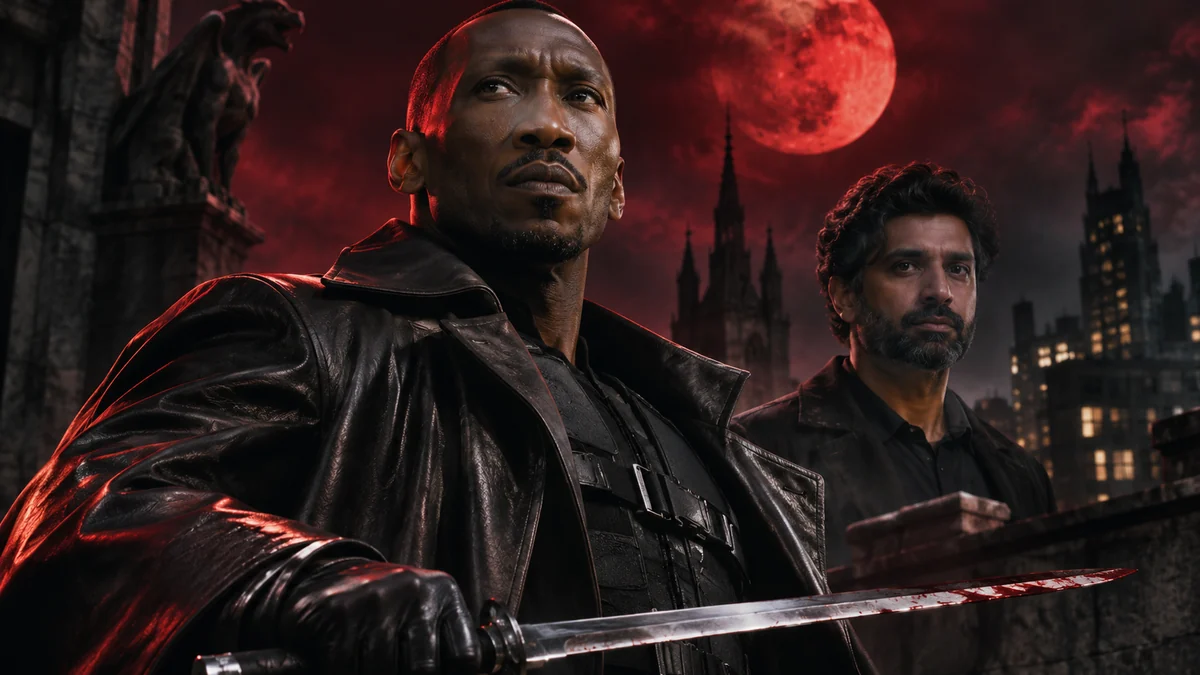
Marvel’s abandoned Blade reboot has become one of the MCU’s most frustrating unfinished projects, and its original director has now explained what went wrong behind the scenes. In a November 20, 2026 interview with The New Arab, filmmaker Bassam Tariq revealed that Marvel began casting actors before the screenplay was properly finished, leaving him struggling to maintain their trust. His comments offer a revealing look at the creative problems surrounding Mahershala Ali’s cancelled superhero movie.
Bassam Tariq says Marvel was casting Blade without a finished script
When Bassam Tariq joined Marvel Studios’ Blade reboot in 2021, the project seemed like an exciting opportunity to bring the famous vampire hunter into the Marvel Cinematic Universe. Mahershala Ali had already been announced as the lead actor, and Marvel was preparing to introduce a completely new version of the character. However, according to Tariq, the development process was already creating serious problems before cameras could begin rolling.
Speaking to The New Arab, the director described the unusual experience of preparing a major studio production while its screenplay remained unfinished. Marvel was moving ahead with casting and other preparations, but Tariq did not have a complete script to show the actors. That meant he was asking performers to commit to characters whose roles could still change substantially as the writing continued.
The situation placed the filmmaker in an uncomfortable position. He had to explain characters and their motivations to actors who were relying on his understanding of the story, even though the final screenplay might contradict those explanations. For a director attempting to build confidence with a cast, that uncertainty was especially damaging.
Tariq described the process as dangerous because an actor could lose trust in the director once the eventual script failed to match what had previously been promised. His concern was about more than an unfinished screenplay. It was about the director’s ability to communicate a consistent creative vision when major decisions remained outside his control.
Corporate decisions damaged the director’s credibility with actors
The most revealing part of Tariq’s interview concerned his relationship with the people he was supposed to direct. He explained that he sometimes had to deliver disappointing news to actors despite having no authority over the decisions responsible for those changes. According to Tariq, those decisions were coming from a corporate entity rather than from him.
That distinction explains why the experience became so difficult. In a traditional director-led production, actors generally expect the filmmaker to understand the story and guide their performances. Tariq found himself representing decisions he had not made, while trying to reassure actors about a screenplay that was still changing.
He also made clear that other filmmakers might be comfortable operating within such a system. For him, however, the arrangement was damaging his professional relationships and his confidence in the production process. He came away believing that he needed much greater authority over the screenplay on future projects.
His strongest statement was that “life’s too short to make shit films.” Tariq described that realization as his biggest lesson from the experience and said he needed full control over his scripts. He also expressed sadness about the abandoned reboot, acknowledging that the creative team had originally been excited about what they hoped to make.
These comments provide new insight into Tariq’s departure, although they should not be mistaken for a complete explanation of every decision that led to Blade’s cancellation. The filmmaker was describing the creative difficulties he personally experienced and what they taught him about working within the studio system. He did not claim that one particular executive or individual decision was solely responsible for the film falling apart.
Marvel’s Blade endured years of rewrites and director departures
Blade was originally announced at San Diego Comic-Con in July 2019, when Kevin Feige introduced Mahershala Ali as the MCU’s new vampire hunter. The casting immediately attracted attention because Ali was a two-time Academy Award winner, while Wesley Snipes had already made the character famous through three live-action movies released between 1998 and 2004. Marvel appeared ready to bring Blade into the same interconnected universe as the Avengers.
Tariq was hired in 2021, following his work on Mogul Mowgli, but the production repeatedly struggled to settle on a creative direction. He departed in September 2022, approximately two months before filming was scheduled to begin. Marvel initially attributed the change to continuing shifts in the production schedule, and Tariq remained attached as an executive producer at that stage.
Marvel subsequently hired Yann Demange, whose previous directing credits included ’71 and episodes of Lovecraft Country. Demange’s involvement briefly suggested that the reboot was moving forward again, but he also left the project in June 2024. By that point, the movie had already experienced repeated delays and substantial changes behind the scenes.
The screenplay underwent an equally complicated development process. Variety reported in November 2023 that at least five writers had worked on Blade, including Stacy Osei-Kuffour and Michael Starrbury. The project also encountered the disruption caused by the 2023 Hollywood writers’ strike, further complicating its path toward production.
Despite the character’s popularity and Ali’s involvement, the planned film never entered principal photography. Marvel eventually abandoned that version of Blade, leaving behind years of development work without a completed movie. For a character who had helped establish Marvel’s theatrical success before the MCU existed, it was a particularly disappointing outcome.
Mahershala Ali has also moved on from the cancelled Marvel movie
Tariq’s latest comments arrive after Mahershala Ali publicly confirmed that he was no longer waiting for the Blade reboot. In a 2026 interview with GQ, the actor explained that he had moved on from the project after years of uncertainty. Ali made it clear that Marvel had possessed the resources and opportunity to produce the movie but had never managed to get it into production.
Marvel Studios president Kevin Feige has also acknowledged the failed project. During a 2026 appearance on the Happy Sad Confused podcast, Feige expressed deep disappointment that the studio had been unable to make Ali’s Blade film. His comments were particularly notable because the character had been announced with considerable fanfare seven years earlier.
The original Blade nevertheless remains part of Marvel’s cinematic history through Wesley Snipes. The actor reprised his version of the vampire hunter in 2024’s Deadpool & Wolverine, appearing alongside other returning characters from earlier Marvel film franchises. His appearance gave audiences another chance to see the character on the big screen, even as Ali’s planned reboot continued to struggle.
For longtime Marvel viewers, the contrast is difficult to ignore. Snipes successfully returned to play Blade after two decades away from the role, while Ali’s version never progressed beyond an uncredited voice appearance in the post-credits scene of Eternals. That scene suggested Marvel had plans to incorporate the character into its expanding supernatural stories, but those plans never resulted in the promised solo film.
Bassam Tariq and Mahershala Ali reunited for an original action movie
Although their Blade collaboration failed, Tariq and Ali eventually found another opportunity to work together. The pair reunited for Your Mother Your Mother Your Mother, a 2026 action thriller written and directed by Tariq. The film premiered at the Toronto International Film Festival in September before receiving a theatrical release through Amazon MGM Studios.
Ali stars as Latif, a former military hitman struggling with grief, fatherhood and his Muslim faith after the death of his wife. The story combines action with personal drama, giving Tariq the opportunity to explore themes that had interested him throughout his filmmaking career. John Cho, Giancarlo Esposito and Tramell Tillman also appear in the movie.
The new project represents a significant contrast with Tariq’s experience at Marvel. Rather than stepping into an established superhero franchise with extensive studio oversight, he developed an original screenplay built around his own creative interests. Ali, meanwhile, was able to put some of the physical preparation he had undertaken for Blade to use in another action-oriented role.
In his latest interview, Tariq also spoke positively about Ryan Coogler’s Sinners, the 2025 vampire horror film starring Michael B. Jordan. He recalled seeing costume work by Ruth E. Carter that had originally been developed for Blade and expressed admiration for the creative freedom Coogler demonstrated with his own original story. His comments made clear that his disappointment with Blade had shaped how he viewed the possibilities of making ambitious genre films outside an established franchise.
Blade’s cancellation leaves a major gap in Marvel’s supernatural plans
The failure of Blade leaves the MCU without the standalone vampire-hunter movie that Marvel first promised in 2019. The character has a long history in Marvel Comics, and the success of Snipes’ original films demonstrated his appeal to audiences well before superhero movies became Hollywood’s dominant blockbuster genre. However, there is currently no confirmed replacement film carrying forward the abandoned Mahershala Ali project.
Tariq’s account also raises broader concerns about the way major franchise productions are developed. Beginning casting before completing a stable screenplay can create problems for performers, directors and production teams, particularly when creative decisions continue changing during preproduction. In Blade’s case, those difficulties were accompanied by multiple writer changes, two director departures and years of postponed filming.
The November 20 interview adds a firsthand perspective to a development history already marked by public disappointment. Tariq’s experience does not explain every factor behind Marvel’s decision to abandon the reboot, but it establishes that screenplay instability and the division of creative authority were significant problems during his involvement. With Ali now focused on other projects and the original reboot cancelled, which would be the better direction for Marvel’s next Blade movie: bringing Wesley Snipes back again or introducing an entirely new actor?
Source: The New Arab