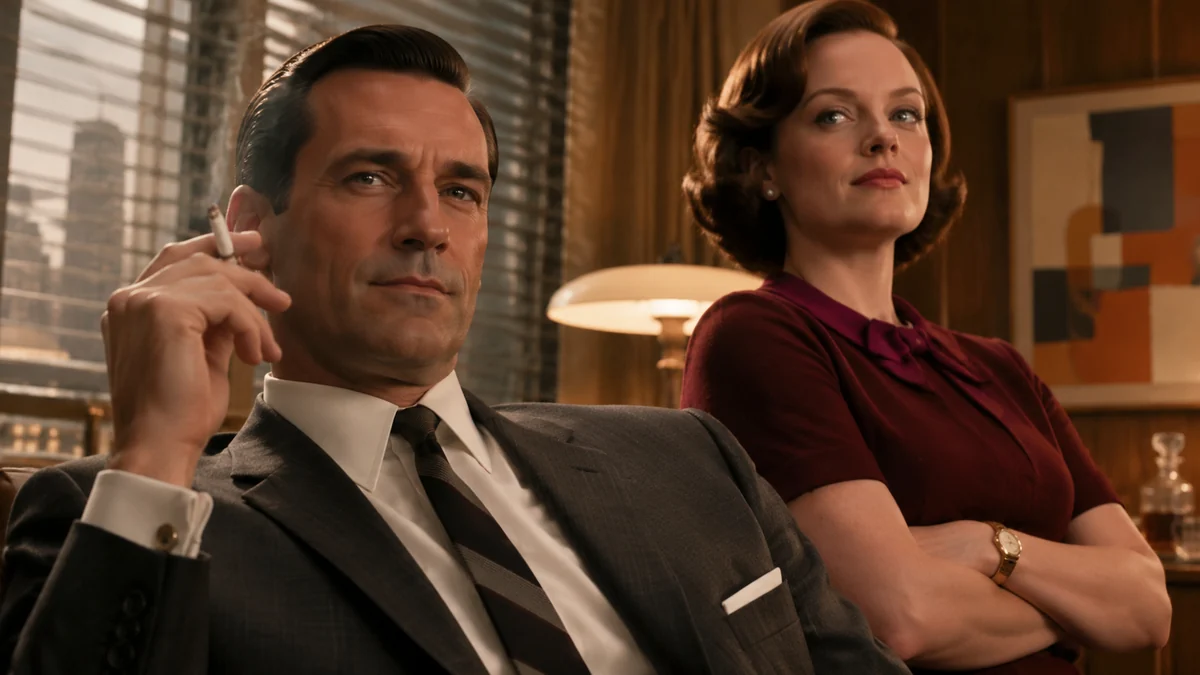
Few television dramas have delivered as many unforgettable episodes as Mad Men. Across seven seasons, Matthew Weiner’s AMC series transformed the world of 1960s advertising into an intimate examination of ambition, identity, marriage and the personal costs of success. From Don Draper’s emotionally devastating encounters with Peggy Olson to the spectacular creation of a new advertising agency, we have ranked the 10 best Mad Men episodes based on their storytelling, performances, character development and lasting impact on the series.
10. The Wheel (Season 1, Episode 13)
Mad Men introduced plenty of brilliant advertising pitches, but few are as emotionally powerful as Don Draper’s presentation for Kodak’s slide projector in the first-season finale. Don calls the device the Carousel and builds his pitch around photographs from his own family life. Instead of selling a machine, he sells nostalgia, the feeling of returning to moments that can never quite be recreated.
The presentation is a masterclass in understanding an audience. Don knows that people do not necessarily want another piece of technology; they want to preserve memories and feel connected to their past. Jon Hamm delivers the pitch with such conviction that it becomes one of the defining scenes of the entire series. It also reveals how deeply Don longs for the family life he struggles to maintain.
The emotional impact becomes even stronger when Don returns home after the presentation. Betty and the children have left for Thanksgiving, and he finds himself alone. The contrast between his ability to sell the idea of a perfect family and his inability to maintain one gives the finale its emotional force. It is an excellent example of how Mad Men could turn an ordinary business assignment into a deeply personal story.
9. The Hobo Code (Season 1, Episode 8)
One of the most revealing early episodes of Mad Men arrives when Don spends time with Midge Daniels and her bohemian friends. Their lifestyle is radically different from the polished corporate environment in which Don usually operates. During the episode, he remembers a childhood encounter with a travelling hobo who once worked for his family and taught him a system of symbols used by people travelling from place to place.
The flashbacks offer an important glimpse into the origins of Don’s complicated relationship with honesty and identity. The hobo recognises the difference between the person someone claims to be and the person they actually are. That lesson stays with Don, who has spent his adult life maintaining an identity that does not belong to him. His attraction to the hobo’s code becomes particularly revealing when viewers understand how much of his own history he has concealed.
The episode also develops Peggy and Pete’s relationship. Peggy receives recognition for her lipstick advertising copy, while her personal involvement with Pete becomes increasingly complicated. Sal faces an uncomfortable situation involving a male client, introducing another storyline about the secrets people must keep in the conservative workplace of the 1960s.
What makes The Hobo Code effective is the way its separate stories connect through the idea of hidden identities. Don, Peggy and Sal are all dealing with different versions of the same problem: the distance between their private lives and the expectations placed on them by others. It establishes the psychological complexity that would become one of Mad Men’s greatest strengths.
8. Meditations in an Emergency (Season 2, Episode 13)
The second-season finale places the characters against the backdrop of the Cuban Missile Crisis, giving the episode an atmosphere of uncertainty that mirrors the problems unfolding inside Sterling Cooper. Don returns to New York after spending time away, while Duck Phillips attempts to take control of the agency. Betty discovers that she is pregnant, but the news does not immediately bring her happiness because her marriage to Don is already in serious trouble.
Meanwhile, Pete finally tells Peggy that he loves her. Peggy responds with one of the most important revelations in their relationship: she tells him that she gave birth to their child and chose to give the baby up for adoption. It is a moment that changes how viewers understand her character and the emotional weight she has carried throughout the series. Elisabeth Moss handles the conversation with remarkable restraint, allowing the significance of the revelation to come through without turning it into an unnecessarily dramatic confrontation.
The episode also explores how people react when they believe their lives could end at any moment. The Cuban Missile Crisis makes ordinary personal disagreements seem much more urgent, forcing characters to consider where they want to be and whom they want beside them. Pete and Peggy’s conversation becomes particularly powerful because they finally address something that has remained unspoken for so long.
The finale brings several major storylines together while leaving the characters facing difficult decisions about their futures. January Jones delivers some of her strongest work as Betty begins questioning the life she has built around Don. The combination of international anxiety, professional uncertainty and personal confessions makes Meditations in an Emergency one of the series’ strongest finales.
7. Far Away Places (Season 5, Episode 6)
Mad Men occasionally experimented with its storytelling structure, and Far Away Places is one of its most interesting examples. Rather than following a conventional beginning-to-end narrative, the episode moves between three separate stories involving Peggy, Roger and Don. Each storyline explores loneliness, frustration and the difficulty of communicating with people who are supposed to be closest to us.
Peggy struggles with her relationship with Abe after an argument exposes the growing distance between them. She also faces professional frustration when Don and Megan leave for an impromptu trip, forcing her to handle a Heinz presentation without their support. Her attempt to secure the account does not go as planned, and her increasingly uncomfortable day eventually leads her to reconsider what she wants from her personal and professional life.
Roger and his wife Jane experience something entirely different when they take LSD at a dinner party. Their altered state leads to an unusually honest conversation about their marriage and the fact that their relationship has effectively ended. Meanwhile, Don and Megan take a road trip to a Howard Johnson’s restaurant in Plattsburgh, where a disagreement about their marriage escalates into a serious confrontation. Don drives away without Megan and later panics when he cannot find her.
The structure is particularly effective because the three stories explore different forms of emotional disconnection. Each character is trying to escape an uncomfortable reality, whether through professional distractions, drugs or arguments. The episode also reveals how much Don and Megan’s marriage has changed since their relationship began. What initially appeared to be Don’s opportunity for a fresh start is becoming another relationship he cannot successfully maintain.
6. Guy Walks Into an Advertising Agency (Season 3, Episode 6)
One of Mad Men’s most shocking moments arrives in an episode whose title initially sounds like the setup for a joke. Sterling Cooper is preparing for changes under its British owners, and the visiting executives include Guy MacKendrick, a talented employee expected to take on an important position. The office is also preparing to say goodbye to Joan, whose professional future appears to be moving in a different direction after her husband Greg secures a surgical position.
The celebrations take an extraordinary turn when a secretary loses control of a riding lawnmower and runs over Guy’s foot. The accident is graphic, sudden and almost absurdly out of place in a series better known for its quiet conversations and complicated relationships. It is one of those television moments that becomes difficult to forget precisely because viewers have no reason to expect it.
However, the real brilliance of the episode comes from how the characters react afterwards. The British executives are less concerned about Guy’s personal suffering than about the damage to his career prospects. Their response exposes the cold corporate mentality operating beneath Sterling Cooper’s polished appearance. A promising career can disappear in seconds, and the company immediately starts thinking about how to manage the consequences.
Lesli Linka Glatter’s direction makes the episode particularly memorable. The combination of dark comedy, workplace politics and shocking violence demonstrates that Mad Men could deliver an unforgettable television moment without abandoning its examination of corporate culture and human behaviour. It also gives Joan an important moment to demonstrate her practical intelligence and ability to handle a crisis.
5. The Other Woman (Season 5, Episode 11)
The Other Woman is among the most difficult episodes of Mad Men to watch because it exposes the sexism that has shaped Joan and Peggy’s experiences at Sterling Cooper Draper Pryce. The agency is pursuing a major Jaguar account, and Pete Campbell sees an opportunity to secure the business by persuading Joan to sleep with a client. In exchange, she would receive a partnership stake in the company.
Joan understands exactly what is being asked of her. She also understands that her professional contributions have repeatedly been undervalued because of the attitudes of the men around her. Her decision is deeply complicated, as the financial and professional reward comes at a personal cost that none of her male colleagues would be expected to pay. Don strongly objects to the proposal, but the other partners eventually agree to the arrangement.
Meanwhile, Peggy faces a different kind of professional humiliation. She develops an advertising proposal for Chevalier Blanc, only to see her contributions overlooked. After years of trying to establish herself in an industry that routinely underestimates her, she begins questioning whether staying at the agency is worth the effort. Her conversation with Freddy Rumsen eventually convinces her that she should pursue another opportunity.
Peggy accepts a position at Cutler, Gleason and Chaough, becoming copy chief at the rival agency. Her departure is a major moment for the character because she has spent much of the series learning from Don. She is now prepared to leave his shadow and pursue an opportunity on her own terms. Christina Hendricks and Elisabeth Moss give the episode two very different but equally compelling performances, making it one of the show’s strongest examinations of women trying to succeed in a male-dominated industry.
4. Commissions and Fees (Season 5, Episode 12)
Lane Pryce’s story reaches its devastating conclusion in Commissions and Fees. After discovering that Lane has forged his signature on a company cheque, Don confronts him and demands that he resign. Don believes he is giving Lane a way out without exposing the financial misconduct, but he fails to understand how completely the situation has destroyed Lane’s sense of dignity and security.
Lane attempts to explain that he had intended to borrow the money temporarily and that his financial circumstances had become increasingly difficult. He also reminds Don of his contributions to the agency, particularly his role in establishing Sterling Cooper Draper Pryce. However, Don refuses to change his decision because the forgery has damaged the trust between them. Jared Harris gives a heartbreaking performance as Lane struggles to accept that his position, professional reputation and future have collapsed.
The situation becomes even more painful when Lane returns home and discovers that his wife has purchased a Jaguar for him. He cannot bring himself to explain his financial problems or the fact that he has been dismissed. His personal desperation eventually leads to a failed suicide attempt, followed by his death by suicide in his office. The discovery is devastating for the remaining employees, particularly because Lane had become an important part of the agency’s identity.
The episode also follows Sally’s visit to Don and Megan, where an uncomfortable personal experience brings her closer to Betty. This storyline provides an interesting contrast to Lane’s tragedy, as Sally begins to understand aspects of growing up while the adults around her struggle with their own problems. Commissions and Fees is one of the series’ darkest episodes, and its emotional impact comes from the way it connects professional failure with personal vulnerability.
3. The Gypsy and the Hobo (Season 3, Episode 11)
Don Draper’s carefully constructed identity finally begins collapsing in The Gypsy and the Hobo. For years, he has managed to keep his real identity hidden, even from the person with whom he shares a home and family. Betty has become increasingly suspicious, particularly after discovering a box containing photographs and documents connected to his past. When she confronts him, Don realises that he can no longer avoid explaining who he really is.
He reveals that his original name was Dick Whitman and that he assumed the identity of Donald Draper after a military accident during the Korean War killed the real Draper. The revelation explains the mystery that has surrounded his character since the beginning of the series. Don has built an entirely new life around a stolen identity, but the emotional consequences of abandoning his past have followed him for years.
The conversation between Don and Betty is one of Jon Hamm and January Jones’s strongest scenes together. Don explains his childhood, his difficult relationship with his family and the circumstances that led him to become someone else. He also discusses his half-brother Adam, whom he rejected after Adam discovered his whereabouts. That decision eventually contributed to Adam’s tragic fate, leaving Don with another source of guilt.
What makes the episode particularly powerful is Betty’s reaction. She does not simply become angry about the lie; she begins questioning whether she has ever truly known the man she married. Don’s explanation cannot immediately repair their relationship, and the damage is already too extensive to ignore. The Halloween scene at the end brings the episode’s central idea into focus when a neighbour looks at Don and asks who he is supposed to be. It is a question that has followed the character throughout the entire series.
2. Shut the Door. Have a Seat. (Season 3, Episode 13)
If there is one episode that captures the excitement of Mad Men’s advertising business, it is the third-season finale. Sterling Cooper is facing a takeover after its British owners sell the agency to McCann Erickson. Don realises that waiting for the situation to resolve itself could destroy everything he has built. Instead, he comes up with a plan to establish a new agency with Roger Sterling, Bert Cooper and Lane Pryce.
What follows is practically a corporate heist. The group must convince the right people to leave, secure important clients and organise an entirely new business before the British owners can stop them. The time difference between London and New York becomes an unexpected advantage as Don and his colleagues work against the clock. Every conversation matters because one wrong move could leave them without an agency, a client base or a future.
The episode is particularly satisfying because it brings together characters whose relationships have developed across three seasons. Roger’s experience, Bert’s business knowledge, Lane’s financial expertise and Don’s ability to persuade people all become essential to the plan. Their collaboration demonstrates why the agency can survive even when the corporate structure around it is falling apart.
There is also a painful personal story unfolding alongside the professional excitement. Betty tells Don that she wants a divorce, forcing him to confront the end of his marriage at the same time that he is trying to protect his career. The contrast between these developments makes the finale even more effective. Matthew Weiner and Erin Levy won the Emmy for Outstanding Writing for a Drama Series for this episode, and it remains one of the most entertaining hours in the entire show.
1. The Suitcase (Season 4, Episode 7)
The best Mad Men episode is arguably the one that strips away almost everything viewers associate with the series. The Suitcase largely centres on Don and Peggy spending an exhausting night together at the office while working on a Samsonite advertising campaign. Their colleagues are distracted by the boxing match between Muhammad Ali and Sonny Liston, while Peggy is supposed to be celebrating her birthday with her boyfriend.
Don refuses to let her leave, insisting that the campaign needs her attention. What initially looks like another example of his demanding management style gradually develops into something much more personal. As the night continues, the two characters drink, argue and reveal details about their lives that they would normally keep hidden. Their professional disagreements also expose how much Peggy has grown since the beginning of the series.
Don is avoiding an important telephone call because he knows it concerns Anna Draper, the woman who knows the truth about his stolen identity. Anna has been one of the few people who understands the real Dick Whitman, and news of her death affects him deeply. His usual professional confidence begins to disappear as his personal grief becomes impossible to contain. Jon Hamm delivers one of his finest performances as Don struggles to deal with a loss he cannot easily explain to anyone around him.
For Peggy, the evening becomes an opportunity to confront the complicated relationship she has with her mentor. She is no longer simply the secretary who impressed Don with her early advertising ideas. She has become a talented creative professional who can challenge him, understand him and occasionally recognise his weaknesses before he recognises them himself. Elisabeth Moss gives the character a wonderful combination of frustration, affection and emotional maturity.
The episode also features one of the series’ most revealing explorations of the relationship between two people who rarely express their feelings directly. Don and Peggy have developed a connection that shifts between professional admiration, resentment, parental dynamics and genuine affection. The Suitcase brings all those elements together without forcing either character into an easy emotional resolution.
Jennifer Getzinger directed the episode, while Matthew Weiner received an Emmy nomination for its writing. The decision to concentrate so heavily on two characters gives their performances room to breathe. By the end, viewers understand that Don and Peggy may never have a conventional relationship, but they have developed a connection that neither can easily replace.
That is what makes The Suitcase the defining Mad Men episode. It contains the series’ greatest strengths: extraordinary performances, carefully constructed dialogue, complicated relationships and the painful distance between the identities people present to the world and the people they really are. If you could recommend just one Mad Men episode to someone who has never watched the series, would you choose The Suitcase or Shut the Door. Have a Seat.?