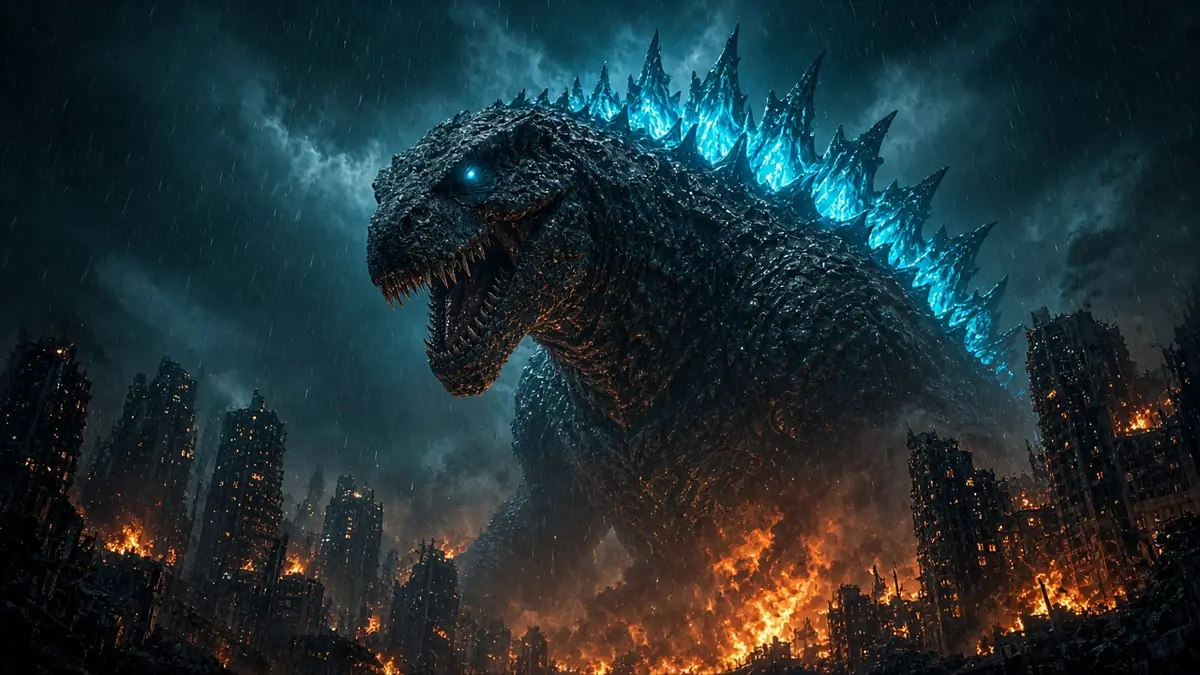
Godzilla has destroyed Tokyo, battled enormous monsters and terrified movie audiences for more than seven decades, but some entries in the franchise are considerably more memorable than others. From Ishiro Honda’s groundbreaking 1954 original to Takashi Yamazaki’s Oscar-winning Godzilla Minus One, the series has repeatedly reinvented its central monster without losing its appeal. With Godzilla Minus Zero breaking box-office records in November 2026, we are ranking the 10 best Godzilla movies that demonstrate why the King of the Monsters remains one of cinema’s greatest creations.
10. Godzilla: Final Wars (2004)
Godzilla: Final Wars is essentially a celebration of everything that makes the franchise entertaining, even when it occasionally abandons subtlety. Directed by Ryuhei Kitamura, the film brings together an enormous collection of monsters, including Rodan, Anguirus, King Caesar, Mothra, Gigan and King Ghidorah. The story follows humanity’s struggle against an alien invasion that uses these creatures to threaten the planet, forcing Godzilla to return as Earth’s ultimate defender.
The film takes an unusually energetic approach to its monster battles, with fast editing, elaborate destruction sequences and even martial-arts-inspired confrontations. Don Frye plays Captain Douglas Gordon, while Masahiro Matsuoka portrays Shinichi Ozaki, one of the central human characters. The result feels closer to an extravagant science-fiction action spectacle than the more restrained Godzilla films that preceded it.
Final Wars is not the strongest entry when it comes to storytelling, and its exaggerated style can be divisive. However, its enormous monster lineup and willingness to embrace the franchise’s strangest ideas make it a particularly enjoyable celebration of Godzilla’s history. It also served as the franchise’s final live-action Japanese theatrical entry before the 2016 reboot.
9. Godzilla vs. Biollante (1989)
Godzilla vs. Biollante is one of the most imaginative entries from the Heisei era. The story begins after Godzilla’s return, when scientists attempt to develop biological technology using cells from the monster. Their experiments eventually produce Biollante, a terrifying creature combining plant life, human genetic material and Godzilla’s cells.
Biollante is one of the franchise’s most unusual opponents because she is neither a conventional monster nor a straightforward experiment gone wrong. Her enormous plant-like body, crocodilian features and grotesque transformations give her a distinctive appearance that separates her from Godzilla’s more familiar rivals. The film also introduces a technological and political dimension through competing organisations seeking to control Godzilla’s biological material.
Director Kazuki Omori gives the story a darker science-fiction atmosphere, exploring the consequences of manipulating nature for military and commercial purposes. The practical creature effects are particularly memorable, especially during Biollante’s enormous final transformation. Although it did not become the biggest commercial success of the franchise, it has developed a devoted following among Godzilla enthusiasts.
8. Godzilla (2014)
Gareth Edwards brought Godzilla back to Hollywood cinemas in 2014 with a film that treated the monster as an enormous natural catastrophe rather than a conventional superhero-style protagonist. The story follows US Navy officer Ford Brody, played by Aaron Taylor-Johnson, as he becomes caught in a crisis involving Godzilla and two enormous parasitic creatures known as MUTOs. Bryan Cranston, Ken Watanabe and Elizabeth Olsen also appear in important roles.
One of the film’s greatest strengths is its approach to scale. Godzilla is frequently shown from the perspective of ordinary people, making his enormous size feel genuinely intimidating. Edwards also builds anticipation by keeping the monster partially concealed during the early sections, allowing the audience to experience his arrival through glimpses and distant destruction.
The film’s San Francisco climax delivers some of the most impressive monster action in the American franchise. Its human storyline is less consistent, but the visual presentation and imposing design of Godzilla make the 2014 film an important modern introduction to the character. It also established the foundation for Legendary Pictures’ MonsterVerse, which subsequently expanded through Kong: Skull Island, Godzilla: King of the Monsters and Godzilla vs. Kong.
7. Mothra vs. Godzilla (1964)
Mothra vs. Godzilla is one of the strongest early examples of the franchise moving beyond the original monster-disaster formula. Released in 1964 and directed by Ishiro Honda, the film introduces a conflict between Godzilla and Mothra, a giant moth-like creature worshipped by the inhabitants of Infant Island. Their confrontation begins after Godzilla emerges near Nagoya, threatening the surrounding population.
The film also introduces the Shobijin, two tiny representatives of Mothra who attempt to convince humanity to respect the creature’s power. Their involvement gives the story an interesting emotional dimension because Mothra’s motivations are tied to protecting her offspring rather than simply defeating another monster. The film gradually builds towards a spectacular battle involving Godzilla and Mothra’s larvae.
What makes this entry especially important is the way it develops the franchise’s monster mythology. Mothra would become one of Godzilla’s most recognisable recurring allies and opponents, appearing in numerous later productions. The film balances environmental themes, human drama and memorable creature action without losing the sense of danger that made the original Godzilla so effective.
6. Godzilla vs. King Ghidorah (1991)
King Ghidorah is arguably Godzilla’s most recognisable recurring enemy, and Godzilla vs. King Ghidorah gives the three-headed dragon one of its most ambitious stories. The film introduces time travellers from the future who claim that Godzilla will eventually destroy Japan. Their proposed solution involves changing the past, but their intervention creates an entirely different threat in the form of King Ghidorah.
The story is considerably more complicated than a straightforward monster battle, incorporating time travel, political manipulation and alternate historical events. However, the central attraction remains the confrontation between Godzilla and his golden three-headed rival. King Ghidorah’s ability to attack with multiple gravity beams makes him a particularly dangerous opponent, while Godzilla’s physical strength gives the battles considerable impact.
The film also explores the relationship between Godzilla and Japan’s national identity, continuing themes that have appeared throughout the franchise. Its time-travel narrative has generated plenty of debate among viewers, but the spectacle of Godzilla fighting King Ghidorah makes it one of the Heisei era’s most memorable productions.
5. Godzilla Minus Zero (2026)
Godzilla Minus Zero has already become one of the most significant recent entries in the franchise. Directed by Takashi Yamazaki, the sequel follows the events of Godzilla Minus One, returning to postwar Japan as the country attempts to recover from the devastation of the previous encounter. Just when ordinary life appears to be returning, another terrifying Godzilla threat emerges.
Ryunosuke Kamiki, Minami Hamabe and Hidetaka Yoshioka return for the sequel, continuing the human story established by its predecessor. Yamazaki again handles the film’s direction, screenplay and visual effects, while the production became the first Japanese feature filmed specifically for IMAX. More than half of the film uses an expanded aspect ratio exclusive to the format, giving its enormous creature sequences additional visual scale.
The theatrical performance has been extraordinary. Godzilla Minus Zero opened in Japan on November 3, 2026, generating approximately ¥910 million on its first day and setting a record for a live-action film in the country. Its North American opening weekend reached approximately $31.6 million, while its worldwide opening approached $63 million, making it a record-setting launch for a Japanese Godzilla production.
It is still early to judge its long-term place in the franchise, but the film has already demonstrated that Japanese Godzilla productions can compete on an enormous international scale. Its placement here reflects its current significance and theatrical achievement rather than a claim that its legacy has already surpassed the established classics.
4. Godzilla (1954)
No ranking of the greatest Godzilla movies can ignore the film that started everything. Ishiro Honda’s original Godzilla emerged during a period when Japan was still dealing with the consequences of World War II and the atomic bombings of Hiroshima and Nagasaki. The monster’s arrival devastates coastal communities and creates a national emergency that the authorities struggle to contain.
Unlike many later entries, the original film presents Godzilla as a terrifying symbol of nuclear destruction. Its appearance is accompanied by images of ruined buildings, injured civilians and overwhelmed emergency services, giving the story a seriousness that distinguishes it from conventional monster adventures. Akira Takarada, Momoko Kochi and Akihiko Hirata deliver performances that keep the human consequences at the centre of the narrative.
Honda’s direction and Eiji Tsuburaya’s special-effects work helped establish the visual language of kaiju cinema. The film also introduced the world to the original Godzilla suit, whose imposing appearance became an essential part of the character’s identity. More than 70 years later, its themes remain relevant, and its influence can be seen throughout the entire franchise.
3. Shin Godzilla (2016)
Shin Godzilla gave the monster one of his most unsettling modern interpretations. Directed by Hideaki Anno and Shinji Higuchi, the film follows an evolving Godzilla as he emerges in Japan and begins causing unprecedented destruction. Rather than focusing exclusively on military confrontations, the story examines how government departments, scientists and political leaders respond to an emergency that existing institutions are unable to understand.
The film’s Godzilla is particularly disturbing because of his ability to evolve. His appearance changes as the story progresses, with each transformation introducing new and increasingly frightening capabilities. The creature’s fourth form, which appears during the climactic confrontation, is one of the most memorable designs in the franchise.
Shin Godzilla also works as a sharp political satire. Its depiction of bureaucratic discussions, delayed decisions and competing institutional interests gives the monster attack a surprisingly grounded dimension. The film won seven Japanese Academy Awards, including Picture of the Year and Director of the Year, demonstrating that a Godzilla production could succeed as both a major genre spectacle and a serious cinematic achievement.
2. Godzilla Minus One (2023)
Takashi Yamazaki’s Godzilla Minus One is among the most emotionally effective films in the entire franchise. Set in Japan shortly after World War II, it follows former kamikaze pilot Koichi Shikishima, played by Ryunosuke Kamiki, as he struggles with guilt and trauma after surviving the war. His already difficult attempt to rebuild his life becomes even more complicated when Godzilla appears and threatens the recovering nation.
The film’s central strength is its human story. Shikishima’s relationship with Noriko Oishi, played by Minami Hamabe, and their adopted daughter Akiko gives the narrative an emotional foundation that makes Godzilla’s attacks feel deeply personal. The monster is terrifying, but the audience also understands what its destruction means for people who have already lost almost everything.
Yamazaki’s visual effects are particularly remarkable considering the film’s relatively modest reported production budget. The destruction sequences are enormous, the creature design is frightening and Godzilla’s atomic breath is among the most spectacular moments in the series. The film received the Academy Award for Best Visual Effects at the 96th Oscars, becoming the first Godzilla movie to win an Academy Award.
Its combination of character development, historical context and monster spectacle makes Minus One an exceptional achievement. It also established the foundation for the 2026 sequel, which has now expanded the story into an international theatrical event. Few recent franchise films have managed to deliver such a convincing balance between emotional drama and blockbuster entertainment.
1. The Return of Godzilla (1984)
The Return of Godzilla takes the top position for its powerful restoration of the monster’s original identity. Directed by Koji Hashimoto, the film ignores the more playful direction taken by several earlier sequels and returns Godzilla to his role as an existential threat. Released in 1984, it effectively reintroduced the character to a new generation while acknowledging the historical significance of the original 1954 production.
The story follows the emergence of Godzilla after decades of relative absence, with Japan facing a dangerous creature that threatens its cities and national security. The film also introduces the complicated international politics surrounding the monster, as the Japanese government must navigate pressure from powerful countries over how to respond. This gives the narrative a tense atmosphere that extends beyond the usual human-versus-monster conflict.
Godzilla’s design is imposing, and the film restores the sense of fear that made the original such a landmark. Its darker approach also established the direction for the Heisei era, which continued with Godzilla vs. Biollante and several other sequels. While later productions improved on its visual effects and emotional storytelling, The Return of Godzilla remains a particularly important turning point in the character’s history.
The film earns the top position because it understood something essential about Godzilla: the monster works best when his presence changes the entire world around him. Rather than treating him as another opponent in an endless series of battles, it restores his identity as a force that humanity cannot fully control. Which of these 10 Godzilla movies deserves the number-one position on your personal ranking?