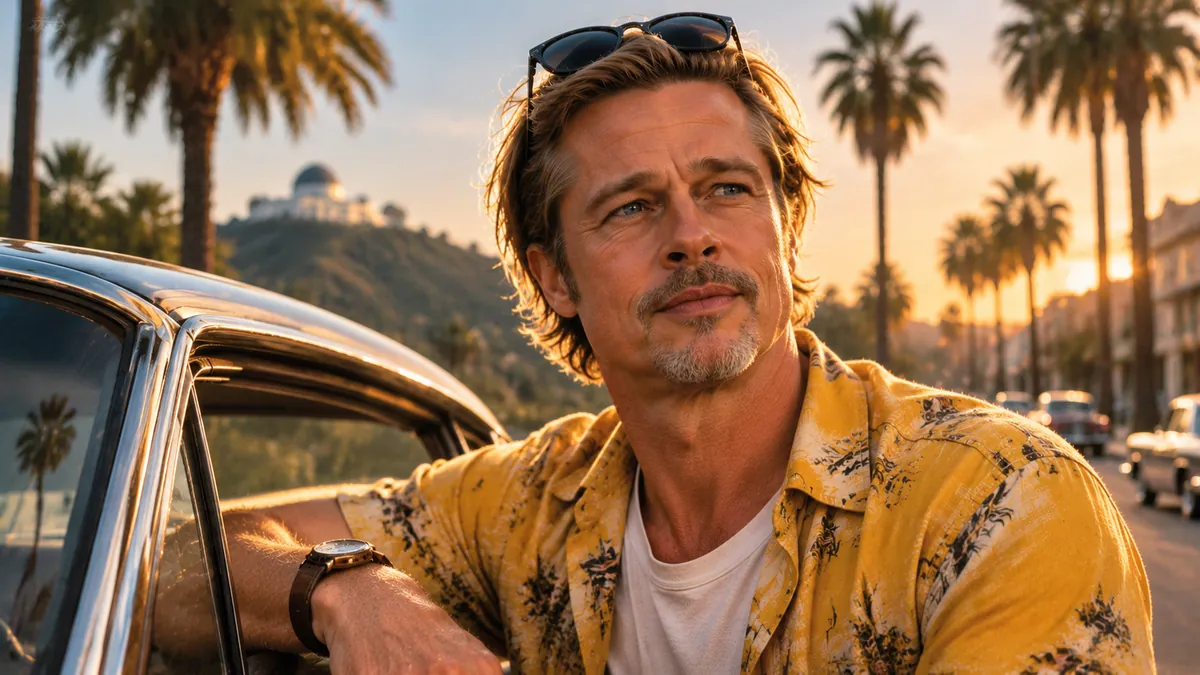
Brad Pitt has spent more than three decades proving that being a Hollywood movie star and being a genuinely versatile actor are two very different things. From playing a dangerously unpredictable criminal in Fight Club to a charming stuntman in Once Upon a Time in Hollywood, he has built a filmography filled with memorable performances. With The Further Mis-Adventures of Cliff Booth arriving in IMAX theatres on November 25 before its Netflix premiere on December 23, 2026, we are revisiting the 10 best Brad Pitt movies that demonstrate why his career continues to attract audiences across generations.
10. Thelma & Louise (1991)
Before Brad Pitt became one of Hollywood’s biggest leading men, a relatively brief supporting performance helped introduce him to a much wider audience. Ridley Scott’s Thelma & Louise follows two women, played by Geena Davis and Susan Sarandon, whose weekend getaway turns into a desperate journey after a violent encounter changes their lives. Pitt appears as J.D., a charming young hitchhiker who enters their story and leaves a lasting impression.
What makes the performance memorable is how comfortably Pitt uses his charisma without dominating the film. J.D. initially appears friendly and attractive, but his behaviour eventually reveals a more complicated character. The role also demonstrates how effectively Pitt could make a relatively small appearance feel significant.
The film itself remains a major achievement, with Davis and Sarandon delivering two of their most celebrated performances. Callie Khouri won the Academy Award for Best Original Screenplay, while the film received six Oscar nominations. For Pitt, this was an important early stepping stone towards the career that followed.
9. Snatch (2000)
Guy Ritchie’s Snatch is a fast-moving crime comedy filled with underground boxing, stolen diamonds, dangerous criminals and characters who constantly find themselves in trouble. Pitt plays Mickey O’Neil, an Irish Traveller boxer whose fighting abilities make him valuable to an unscrupulous promoter. However, Mickey is far more difficult to control than anyone expects.
Pitt’s performance is particularly entertaining because of his deliberately difficult-to-understand accent and unpredictable personality. Mickey communicates in a distinctive manner, often leaving other characters struggling to understand what he is saying. The actor transforms what could have been a straightforward supporting role into one of the film’s biggest attractions.
Jason Statham, Benicio del Toro and Stephen Graham also contribute to the film’s energetic ensemble. Snatch is full of overlapping storylines, sharp dialogue and ridiculous situations, but Mickey frequently steals the attention whenever he appears. It remains one of the strongest examples of Pitt’s ability to embrace comedy without relying on his conventional leading-man image.
8. Ocean’s Eleven (2001)
Steven Soderbergh’s Ocean’s Eleven gave Pitt an opportunity to demonstrate just how effortlessly he could operate inside an ensemble cast. The film follows Danny Ocean, played by George Clooney, as he assembles a team of specialists to rob three Las Vegas casinos in a carefully coordinated operation. Pitt plays Rusty Ryan, Danny’s trusted partner and one of the group’s most capable members.
Rusty is cool-headed, observant and rarely surprised by anything happening around him. Pitt develops excellent chemistry with Clooney, creating a friendship that feels natural rather than manufactured for a crime movie. Their relaxed conversations provide some of the film’s funniest moments, even when the characters are discussing an extraordinarily complicated robbery.
The supporting cast includes Matt Damon, Julia Roberts, Don Cheadle, Bernie Mac and Elliott Gould. Ocean’s Eleven succeeds because every character contributes something distinctive to the operation, while Soderbergh keeps the elaborate plan accessible and entertaining. Pitt’s understated performance is a major reason Rusty remains one of the franchise’s most recognisable characters.
7. 12 Monkeys (1995)
Terry Gilliam’s 12 Monkeys is one of the most unusual science-fiction films in Pitt’s filmography. Bruce Willis plays James Cole, a prisoner sent back through time to investigate the origins of a devastating virus that has nearly destroyed humanity. During his investigation, he encounters Jeffrey Goines, played by Pitt, whose unpredictable behaviour becomes increasingly important to the story.
Jeffrey is eccentric, energetic and frequently disturbing, making him a striking contrast to Willis’s controlled performance. Pitt throws himself into the character with an intensity that feels completely different from the romantic and heroic roles audiences had associated with him. His work earned him the Golden Globe for Best Supporting Actor and his first Academy Award nomination in the same category.
The film’s fragmented storytelling and unsettling atmosphere make it particularly rewarding for viewers who enjoy science fiction that leaves room for interpretation. Gilliam creates a world where memory, identity and reality constantly overlap. Pitt’s performance is an important part of what makes the film so unpredictable.
6. The Assassination of Jesse James by the Coward Robert Ford (2007)
Andrew Dominik’s historical western is a very different kind of Brad Pitt movie. Instead of presenting Jesse James as a straightforward legendary outlaw, the film examines the relationship between the famous criminal and Robert Ford, the young admirer whose obsession eventually turns into betrayal. Pitt plays James with a quiet intensity that makes the character difficult to understand and even harder to predict.
Jesse is charismatic, paranoid and increasingly aware that his reputation is becoming more important to the people around him than his actual presence. Pitt avoids turning him into a romanticised Western hero, allowing his insecurity and cruelty to emerge through small gestures and conversations. Casey Affleck delivers an equally compelling performance as Ford, creating a tense relationship that drives the entire story.
The film also features extraordinary cinematography by Roger Deakins, whose atmospheric photography earned an Academy Award nomination. Its deliberate pace will not appeal to everyone, but the result is a haunting examination of celebrity, loyalty and the destruction of a legend. Pitt’s performance remains one of the most interesting dramatic turns of his career.
5. Moneyball (2011)
Moneyball demonstrates that Pitt does not need explosive action sequences or complicated characters to hold an audience’s attention. Based on Michael Lewis’s book, the film follows Oakland Athletics general manager Billy Beane as he attempts to build a competitive baseball team using statistical analysis and an unconventional approach to player recruitment. Pitt plays Beane as a determined executive who is constantly fighting established thinking within professional baseball.
What makes the performance particularly effective is the combination of confidence and vulnerability. Beane understands that his approach could transform the organisation, but he also faces resistance from people who have spent their careers evaluating players differently. Pitt communicates much of the character’s frustration through restrained conversations and small reactions rather than dramatic speeches.
Jonah Hill plays Peter Brand, the analytical assistant who helps Beane implement the strategy, while Philip Seymour Hoffman appears as manager Art Howe. Their conflicting perspectives create some of the film’s strongest scenes. Pitt received an Academy Award nomination for Best Actor, and the film itself was nominated for Best Picture, Best Adapted Screenplay and several other awards.
4. Se7en (1995)
David Fincher’s Se7en remains one of the defining crime thrillers of the 1990s. The film follows two detectives investigating a serial killer whose crimes are inspired by the seven deadly sins. Pitt plays Detective David Mills, an ambitious young investigator partnered with Morgan Freeman’s experienced Detective William Somerset.
Mills is impulsive, emotional and considerably less patient than Somerset, creating an effective contrast between the two leads. Pitt captures the character’s frustration with the case and his determination to catch the killer, while Freeman provides the calm intelligence that balances their partnership. Their relationship becomes increasingly important as the investigation moves into darker territory.
Fincher’s direction keeps the audience trapped in an atmosphere of constant dread, with the killer’s identity and motivations gradually emerging through the investigation. The film’s final sequence remains one of the most disturbing and memorable endings in modern thriller cinema. Pitt’s performance gives the story an emotional centre that makes its devastating conclusion even more powerful.
3. Inglourious Basterds (2009)
Quentin Tarantino’s Inglourious Basterds takes place during World War II and imagines an alternate history in which a group of Jewish-American soldiers plans to eliminate Nazi leadership. Pitt plays Lieutenant Aldo Raine, the commander of the Basterds, whose unconventional methods make him one of the film’s most entertaining characters. He leads his men with an intimidating confidence and a distinctive Tennessee accent.
Aldo is deliberately larger than life, combining military authority with an almost theatrical personality. Pitt understands exactly how much humour to bring into the performance without undermining the danger surrounding the character. His interactions with Christoph Waltz’s Hans Landa are especially memorable, even though their characters approach power and intimidation in completely different ways.
The film also features outstanding performances from Mélanie Laurent, Diane Kruger and Michael Fassbender. Tarantino builds tension through extended conversations before delivering sudden bursts of violence, and Pitt’s character provides an entertaining counterbalance to the film’s more serious dramatic threads. Inglourious Basterds received eight Academy Award nominations, with Waltz winning Best Supporting Actor.
2. Once Upon a Time… in Hollywood (2019)
Quentin Tarantino reunited with Pitt for Once Upon a Time… in Hollywood, a film that explores the changing entertainment industry of late-1960s Los Angeles. Leonardo DiCaprio plays Rick Dalton, a television actor struggling to maintain his career, while Pitt portrays Cliff Booth, his loyal stunt double and closest friend. The two characters offer different perspectives on an industry that is gradually moving beyond the era they understand.
Cliff is one of Pitt’s most effortlessly entertaining characters. He is relaxed, observant and capable of handling dangerous situations without making a spectacle of himself. Pitt’s chemistry with DiCaprio gives the film much of its emotional appeal, particularly in the quieter scenes where the two men discuss their careers and personal lives.
The performance earned Pitt the Academy Award for Best Supporting Actor, his first competitive acting Oscar. His work is especially effective because he never tries to turn Cliff into a conventional action hero. Instead, he creates a character whose confidence comes from experience, making the film’s climactic events even more satisfying.
1. Fight Club (1999)
David Fincher’s Fight Club takes the top position because it captures one of the most memorable transformations in Pitt’s career. Based on Chuck Palahniuk’s novel, the film follows an unnamed narrator, played by Edward Norton, whose dissatisfaction with modern life leads him into an increasingly dangerous friendship with Tyler Durden. Pitt plays Tyler, a charismatic and anarchic figure who challenges everything the narrator believes about society and identity.
Tyler is immediately fascinating because of the confidence with which he approaches almost everything. His philosophy, appearance and unpredictable behaviour make him an unforgettable cinematic presence, but the character’s appeal gradually becomes inseparable from the disturbing consequences of his ideas. Pitt balances humour, menace and charisma in a performance that gives the film much of its enduring impact.
Fight Club was initially divisive among critics and audiences, but it developed a major cult following in the years after its release. Its commentary on consumerism, masculinity and alienation continues to attract discussion, while its narrative structure rewards repeat viewings. Pitt’s portrayal of Tyler Durden remains one of the defining performances of his career and a role that continues to influence popular culture.
Brad Pitt’s next chapter as Cliff Booth
Pitt’s upcoming return in The Further Mis-Adventures of Cliff Booth makes this ranking particularly timely. Directed by David Fincher and written by Quentin Tarantino, the film brings back the character introduced in Once Upon a Time… in Hollywood, with the story moving forward to 1977. Cliff now works as a Hollywood fixer, taking on unusual assignments involving the entertainment industry’s powerful figures and criminal underworld.
The film also features Elizabeth Debicki, Scott Caan, Carla Gugino, Yahya Abdul-Mateen II and Peter Weller. It is scheduled for an exclusive two-week IMAX theatrical run beginning November 25, 2026, before arriving on Netflix on December 23. With Pitt returning to a character that earned him an acting Oscar, which of these 10 films would you rank as his greatest performance?