“`
Marvel has given us some extraordinary superheroes, but the best MCU villains are often the characters who make their stories unforgettable. Thanos defeated the Avengers when almost nobody expected him to win, Loki transformed from a jealous brother into one of Marvel’s most beloved characters, and Killmonger forced Black Panther to confront uncomfortable truths about Wakanda. With Robert Downey Jr.’s Doctor Doom preparing to challenge Earth’s mightiest heroes in Avengers: Doomsday, there’s no better time to revisit the villains who set the standard.
We’ve ranked the ten greatest MCU villains based on their performances, motivations, impact on the heroes and lasting importance to Marvel’s stories. This includes antagonists from the movies and television series, along with characters who eventually moved beyond their villainous beginnings. Doctor Doom isn’t eligible yet because his upcoming Avengers appearance hasn’t been released, but the competition he’s entering is already formidable.
10. Hela – Thor: Ragnarok (2017)
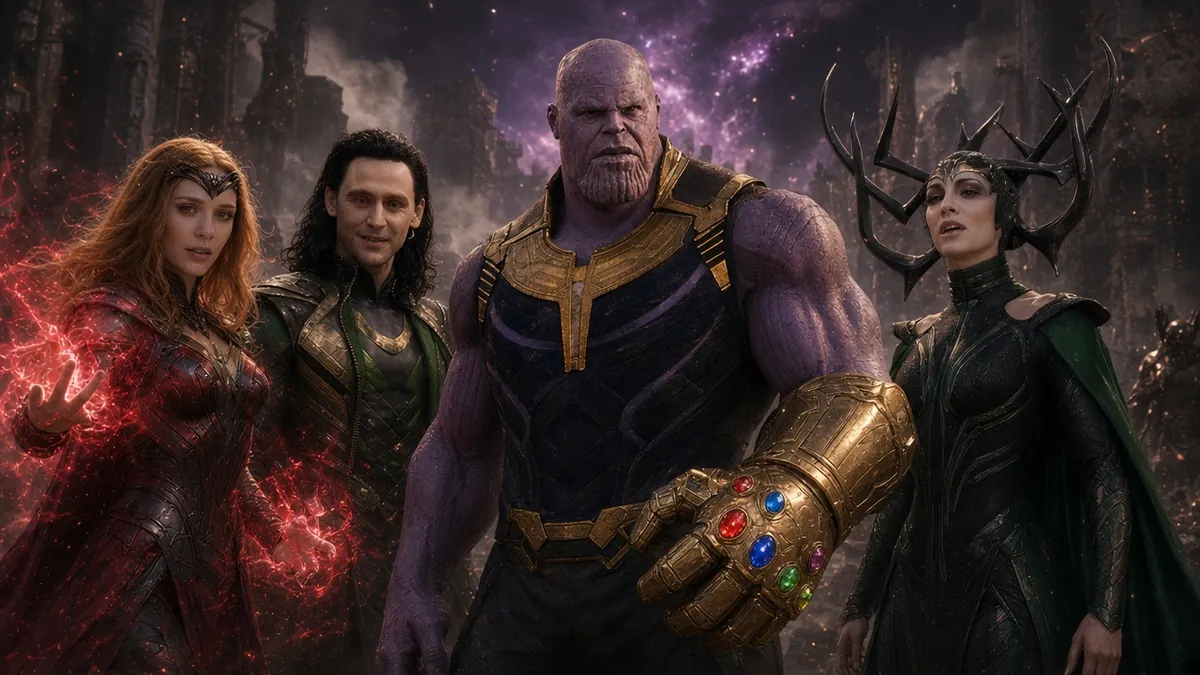
Cate Blanchett’s Hela makes one of the most spectacular entrances of any Marvel villain. Moments after appearing in Thor: Ragnarok, the Goddess of Death catches Mjolnir with one hand and destroys the hammer that had defined Thor’s power since his first movie. It’s an extraordinary demonstration of strength, immediately establishing that Thor and Loki are facing an enemy unlike anything they’ve encountered before.
What makes Hela interesting goes beyond her terrifying abilities. As Odin’s firstborn, she reveals that Asgard’s supposedly glorious history was built through conquest and violence, challenging Thor’s understanding of his father’s legacy. Her desire to reclaim the throne is rooted in that history, even though her ambition threatens to destroy the kingdom she believes belongs to her.
Blanchett balances theatrical confidence with genuine menace, making Hela entertaining whenever she appears. Her confrontation with Asgard’s defenders and the undead army she commands give Ragnarok some of its most memorable imagery. The character ranks lower because her motivations receive less development than those of Marvel’s strongest villains, but few antagonists make such an immediate impression.
9. Vulture – Spider-Man: Homecoming (2017)
Michael Keaton’s Adrian Toomes proves that a Marvel villain doesn’t need cosmic powers or plans for world domination to be frightening. After losing his salvage business contract following the Battle of New York, Toomes begins selling weapons built from recovered alien technology. His criminal enterprise grows from resentment toward wealthy institutions that can destroy smaller businesses without experiencing the consequences.
That motivation gives Vulture an unusually grounded identity. He isn’t trying to conquer New York or eliminate humanity; he wants to provide for his family while convincing himself that his illegal activities are justified. Keaton makes this self-deception believable, allowing audiences to understand Toomes’ frustration without excusing his willingness to endanger innocent people.
His greatest moment comes when Peter Parker discovers that Toomes is the father of his homecoming date, Liz. The tense car ride that follows transforms an ordinary family interaction into one of the MCU’s most uncomfortable confrontations, especially when Toomes realizes Peter is Spider-Man. The scene works because Keaton barely needs his mechanical wings to become terrifying, proving how effective a personal villain can be.
8. Scarlet Witch – Doctor Strange in the Multiverse of Madness (2022)
Wanda Maximoff’s transformation into the antagonist of Doctor Strange in the Multiverse of Madness remains one of Marvel’s darkest character developments. Elizabeth Olsen had already established Wanda as a grieving hero through Avengers: Infinity War, Endgame and WandaVision. However, her desperation to reunite with Billy and Tommy, combined with the corrupting influence of the Darkhold, pushes her toward increasingly horrifying decisions.
Her pursuit of America Chavez turns the movie into an unusually intense supernatural thriller. Wanda attacks Kamar-Taj, travels through the multiverse using forbidden magic and eliminates several members of Earth-838’s Illuminati. These sequences reveal the horrifying extent of her abilities, particularly when opponents who would normally be considered exceptionally powerful struggle to survive even brief encounters with her.
What prevents Scarlet Witch from ranking higher is the uneven transition between WandaVision’s emotionally complicated ending and her considerably more ruthless behavior in Multiverse of Madness. Nevertheless, Olsen makes the character’s grief and desperation painfully convincing. Wanda’s villainous chapter is especially disturbing because audiences spent years watching her attempt to become a hero, only to see her greatest vulnerabilities become the source of her cruelty.
7. The High Evolutionary – Guardians of the Galaxy Vol. 3 (2023)
Chukwudi Iwuji’s High Evolutionary is one of the MCU’s most thoroughly detestable villains, and that’s precisely what makes him effective. Obsessed with creating a supposedly perfect civilization, he conducts horrific experiments on living creatures and treats their suffering as an acceptable consequence of scientific progress. His connection to Rocket transforms Guardians of the Galaxy Vol. 3 from another cosmic adventure into a deeply personal confrontation with abuse and exploitation.
The movie’s flashbacks reveal Rocket’s childhood alongside Lylla, Teefs and Floor, three other experimental subjects who become his closest companions. Their experiences expose the cruelty behind the High Evolutionary’s intellectual arrogance, while Rocket’s unusual intelligence eventually becomes something his creator cannot tolerate. Rather than appreciating Rocket’s abilities, the villain grows increasingly furious that one of his experiments might have achieved something beyond his own understanding.
Iwuji’s performance makes the character genuinely unsettling because his polished manner can disappear into explosive cruelty without warning. His willingness to destroy an entire civilization when it fails to meet his expectations demonstrates how little he values individual lives. Unlike Killmonger or Thanos, the High Evolutionary receives almost no sympathetic justification for his actions, making the Guardians’ determination to defeat him enormously satisfying.
6. Baron Zemo – Captain America: Civil War (2016)
Daniel Brühl’s Helmut Zemo accomplished something that countless superpowered villains failed to achieve: he tore the Avengers apart without possessing any extraordinary abilities. Introduced in Captain America: Civil War, Zemo is a former Sokovian intelligence officer whose family died during the Avengers’ battle against Ultron. Rather than attempting to defeat the heroes through physical combat, he develops a calculated plan to destroy their trust in one another.
Zemo understands that the Avengers’ greatest weakness is their complicated personal history. By manipulating events surrounding Bucky Barnes and revealing the truth about the deaths of Tony Stark’s parents, he transforms an already divided team into enemies. The resulting confrontation between Iron Man, Captain America and the Winter Soldier becomes devastating because each character believes they have a personal reason to fight.
His return in The Falcon and the Winter Soldier further develops his hatred of superhuman power while allowing Brühl to explore the character’s dry humor and aristocratic personality. What makes Zemo remarkable is that his original plan succeeds even though he never physically overpowers an Avenger. He proves that an intelligent antagonist with the right information can be every bit as dangerous as someone wielding an Infinity Stone.
5. Kingpin – Daredevil and Daredevil: Born Again
Vincent D’Onofrio’s Wilson Fisk has become the defining villain of Marvel’s street-level television stories. Introduced in Daredevil, Fisk controls New York’s criminal underworld while presenting himself as a businessman determined to improve his city. His relationship with Vanessa Marianna reveals a more vulnerable side, but that humanity never prevents him from committing extraordinarily brutal acts when someone threatens his ambitions.
D’Onofrio gives Fisk an unusual combination of quiet restraint and explosive violence. He can appear almost painfully awkward during a personal conversation before becoming terrifyingly aggressive when his authority is challenged. This unpredictability makes his confrontations with Charlie Cox’s Matt Murdock compelling, particularly because both men claim to want a better New York while having fundamentally incompatible ideas about how to achieve it.
Daredevil: Born Again expands Fisk’s power by making him New York City’s mayor, allowing him to pursue his enemies through political authority and the Anti-Vigilante Task Force. The second season, released in March 2026, pushes that conflict further as Daredevil organizes resistance against Fisk’s increasingly oppressive administration. Kingpin earns his position because his threat has evolved from organized crime into institutional control without losing the frightening personality that made him memorable.
4. Green Goblin – Spider-Man: No Way Home (2021)
Willem Dafoe had already delivered one of the most memorable comic-book villain performances in 2002’s Spider-Man, but his return in Spider-Man: No Way Home introduced that same character to the MCU’s multiverse storyline. Norman Osborn initially appears frightened and confused after arriving in an unfamiliar reality, giving Peter Parker reason to believe he deserves help. Unfortunately, the Green Goblin personality soon returns, turning Peter’s compassion into a devastating vulnerability.
Dafoe’s performance is particularly effective because he can switch between Norman’s helplessness and the Goblin’s sadistic confidence. During the confrontation inside Happy Hogan’s apartment building, the villain absorbs Spider-Man’s punches with an unsettling grin before unleashing a brutal attack. The sequence culminates in Aunt May’s death, leaving Tom Holland’s Peter Parker consumed by grief and anger.
Unlike villains who want political power or universal control, Green Goblin seems driven by the pleasure of corrupting Spider-Man’s moral principles. He wants Peter to abandon compassion and embrace the violence he is capable of inflicting, making their final battle deeply personal. Dafoe’s return works because his villain attacks the very beliefs that define Spider-Man, creating one of the MCU’s most emotionally destructive conflicts.
3. Erik Killmonger – Black Panther (2018)
Michael B. Jordan’s Erik Killmonger remains one of Marvel’s most compelling villains because his anger emerges from an injustice the film never dismisses. Born N’Jadaka, he grows up in Oakland after his father is killed by King T’Chaka, leaving him disconnected from his Wakandan heritage. When he eventually returns to claim the throne, his resentment extends beyond his personal tragedy to Wakanda’s refusal to use its extraordinary resources to help oppressed people elsewhere.
Killmonger’s criticism of Wakandan isolationism creates a genuine ideological challenge for T’Challa. He argues that the kingdom has ignored suffering around the world despite possessing technology capable of changing countless lives. However, his proposed solution involves distributing weapons and encouraging violent global uprisings, revealing how his desire for justice has become inseparable from revenge and domination.
Jordan balances rage, confidence and vulnerability, making Killmonger feel like someone whose life might have taken a completely different direction under other circumstances. His final conversation with T’Challa provides one of Black Panther’s most powerful emotional moments, while his challenge permanently influences the hero’s understanding of Wakanda’s responsibilities. Few MCU antagonists have forced a protagonist to reconsider his beliefs as profoundly as Killmonger.
2. Loki – Thor (2011) and The Avengers (2012)
Tom Hiddleston’s Loki began as a jealous prince seeking his father’s approval and eventually became one of the MCU’s most complicated characters. In Thor, his discovery that he is actually a Frost Giant intensifies his resentment toward Odin and his adopted brother. By The Avengers, that insecurity has developed into a dangerous desire for domination, leading him to invade Earth with an alien army and threaten humanity’s freedom.
Loki’s early appearances work because his theatrical arrogance conceals a desperate need for recognition. Hiddleston moves effortlessly between humor, manipulation, vulnerability and cruelty, making Loki entertaining even when his plans are clearly monstrous. His complicated relationship with Thor also gives the character an emotional foundation that many of Marvel’s other villains never receive.
What truly distinguishes Loki is the transformation that follows. Through Thor: Ragnarok, Avengers: Infinity War and his Disney+ series, different stages of his story explore sacrifice, responsibility and the possibility of escaping a supposedly predetermined identity. By the end of Loki Season 2, the variant introduced in the series makes an extraordinary sacrifice to preserve the branching timelines, completing a journey far removed from his original ambitions.
That evolution makes Loki difficult to classify as a villain today, but his early antagonistic role remains essential to the MCU’s history. He helped establish the Avengers as a team and demonstrated how a supervillain could remain compelling across multiple films without constantly repeating the same motivations. Hiddleston’s performance gives Loki the strongest long-term character development of anyone on this list, even if another villain claims the top position.
1. Thanos – Avengers: Infinity War (2018) and Endgame (2019)
Josh Brolin’s Thanos takes first place because no other MCU villain has combined such enormous stakes with an equally devastating impact on the heroes. After years of appearances and references, the Mad Titan finally becomes the central antagonist of Avengers: Infinity War, pursuing all six Infinity Stones to eliminate half of all living beings. His belief that this mass destruction will restore balance to the universe gives his mission a warped internal logic, even though the reasoning is morally indefensible.
What separates Thanos from a typical world-ending antagonist is the way Infinity War structures its story around his pursuit of the Stones. He defeats the Hulk, sacrifices Gamora to obtain the Soul Stone, overpowers several groups of Avengers and repeatedly proves that even their combined strength might not be enough. Every victory brings him closer to completing a mission the audience desperately wants him to abandon.
Then comes the moment that changed the MCU forever. Despite the heroes’ efforts, Thanos obtains the final Infinity Stone and snaps his fingers, causing half of all life to disappear. The deaths of characters including Spider-Man, Black Panther and Doctor Strange transform what might have been another superhero finale into an extraordinary defeat for the Avengers.
Avengers: Endgame explores the consequences of that victory before introducing a younger version of Thanos who becomes determined to eliminate the existing universe and rebuild it. The difference between the two versions reveals the destructive certainty beneath his supposedly noble mission. When confronted with resistance, Thanos abandons any pretense of compassion and demonstrates that his vision of universal balance has always depended on his unquestioned authority.
Brolin’s performance gives the character weight through restrained dialogue, physical confidence and moments of personal conflict, particularly involving Gamora. The motion-capture effects also allow Thanos to convey subtle expressions that make his interactions more convincing than those of many earlier digital antagonists. His victory reshaped the MCU’s narrative, and the Avengers needed an entire second movie to reverse its consequences.
Thanos remains the standard against which Marvel’s biggest villains are measured because he wins, forces the heroes to change and leaves consequences that extend far beyond his own defeat. Loki may possess the more elaborate character journey, while Killmonger offers a stronger ideological challenge, but Thanos delivers the franchise’s most consequential confrontation. With Doctor Doom preparing to enter the Avengers’ story, which MCU villain do you believe presents the toughest challenge for Robert Downey Jr.’s new character to surpass?