“`
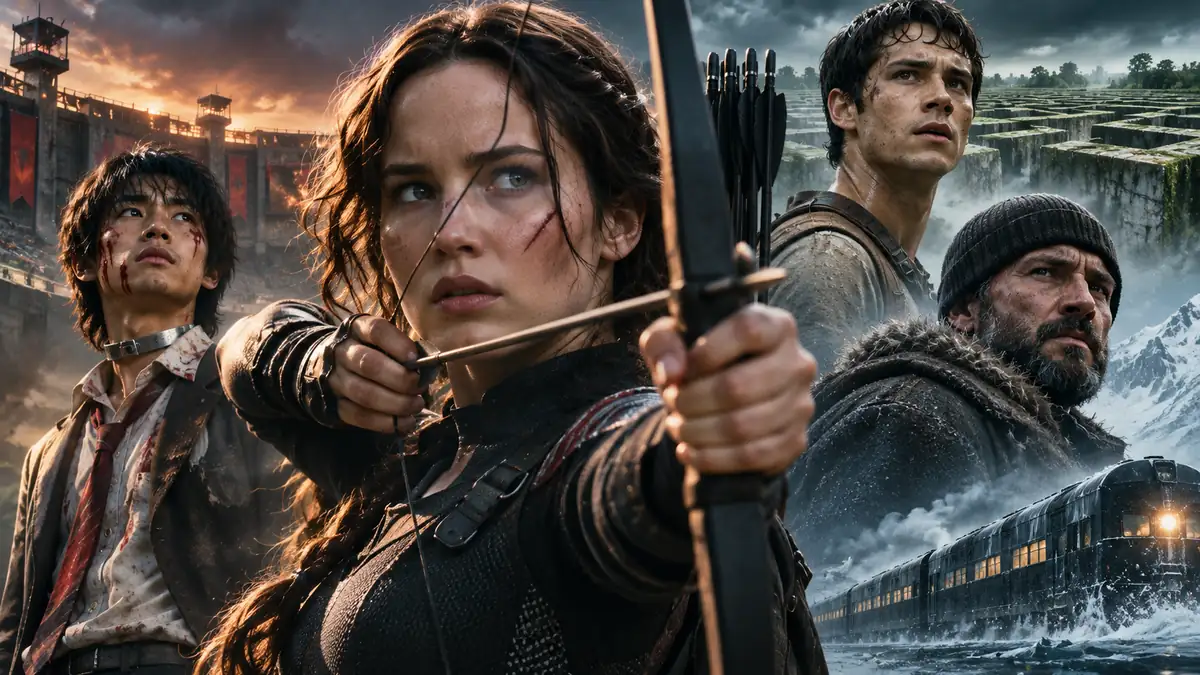
The Hunger Games made dystopian survival stories irresistible by combining deadly competitions, political rebellion and characters forced to make impossible choices. With Sunrise on the Reaping returning audiences to Panem, there’s plenty of reason to revisit other movies that explore similar worlds. From teenagers trapped in government-controlled death matches to revolutionaries fighting brutal regimes, these ten films deliver the danger, tension and moral dilemmas that made Katniss Everdeen’s story so compelling.
We’ve ranked these movies based on their storytelling, characters, dystopian worldbuilding and similarities to The Hunger Games. Some are direct matches for the franchise’s survival-game premise, while others explore its deeper themes of authoritarian control, inequality and resistance. Whether you’re looking for another Katniss-style protagonist or something considerably darker, these films deserve a place on your watchlist.
10. The Giver (2014)
Before teenagers were fighting to survive in Panem, Lois Lowry’s novel The Giver had already explored the disturbing consequences of a society that eliminates individual choice. Its 2014 film adaptation stars Brenton Thwaites as Jonas, a teenager living in a seemingly peaceful community where emotions, memories and personal freedom are tightly controlled. Everyone has an assigned role, and citizens are raised to accept the rules without questioning the people who created them.
Everything changes when Jonas becomes the Receiver of Memory, a position that gives him access to humanity’s forgotten experiences. Under the guidance of the Giver, played by Jeff Bridges, he discovers emotions and historical truths that challenge everything he has been taught. The movie also features Meryl Streep as the Chief Elder, whose determination to preserve social order creates an intimidating obstacle.
The connection to The Hunger Games comes from the way both stories expose the cruelty beneath a supposedly orderly society. Jonas and Katniss begin as ordinary teenagers who gradually realize that their governments depend on controlling what people know and experience. The Giver is less action-heavy and its adaptation has limitations, but its ideas about conformity and rebellion make it an interesting companion to Collins’ franchise.
9. The Purge (2013)
Imagine living in a country where the government encourages violence instead of preventing it. That’s the horrifying premise of James DeMonaco’s The Purge, which takes place in a dystopian United States where nearly all crimes become legal during one annual 12-hour period. Ethan Hawke and Lena Headey play James and Mary Sandin, a wealthy couple whose supposedly secure home becomes a nightmare when a stranger seeks refuge from a murderous group.
The movie initially plays like a home-invasion thriller, but its political premise gives the violence a disturbing purpose. Wealthier citizens can purchase elaborate security systems, while vulnerable people face far greater exposure to the night’s brutality. As events unfold, the Sandin family must decide whether protecting themselves justifies abandoning someone who desperately needs help.
Much like the Capitol’s Hunger Games, the Purge transforms organized violence into a government-sanctioned tradition. Both societies present cruelty as something necessary for their continued stability, forcing ordinary citizens to participate in systems that benefit those already holding power. The first Purge movie doesn’t explore its wider society as extensively as later installments, but its central concept remains unsettlingly effective.
8. Divergent (2014)
If you’re searching for another young-adult dystopian adventure with a rebellious heroine, Divergent is one of the closest matches. Based on Veronica Roth’s novel, the film stars Shailene Woodley as Beatrice “Tris” Prior, a teenager living in a futuristic Chicago divided into five factions according to personality traits. Every citizen is expected to conform to a specific social identity, but Tris discovers that she doesn’t fit neatly into the system.
After choosing the fearless Dauntless faction, Tris undergoes dangerous physical and psychological training while hiding her unusual identity. Her relationship with instructor Four, played by Theo James, develops alongside her growing understanding of the government’s methods of control. Kate Winslet’s Jeanine Matthews becomes a formidable antagonist whose plans threaten people who cannot be categorized.
Tris shares Katniss’ instinct to challenge rules that demand obedience at the expense of individuality. Both heroines become dangerous to their governments simply because they refuse to behave as expected, and their personal struggles eventually develop into larger political conflicts. Divergent doesn’t have The Hunger Games’ strongest social commentary, but its initiation sequences, romance and rebellious protagonist make it an easy recommendation for fans.
7. The Maze Runner (2014)
Waking up in an unfamiliar place with no memory of how you arrived would be terrifying enough. The Maze Runner makes that situation considerably worse by placing Dylan O’Brien’s Thomas inside the Glade, an enclosed settlement surrounded by enormous moving walls. Beyond those walls lies a constantly changing maze inhabited by deadly creatures known as Grievers, and nobody understands who created the environment.
Thomas quickly realizes that the teenagers living in the Glade have developed their own survival system, complete with designated responsibilities and strict rules. However, his curiosity and refusal to accept the group’s limitations gradually push them toward dangerous discoveries. Kaya Scodelario, Thomas Brodie-Sangster and Will Poulter help create an ensemble whose conflicting personalities keep the tension alive.
The strongest similarity to The Hunger Games is its reliance on young characters trapped inside an artificially controlled environment. Both movies create suspense by gradually revealing that the danger surrounding their protagonists is part of something larger than the characters initially understand. The Maze Runner places greater emphasis on mystery and escape than political spectacle, making its unpredictable environment the movie’s greatest strength.
6. The Running Man (1987)
Long before Jennifer Lawrence volunteered as tribute, Arnold Schwarzenegger starred in a dystopian action movie about a deadly television competition. Directed by Paul Michael Glaser and loosely adapted from Stephen King’s novel, The Running Man follows Ben Richards, a former police officer framed for a massacre in a totalitarian America. He eventually becomes a contestant on a violent game show where criminals must survive professional killers known as Stalkers.
Richard Dawson plays Damon Killian, the manipulative television host who turns suffering into entertainment for a captivated audience. The government-controlled media system uses edited footage, manufactured narratives and carefully staged performances to shape public opinion. Richards must fight for his life while confronting the people responsible for turning the competition into a tool of political control.
The similarities to The Hunger Games are impossible to ignore, particularly the combination of televised violence and authoritarian propaganda. President Snow’s Capitol uses spectacle to reinforce its power, while Killian’s television network manufactures heroes and villains to serve the state. The Running Man is considerably more exaggerated, with Schwarzenegger delivering the action and wisecracks audiences expect, but its satire remains entertaining decades later.
5. The Platform (2019)
Few dystopian movies communicate social inequality as brutally as The Platform. Directed by Galder Gaztelu-Urrutia, this Spanish science-fiction horror film takes place inside a vertical prison where inmates occupy stacked levels connected by a central opening. Every day, a platform loaded with food descends through the building, allowing those at the top to eat first while prisoners on lower levels struggle with whatever remains.
Iván Massagué stars as Goreng, a man who enters the facility and gradually discovers the horrifying consequences of its distribution system. Because inmates periodically change levels, someone enjoying relative comfort one month might find themselves facing starvation the next. The film uses this simple arrangement to explore selfishness, desperation and the difficulty of collective action in an environment built around scarcity.
The Platform resembles The Hunger Games through its ruthless depiction of class divisions, although its methods are considerably more disturbing. Both stories place people into artificial survival systems where resources are distributed unequally and cooperation becomes difficult to maintain. Where the Capitol stages an elaborate spectacle for entertainment, The Platform strips inequality down to food, physical space and the desperate decisions people make when survival is uncertain.
4. Snowpiercer (2013)
Bong Joon-ho’s Snowpiercer imagines a world where a failed attempt to combat global warming has left Earth frozen and humanity’s survivors confined to a continuously moving train. Chris Evans plays Curtis, a passenger living in the overcrowded rear compartments, where the poorest inhabitants endure miserable conditions. Meanwhile, wealthy passengers occupy luxurious sections farther toward the front, enjoying resources unavailable to everyone behind them.
Determined to challenge this arrangement, Curtis leads an uprising that forces his fellow passengers through increasingly dangerous sections of the train. Tilda Swinton delivers a wonderfully unsettling performance as Minister Mason, a representative of the ruling order who treats class hierarchy as an unquestionable fact. As the rebellion progresses, the revolutionaries discover how deeply the train’s operation depends on the divisions they are trying to destroy.
Snowpiercer is arguably the strongest companion to The Hunger Games when it comes to examining institutional inequality. The train’s compartments operate much like Panem’s districts, with people assigned vastly different lives according to their place in a rigid social hierarchy. Bong’s direction transforms each compartment into another unsettling discovery, and the movie’s blend of action, dark humor and political commentary gives it remarkable staying power.
3. V for Vendetta (2006)
James McTeigue’s V for Vendetta moves away from survival competitions to focus directly on revolution against a totalitarian government. Set in a future Britain controlled by a fascist regime, the film follows Evey Hammond, played by Natalie Portman, whose life changes after she encounters a mysterious masked revolutionary known as V. Hugo Weaving portrays the enigmatic figure, whose campaign against the government involves elaborate plans and acts of violence.
As Evey becomes entangled in V’s rebellion, she confronts difficult questions about personal freedom, political resistance and the cost of fighting an oppressive state. John Hurt plays Chancellor Adam Sutler, whose government maintains control through propaganda, surveillance and fear. The film’s combination of emotional character development and striking imagery creates a powerful story about the relationship between individuals and authority.
The connection to The Hunger Games becomes especially apparent in how both stories explore the creation of revolutionary symbols. Katniss becomes the Mockingjay, a figure capable of inspiring rebellion far beyond her personal intentions, while V’s distinctive mask becomes associated with resistance against tyranny. Neither story treats revolution as a simple process, and both examine the moral consequences of challenging a government willing to use overwhelming violence.
2. Children of Men (2006)
Alfonso Cuarón’s Children of Men offers one of cinema’s most frightening visions of a society approaching collapse. Set in 2027, the film imagines a world where humanity has mysteriously become infertile and no children have been born for nearly two decades. Clive Owen stars as Theo Faron, a disillusioned former activist living in Britain, where authoritarian policies and widespread unrest have transformed everyday existence into a struggle for survival.
Theo’s life changes when he becomes responsible for protecting Kee, a young refugee whose pregnancy could alter humanity’s future. Their journey takes them through detention facilities, dangerous streets and violent confrontations as competing groups attempt to control what she represents. Julianne Moore, Michael Caine and Chiwetel Ejiofor contribute memorable performances, while Cuarón’s extended action sequences create an extraordinary sense of immediacy.
Children of Men shares The Hunger Games’ interest in how governments exploit fear to justify cruelty, but its approach is more grounded and emotionally exhausting. Theo is not a traditional action hero, and his struggle involves protecting someone vulnerable rather than defeating opponents in a competition. The result is a haunting examination of hope in a society that has nearly forgotten what hope means, making it one of the finest dystopian films ever produced.
1. Battle Royale (2000)
When it comes to movies that capture the terrifying premise of The Hunger Games, nothing matches Kinji Fukasaku’s Battle Royale. Released in 2000 and based on Koushun Takami’s novel, this Japanese thriller follows a class of junior high school students selected by the government to participate in a compulsory survival program. The teenagers are transported to an isolated island, fitted with explosive collars and ordered to kill one another until only one survivor remains.
Tatsuya Fujiwara stars as Shuya Nanahara, while Aki Maeda portrays Noriko Nakagawa and Takeshi Kitano plays the adult overseeing the deadly exercise. The students receive randomly distributed equipment, leaving some with dangerous weapons and others with objects offering little protection. As the competition unfolds, friendships collapse, romantic loyalties become dangerous and terrified teenagers must decide whether to cooperate or turn against their classmates.
Where The Hunger Games combines its arena battles with elaborate Capitol fashion and a carefully managed media spectacle, Battle Royale delivers a harsher experience. The violence is graphic, the atmosphere is unpredictable and the characters rarely have enough time to understand what is happening before another confrontation changes their circumstances. Its relentless pacing makes the government’s treatment of children particularly horrifying, while the emotional relationships among the students prevent the film from becoming an empty exercise in shock.
Most importantly, Battle Royale explores the same central dilemma that defines Katniss Everdeen’s journey: whether people can preserve their humanity inside a system designed to make them destroy one another. Shuya and his classmates face circumstances where kindness may lead to death, but cruelty can become equally destructive. For viewers fascinated by the moral stakes of the Hunger Games arena, Battle Royale is the most compelling and disturbing alternative on this list.
These ten movies demonstrate how differently filmmakers can approach stories about survival, inequality and resistance, from the enclosed terror of Battle Royale to the political rebellion of Snowpiercer and V for Vendetta. Each explores a society where powerful institutions determine the lives of ordinary people, often forcing them to make devastating choices. Which of these dystopian worlds would Katniss Everdeen have the hardest time surviving: Battle Royale’s island, Snowpiercer’s train or The Platform’s prison?