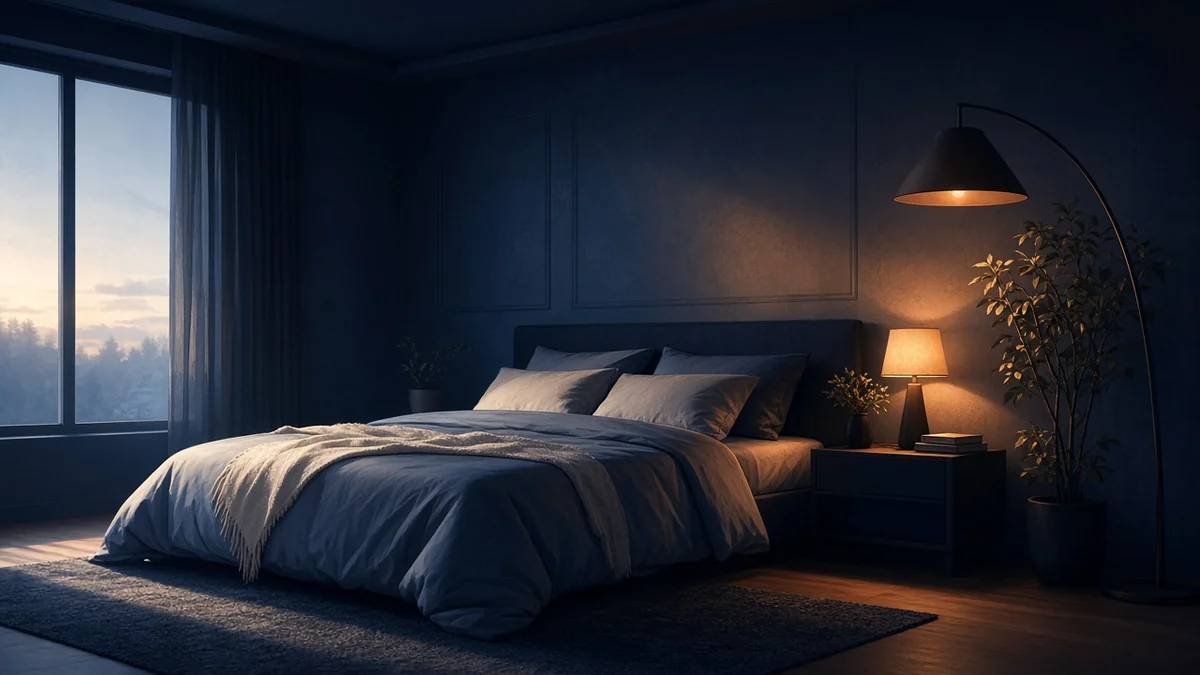
Circadian lighting at home means adjusting light intensity, colour temperature and placement throughout the day to support the body’s natural sleep-wake cycle. Use bright, cooler light in the morning, balanced illumination during working hours and dim, warm lighting in the evening. A practical setup can use ordinary dimmable LED bulbs rather than expensive smart lighting systems.
What is circadian lighting, and how does it work?
Your body operates on an internal biological clock that follows an approximately 24-hour cycle. Known as the circadian rhythm, it influences when you feel alert, when your body prepares for sleep and several other physiological processes. Light is one of the strongest environmental signals that helps keep this internal clock aligned with the day-night cycle.
Specialised light-sensitive cells in the eyes, including intrinsically photosensitive retinal ganglion cells (ipRGCs), respond to environmental light. They communicate with the brain’s circadian control system, influencing alertness and the timing of melatonin production. Exposure to bright light during the day supports wakefulness, while excessive light exposure late in the evening can delay the body’s preparation for sleep.
This is why the same lighting arrangement is not necessarily suitable throughout the day. Bright, cool-toned illumination can be useful in the morning, but keeping those settings active late at night may work against your normal sleep schedule. Circadian lighting attempts to make indoor illumination follow a more natural daily pattern.
What Kelvin temperature is best for circadian lighting?
Kelvin (K) measures the correlated colour temperature of a light source. Lower values produce warmer yellow or orange light, while higher values produce cooler, whiter light. For a practical home setup, cooler lighting around 4000K–5000K works well during the active part of the day, while warmer lighting around 2200K–3000K is suitable for evening relaxation.
| Time of day | Suggested colour temperature | Lighting approach |
|---|---|---|
| Morning | 4000K–5000K | Bright, cool-white illumination |
| Midday | 3500K–5000K | Balanced, functional lighting |
| Early evening | 2700K–3000K | Warm, moderately dim lighting |
| Before bedtime | 2200K–2700K | Very dim, warm lighting below eye level |
| Overnight | Red or amber | Minimal illumination for safe movement |
These are practical starting points rather than medically prescribed Kelvin values. Colour temperature alone does not determine how strongly a light affects your circadian system. Brightness, spectral composition, exposure duration and the timing of exposure also matter.
How many lumens do you need for circadian lighting?
Choosing the right bulb involves more than selecting its Kelvin rating. Lumens measure the total visible light emitted by a bulb, while lux measures the amount of light falling on a particular surface. For circadian lighting, the light reaching your eyes is particularly relevant, so room brightness and fixture placement matter as much as the bulb’s advertised output.
For a practical residential setup, these approximate bulb-output ranges can help with initial selection:
| Room or application | Suggested bulb output |
|---|---|
| Bedroom bedside lamp | 200–450 lumens |
| Living room lamp | 450–800 lumens |
| Home office lighting | 800–1,600 lumens per suitable fixture |
| General ceiling lighting | 800–1,600 lumens per bulb |
| Nightlight | 5–50 lumens |
These are starting estimates, not universal requirements. A large room may need multiple fixtures, while a small bedroom may require considerably less illumination. For daytime circadian exposure, natural daylight near a window is often more useful than simply installing a brighter bulb.
Another important distinction is that a 1,000-lumen bulb does not necessarily deliver 1,000 lux to your eyes. Distance, lampshades, room dimensions and the direction of the light all influence the result. If you want to measure actual illumination, a lux meter provides more useful information than the bulb packaging alone.
How to set up circadian lighting at home throughout the day
You do not need to redesign every room or purchase an automated lighting system. The most practical approach is to divide your day into four lighting periods and use different fixtures for each. The following arrangement works as a starting point for people who maintain a conventional daytime work schedule.
1. Morning: Use bright light after waking up
Morning light helps synchronise your internal clock with the day. Open curtains as soon as you wake up and spend some time near a naturally lit window. If daylight is unavailable, use bright overhead lighting with a colour temperature around 4000K–5000K while getting ready for work.
Outdoor daylight is preferable when practical because it generally provides much higher illumination than ordinary indoor lighting. A morning walk or breakfast near a bright window can therefore be more useful than relying exclusively on artificial bulbs. Avoid looking directly at the sun or high-intensity light sources.
2. Midday: Maintain comfortable working illumination
During working hours, maintain consistent lighting that allows you to read, work on screens and complete tasks without excessive eye strain. A colour temperature between 3500K and 5000K is a reasonable starting range for home offices and study areas. Combine ceiling lights with task lighting to avoid harsh contrasts.
Keep your workspace sufficiently bright without creating glare on your monitor. If your room receives natural daylight, use blinds or curtains to control direct sunlight rather than unnecessarily darkening the entire space. Daytime light exposure also contributes to maintaining a stable sleep-wake rhythm.
3. Early evening: Switch to warm lighting
As evening approaches, reduce the intensity of your indoor lighting. Switch from cool-white ceiling fixtures to warm-white bulbs around 2700K–3000K. Table lamps and floor lamps can create sufficient illumination for reading, conversation and ordinary household activities without flooding the entire room with bright overhead light.
A useful starting point is to reduce the brightness of dimmable fixtures to approximately 50% or lower, depending on the room. Avoid treating this percentage as a fixed biological requirement; the objective is to make the environment noticeably dimmer as bedtime approaches.
4. Before bedtime: Keep lighting warm and low
During the final two hours before your usual bedtime, prioritise low-intensity lighting. Use bedside lamps with warm bulbs around 2200K–2700K, preferably positioned below eye level. Avoid bright overhead fixtures and reduce unnecessary screen exposure.
The Centers for Disease Control and Prevention’s National Institute for Occupational Safety and Health recommends reducing bright light during the hours surrounding bedtime. This is particularly relevant for people who struggle to fall asleep at their usual time.
For overnight bathroom trips, use a very dim red or amber nightlight. These colours generally have less influence on the circadian system than bright blue-rich or white light. Keep the illumination sufficient to move safely without lighting up the entire room.
Does blue light from LEDs and screens affect sleep?
Blue-rich light can influence the circadian system by stimulating light-sensitive cells in the eyes. Exposure during the evening can suppress melatonin production and increase alertness, potentially making it harder to fall asleep. This is why bright cool-white LEDs and illuminated screens can become a problem when used close to bedtime.
A January 2026 study published in Scientific Reports examined 52 residential lighting examples across LED, incandescent and compact fluorescent technologies. The researchers found that cool-white LEDs produced greater estimated melatonin suppression than warm-white alternatives under their testing conditions. Their findings also showed that adjustable LED lamps could reduce estimated suppression substantially when switched from cool to warm settings.
However, this does not mean that all blue light is harmful or that every LED bulb disrupts sleep. Timing, intensity, duration and the spectral characteristics of the light source all influence its effects. Bright daylight exposure during the day remains beneficial for normal circadian timing.
Can you create circadian lighting without buying smart bulbs?
Yes. A manual setup can be inexpensive and effective as a practical lighting arrangement. You can use ordinary dimmable warm-white LED bulbs in table and floor lamps, alongside standard ceiling fixtures for daytime illumination.
Here is a simple shopping and setup checklist:
- Install 4000K–5000K bulbs in the main daytime workspace.
- Use dimmable 2700K bulbs in living-room and bedroom lamps.
- Choose 2200K–2700K bulbs for bedside fixtures.
- Position evening lamps below eye level rather than directly overhead.
- Install a low-output red or amber nightlight in the bathroom corridor.
- Use curtains or blinds to control daylight and reduce unnecessary glare.
If you prefer automation, tunable smart bulbs can change their colour temperature and brightness according to a schedule. However, they are a convenience rather than a requirement. A consistent manual routine can achieve many of the same practical lighting changes.
Is circadian lighting scientifically proven to improve sleep?
There is scientific support for the relationship between light exposure, circadian timing and sleep. Morning light can help advance the body’s internal clock, while bright evening exposure can delay it. Reducing unnecessary evening illumination and maintaining adequate daytime light are therefore reasonable parts of a healthy sleep environment.
However, the effectiveness of commercial circadian lighting systems is still being investigated. In September 2026, researchers at Penn State announced a $3.6 million National Institutes of Health grant to study a smart lighting intervention called SmartEnLite in nursing homes. The planned research involves approximately 300 residents with dementia across 10 Pennsylvania nursing homes, assessing sleep and behavioural outcomes.
The project uses tunable LED lighting, photosensors and automated controls to provide brighter circadian-stimulating light during the day and dimmer lighting at night. Its findings could help inform future lighting practices in long-term care facilities. The research is ongoing, so it should not be presented as proof that a particular home lighting product treats insomnia or other sleep disorders.
Frequently asked questions
What colour light is best before sleeping?
Warm amber, orange and red light are generally preferable to bright cool-white lighting before bed. A dim 2200K–2700K lamp is a practical choice for bedrooms, although darkness is preferable once you are ready to sleep.
Is 4000K or 5000K better for morning lighting?
Both can work for daytime illumination. A 4000K bulb produces a neutral white appearance, while 5000K produces a cooler daylight-like appearance. Actual brightness and exposure duration matter more than choosing one exact Kelvin value.
Do I need smart bulbs for circadian lighting?
No. Standard LED bulbs with appropriate colour temperatures and dimmable table lamps can create a useful manual lighting schedule. Smart bulbs simply make it easier to automate brightness and colour changes.
How long before bed should I dim the lights?
Reducing bright lighting approximately two hours before your usual bedtime is a reasonable starting point. Keep the bedroom dark when sleeping and use only minimal warm or red illumination if you need to move around overnight.
Can circadian lighting replace treatment for insomnia?
No. Lighting adjustments can support healthy sleep-wake timing, but they are not a substitute for medical assessment or evidence-based insomnia treatment. Persistent sleep difficulties should be discussed with a qualified healthcare professional.
Circadian lighting at home can be established with three basic changes: brighter, cooler light in the morning, balanced illumination during the day and dim, warm light before bedtime. Natural daylight, appropriate bulb selection and thoughtful lamp placement matter more than purchasing an expensive automated system. Which room in your home would you change first to create a better day-to-night lighting routine?